This article was automatically translated from the original Turkish version.
+2 More
Registration Number | 1182 | ||||||||
|---|---|---|---|---|---|---|---|---|---|
Registration Date | 27.07.2022 | ||||||||
Application Number | C2021/000499 | ||||||||
Application Date | 29.11.2021 | ||||||||
Name of the Geographical Indication | Malatya Simit Pilavı | ||||||||
Product / Product Group(s) | Pilav / Dishes and Soups | ||||||||
Type of Geographical Indication | Mahreç Sign | ||||||||
Applicant/Registrant(s) | Malatya Metropolitan Municipality | ||||||||
Address of the Registrant | İnönü Mah. İnönü Cad. No 18 Yeşilyurt MALATYA | ||||||||
Geographical Boundary | Malatya Province | ||||||||
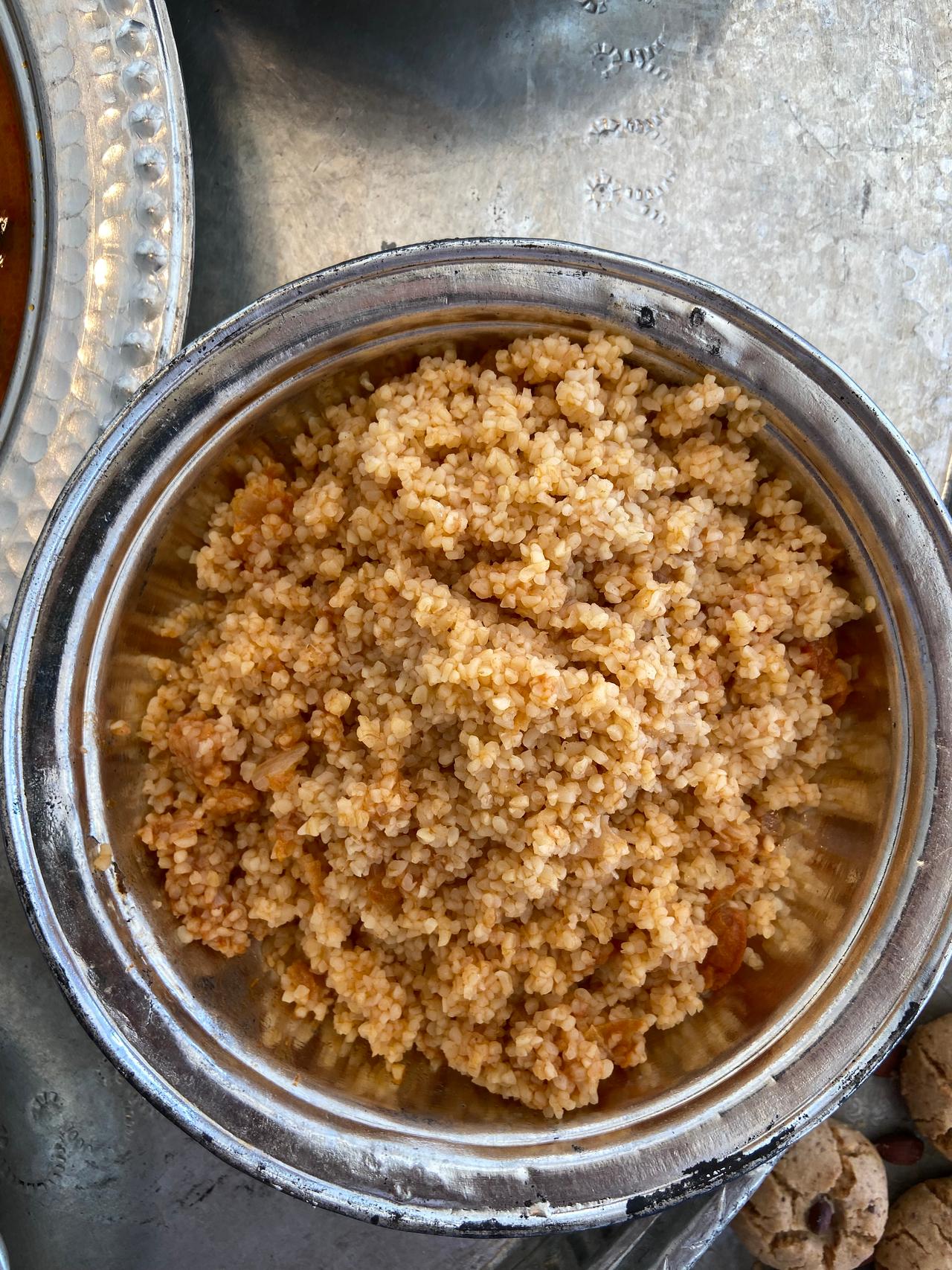
Malatya simit pilavı is a type of rice dish unique to Malatya Province in Türkiye, officially registered with a geographical indication. It is prepared using fine bulgur suitable for meatballs, dried onion, butter, tomato paste, and pepper paste. The fine bulgur used in this dish, known locally as “simit bulgur,” is produced by boiling and grinding wheat. Within the geographical region, it is also referred to as “simit,” “sümüd,” “sümüt,” or “simid.” This dish has deep roots in Malatya’s culinary culture and is typically served with green onion, pickles, and ayran.
Malatya simit pilavı is a rice dish made with fine bulgur suitable for meatballs, dried onion, butter, and paste. The primary ingredient, fine bulgur, is obtained by boiling and grinding wheat and is called “simit bulgur” in the region. This product is also known in the geographical area as “simit,” “sümüd,” “sümüt,” or “simid” bulgur.
The dish’s origins are deeply embedded in the regional culinary tradition, and Malatya simit pilavı holds a significant place in the food culture of its geographical area. Due to this historical and cultural connection, a recognized link is acknowledged between Malatya simit pilavı and Malatya Province.
In the production of Malatya simit pilavı, fine bulgur suitable for meatballs, preferably sourced from Malatya Province—the designated geographical area—is used. The following ingredients are required to prepare a serving for four people:
During preparation, the dried onions are finely chopped and sautéed in melted butter. Tomato paste and pepper paste are then added to the sautéed onions, and the mixture is cooked further. Water is subsequently added. Once the water begins to boil, salt and the fine bulgur are incorporated, and the mixture is simmered over low heat for 10 minutes. After the cooking time is complete, the pot is covered and the pilaf is left to rest for 10 minutes. It is then transferred to a serving dish. Optionally, 40 grams of butter, melted in a pan, may be drizzled over the top.
The dish is commonly served with green onion, pickles, and ayran. These accompaniments contribute regional variety to the way the pilaf is consumed.
Malatya simit pilavı occupies a historical place within the culinary culture of its geographical area. Under the geographical indication registration system, a recognized link is acknowledged between Malatya simit pilavı and Malatya Province. Therefore, all stages of production must be carried out within the designated geographical area of Malatya Province.
The term “Malatya simit pilavı” and its geographical indication emblem must appear on the product itself or its packaging. If these markings cannot be placed on the product or packaging, they must be displayed in a clearly visible location within the production facility.
The production processes and use of the geographical indication for Malatya simit pilavı are monitored under the coordination of the Malatya Metropolitan Municipality. The monitoring body includes one expert each from the Malatya Provincial Directorate of Culture and Tourism, the Agricultural and Rural Development Support Institution, and the Malatya Metropolitan Municipality. This three-member monitoring body conducts inspections annually. Additionally, inspections may be carried out at any time when deemed necessary or upon complaint.
During inspections, compliance is verified regarding the quantity and quality of ingredients used, adherence to the production method, and proper use of the term “Malatya simit pilavı” and its geographical indication emblem. The monitoring body may utilize or procure services from experts employed by public or private institutions. The Malatya Metropolitan Municipality, as the registering authority, is responsible for initiating legal proceedings to protect rights related to the product.
Turkish Patent and Trademark Office. "Malatya Simit Pilavı Coğrafi İşaret Detay." Accessed July 13, 2025. https://ci.turkpatent.gov.tr/cografi-isaretler/detay/5586.
Turkish Patent and Trademark Office. "Malatya Simit Pilavı Coğrafi İşaret Tescil Belgesi (PDF)." Accessed July 13, 2025. https://ci.turkpatent.gov.tr/Files/GeographicalSigns/2d7610de-2307-4c5d-9d67-df093222a21b.pdf.

Registration Number | 1182 | ||||||||
|---|---|---|---|---|---|---|---|---|---|
Registration Date | 27.07.2022 | ||||||||
Application Number | C2021/000499 | ||||||||
Application Date | 29.11.2021 | ||||||||
Name of the Geographical Indication | Malatya Simit Pilavı | ||||||||
Product / Product Group(s) | Pilav / Dishes and Soups | ||||||||
Type of Geographical Indication | Mahreç Sign | ||||||||
Applicant/Registrant(s) | Malatya Metropolitan Municipality | ||||||||
Address of the Registrant | İnönü Mah. İnönü Cad. No 18 Yeşilyurt MALATYA | ||||||||
Geographical Boundary | Malatya Province | ||||||||
No Discussion Added Yet
Start discussion for "Malatya Simit Pilavı" article
Distinctive Characteristics
Recipe/Production Method
Geographical Area and Production Requirements
Usage Format
Monitoring