

This article was automatically translated from the original Turkish version.
+2 More
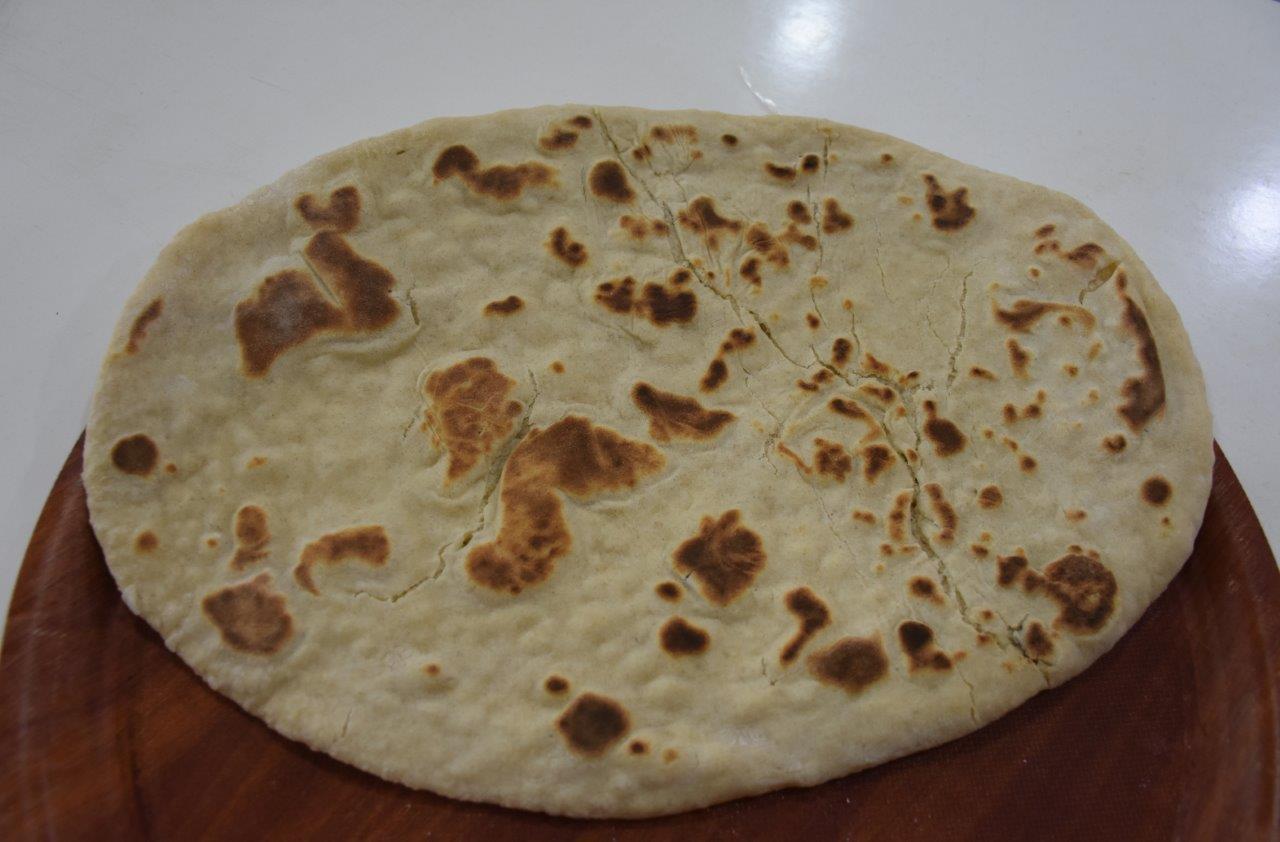
Malatya sourdough bread is a type of bread unique to the Yeşilyurt district of Malatya province, prepared using whole wheat flour, water, salt, yeast, and sourdough starter from a previous batch, and baked on a hot griddle. Characterized by its thin texture and sour taste, this bread is produced in oval or circular shapes measuring approximately 0.5 cm in thickness, 90 cm in diameter, and 25 to 30 cm in width. During production, the dough is fermented at specific temperatures and durations, then baked on both sides on a heated griddle. A mixture of soil and ash applied to the part of the griddle that contacts the fire ensures even heat distribution, contributing to uniform baking of the bread.
Malatya sourdough bread is a type of bread prepared using whole wheat flour, water, salt, yeast, and sourdough starter from a previous batch, and baked on a griddle. Thanks to the sourdough starter used in its production, the bread has a distinctive sour flavor profile.
The weight of the unbaked dough is approximately 170 grams. After baking, the bread measures an average thickness of 0.5 cm and a diameter of 90 cm. It is baked in oval or circular shapes measuring 25 to 30 cm in width. The bread can be consumed fresh daily or stored for up to three days in a cool, shaded area in plastic packaging or storage containers. It is recommended to reheat the bread before consumption. During baking, a thin layer of soil and ash mixture is applied to the part of the griddle that contacts the fire. This practice aims to prevent ash from falling into the fire, ensure even heat distribution across the griddle surface, and guarantee uniform baking of the bread.
The production of Malatya sourdough bread follows a defined process and standardized measurements. The ingredients used to produce 20 loaves of Malatya sourdough bread are as follows:
The sourdough starter is prepared by thoroughly kneading whole wheat flour with warm water at a temperature of 30 to 32 °C, placing the mixture in a glass jar, and allowing it to ferment for approximately 72 hours. Additional flour and water may be added as needed.
After sifting the flour, dry yeast, sourdough starter from a previous batch, warm water, and salt are added. All ingredients are kneaded until a soft dough is obtained. The dough is then left to ferment. Fermentation time varies depending on seasonal conditions: approximately 3 to 4 hours in summer and 5 to 6 hours in winter. Within the geographical boundary, the dough is typically prepared at night and left to ferment until morning.
From the fermented dough, 170 gram portions are separated and flattened on a bread board using a rolling pin. The dough is rolled out with a rolling pin until it reaches a width of 25 to 30 cm, then stretched by hand to achieve a diameter of 90 cm. The dough is placed on a hot griddle and baked on one side for approximately 4 minutes. It is then flipped using a wooden tool known locally as “aktaraç,” and the other side is baked for another 4 minutes. Thus, after a total baking time of 8 minutes, the bread is ready.
Malatya sourdough bread has a long-standing tradition within the culinary culture of Malatya province, and its production and consumption are integral to the region’s traditional food habits. The product is uniquely associated with the geographical boundary of Yeşilyurt district in Malatya province. Therefore, all stages of production must be carried out within this geographical boundary.
The production of Malatya sourdough bread is monitored under a control system established after registration. Monitoring activities are coordinated by the Yeşilyurt Municipality. The monitoring body consists of a three-member team comprising representatives from the Malatya Provincial Directorate of Culture and Tourism, the Malatya Provincial Directorate of Agriculture and Forestry, and the Yeşilyurt Municipality. This body conducts at least one regular inspection per year and may carry out additional inspections whenever necessary or upon complaint.
During inspections, the following aspects are verified:
The monitoring body may obtain support or purchase services from public institutions, private organizations, or qualified individuals or entities. The registering institution holds the authority to carry out necessary legal procedures to protect the rights arising from the geographical indication.
Malatya sourdough bread is a product intrinsically linked to the local culture through its sourdough starter and production technique. Its registered geographical indication status ensures the preservation of traditional production knowledge and enables local producers to manufacture the product according to defined standards.
Turk Patent and Trademark Office. "Malatya Ekşili Ekmek." Turk Patent and Trademark Office. Accessed July 13, 2025. https://ci.turkpatent.gov.tr/cografi-isaretler/detay/5924.
Turk Patent and Trademark Office. *Malatya Ekşili Ekmek. Turk Patent and Trademark Office.* Accessed July 13, 2025. https://ci.turkpatent.gov.tr/Files/GeographicalSigns/324c9cca-792e-4aee-9b0d-df4043a61655.pdf.

Distinguishing Features
Production Method
Geographical Link and Cultural Context
Monitoring and Control