


This article was automatically translated from the original Turkish version.
+2 More
Manazan Caves
Location | Karaman / Türkiye | ||||||||
|---|---|---|---|---|---|---|---|---|---|
Geological Substrate | Limestone with high clay content | ||||||||
Number of Floors | 5 floors | ||||||||
Building Shape | A completely hand-carved underground settlement | ||||||||
Protection Status | Protected area | ||||||||
Heritage Potential | Nomination for UNESCO World Heritage status has been proposed | ||||||||
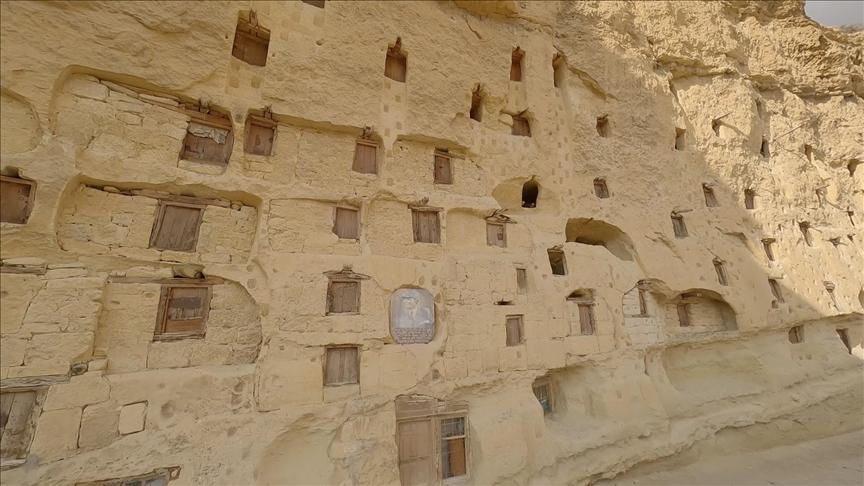
Manazan Caves are a multi-level underground settlement entirely carved by human hands, located within the boundaries of Karaman Province in Türkiye’s Central Anatolia Region. This historical complex is situated along the Karaman–Yeşildere–Taşkale road, east of the Yeşildere Valley, which stretches between Taşkale Town (formerly Kızıllar) and Yeşildere (İbrala) Village, approximately 40 km southeast of Karaman.

Manazan Caves (Anadolu Agency)
The Manazan Caves consist of a five-story settlement entirely carved into a massive cliff composed of clay-rich limestone. The easily workable nature of the limestone enabled the creation of numerous cell-like rooms, galleries, and corridor systems. The first two levels are composed of small rooms arranged east to west, while the upper levels are known locally as Kum Kale, At Meydanı, and Ölüler Meydanı. Access between levels is provided through narrow corridors and shafts, with cell-like rooms opening onto large central galleries on each floor.
On the first level, numerous burial chambers and two chapels have been identified. Some of these chapels contain traces of fresco fragments and geometric decorative patterns, with the largest chapel located on the eastern wing and featuring a cradle vault ceiling. Over time, the southern facade has collapsed due to natural processes. Archaeological excavations in the Ölüler Meydanı level have uncovered numerous human remains, including the skeleton of a young woman estimated to be approximately 1,400 years old, now on display at the Karaman Museum.
The clay-rich limestone structure of the Manazan Caves contributes to stable temperature and humidity conditions within the caves throughout the year. This microclimatic environment has enabled the exceptional preservation of organic remains.
The exact date of construction remains unknown, but ceramic fragments, fresco traces, and a niche inscription dating to the Byzantine period indicate that the caves were in use during the Byzantine era, particularly in the 6th and 7th centuries AD. It is believed that the caves served as places of refuge, worship, and defense during the Early Christian period. Their architectural similarities to other rock settlements such as Cappadocia and Sille further support this interpretation.

Manazan Caves (Anadolu Agency)
The front facade of the caves has been damaged over time by natural erosion and collapses, and a prominent main entrance structure has been lost. However, the interior sections still retain their original form to a large extent. Today, the Manazan Caves hold significant historical and cultural value and attract visitors to the region. The site is a point of interest for photography enthusiasts, archaeologists, and history lovers. Moreover, together with other nearby cultural heritage elements such as the Taşkale Grain Silos, the caves possess potential for regional development.
The Manazan Caves are not merely a settlement site but also a natural and cultural heritage area. Evaluated within the scope of the Taşkale Archaeological Site, this area is among the most important historical sites in Türkiye requiring protection and promotion. Various academic studies have argued that the caves possess the cultural and historical value necessary for nomination as a UNESCO World Heritage Site.
Anadolu Ajansı. “Tarihi Taşkale Tahıl Ambarları ve Manazan Mağaraları Ziyaretçilerin İlgisini Çekiyor.” Accessed May 10, 2025. https://www.aa.com.tr/tr/kultur/tarihi-taskale-tahil-ambarlari-ve-manazan-magaralari-ziyaretcilerin-ilgisini-cekiyor/2749930
Dilay, Seda. “Karaman Kültürel Miras Değerleri ve Taşkale’nin Bölgesel Kalkınmadaki Yeri.” *Avrupa Bilim ve Teknoloji Dergisi* 31, Ek Sayı 1 (2021): 735–745. Accessed May 10, 2025. https://doi.org/10.31590/ejosat.977835
Ministry of Culture and Tourism. "Manazan Mağaraları." *Turkey Culture Portal.* Accessed May 10, 2025. https://kulturportali.gov.tr/turkiye/karaman/gezilecekyer/manazan-magaralari
T.C. Karaman Valiliği. "Manazan Mağaraları." Accessed May 10, 2025. http://www.karaman.gov.tr/manazan-magaralari

Manazan Caves
Location | Karaman / Türkiye | ||||||||
|---|---|---|---|---|---|---|---|---|---|
Geological Substrate | Limestone with high clay content | ||||||||
Number of Floors | 5 floors | ||||||||
Building Shape | A completely hand-carved underground settlement | ||||||||
Protection Status | Protected area | ||||||||
Heritage Potential | Nomination for UNESCO World Heritage status has been proposed | ||||||||
Architectural Structure and Features
Historical Development and Uses
Conservation Status and Contemporary Significance