This article was automatically translated from the original Turkish version.
Type of Geographical İndication | Signpost | ||||||||
|---|---|---|---|---|---|---|---|---|---|
Registration Number | 628 | ||||||||
Registration Date | 16.12.2020 | ||||||||
Product / Product Group(s) | Cheeses | ||||||||
Province(s) | Balıkesir | ||||||||
Applicant/Registrant(s) | Manyas District Governorship | ||||||||
Manyas kelle peyniri is a local cheese variety associated with the districts of Manyas, Bandırma, and Gönen in Balıkesir Province, shaped by traditional production techniques. Protected under a geographical indication, this product derives its name from the process of suspending the curd in bags for draining, which results in a mass resembling a head.
Manyas kelle peyniri, registered as a geographical indication under Law No. 6769 on Industrial Property, was officially registered by the Turkish Patent and Trademark Office on 16 December 2020 following an application submitted on 12 September 2019. The applicant for this product, with registration number 628, is the Manyas District Governorship. On all approved products, the term “Manyas Kelle Peyniri” and the geographical indication emblem must be visibly displayed on the packaging or at the production site.
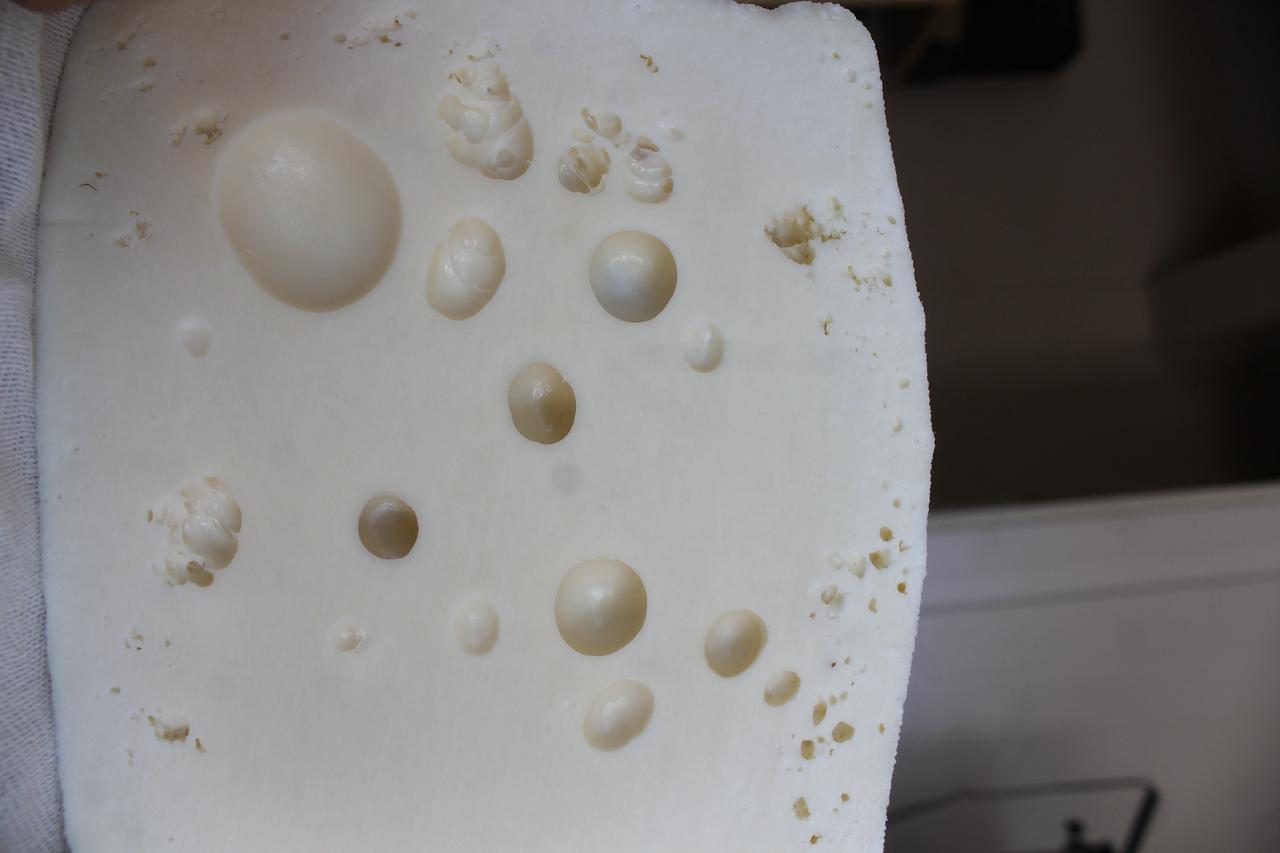
This cheese has a firm rind 2–3 mm thick. Its color ranges from white to light yellow. The structure is porous and crack-free; its taste is distinctly salty and it possesses a unique aroma. It belongs to the category of hard cheeses. Depending on the fat content of the milk used in its production, it is classified as full-fat or semi-fat.
The origins of Manyas kelle peyniri extend back to the Ottoman period. Although the exact date of its inception is unknown, it is traditionally believed to have a history of approximately 250 years. It is thought that this cheese was introduced to the region by Albanian migrants.
The cheese is made from sheep milk, cow milk, or a mixture of both sourced from the region. Sheep milk is predominantly used during the spring months, while cow milk is preferred during other periods. The milk is obtained from animals fed on seasonal forage and native vegetation of the area.
The production process consists of the following stages:
In the final stage, the cheese is marketed in appropriate packaging with labels compliant with regulations. All transportation and storage operations are carried out at temperatures below 10 °C.
Manyas kelle peyniri maintains a strong connection to the region through its production techniques and artisanal expertise. Therefore, all production stages must be carried out exclusively within the officially registered geographical boundaries.
Monitoring is conducted at least once annually under the coordination of the Manyas District Governorship, with participation from relevant local institutions and experts from Balıkesir University. Inspections evaluate the production method, sensory characteristics, ripening duration, and proper use of the geographical indication mark. In cases of non-compliance, appropriate measures are communicated to the relevant parties.
Turk Patent and Trademark Office. "Manyas Kelle Peyniri." *Geographical Indications Portal.* Accessed October 19, 2025. https://ci.turkpatent.gov.tr/cografi-isaretler/detay/926.
Turkish Patent and Trademark Office. "Manyas Kelle Peyniri Coğrafi İşaret Tescil Belgesi." *Coğrafi İşaretler Portalı.* Accessed October 19, 2025. https://ci.turkpatent.gov.tr/Files/GeographicalSigns/2ac84230-f864-4ee2-835e-c530088a08d9.pdf.

Type of Geographical İndication | Signpost | ||||||||
|---|---|---|---|---|---|---|---|---|---|
Registration Number | 628 | ||||||||
Registration Date | 16.12.2020 | ||||||||
Product / Product Group(s) | Cheeses | ||||||||
Province(s) | Balıkesir | ||||||||
Applicant/Registrant(s) | Manyas District Governorship | ||||||||
No Discussion Added Yet
Start discussion for "Manyas Kelle Cheese" article
Physical and Sensory Characteristics
Historical Background
Production Process
Geographical Link and Monitoring