

This article was automatically translated from the original Turkish version.
The marabou stork is a large bird species belonging to the family Ciconiidae and the genus Leptoptilos, recognized by its broad body and distinctive morphological features. In scientific classification, it is placed in the Kingdom: Animalia, Phylum: Chordata, Class: Aves, and Order: Ciconiiformes. This species is primarily distributed across sub-Saharan Africa and is notable as a scavenger for its role in ecosystem sanitation and its ability to adapt to human activities.
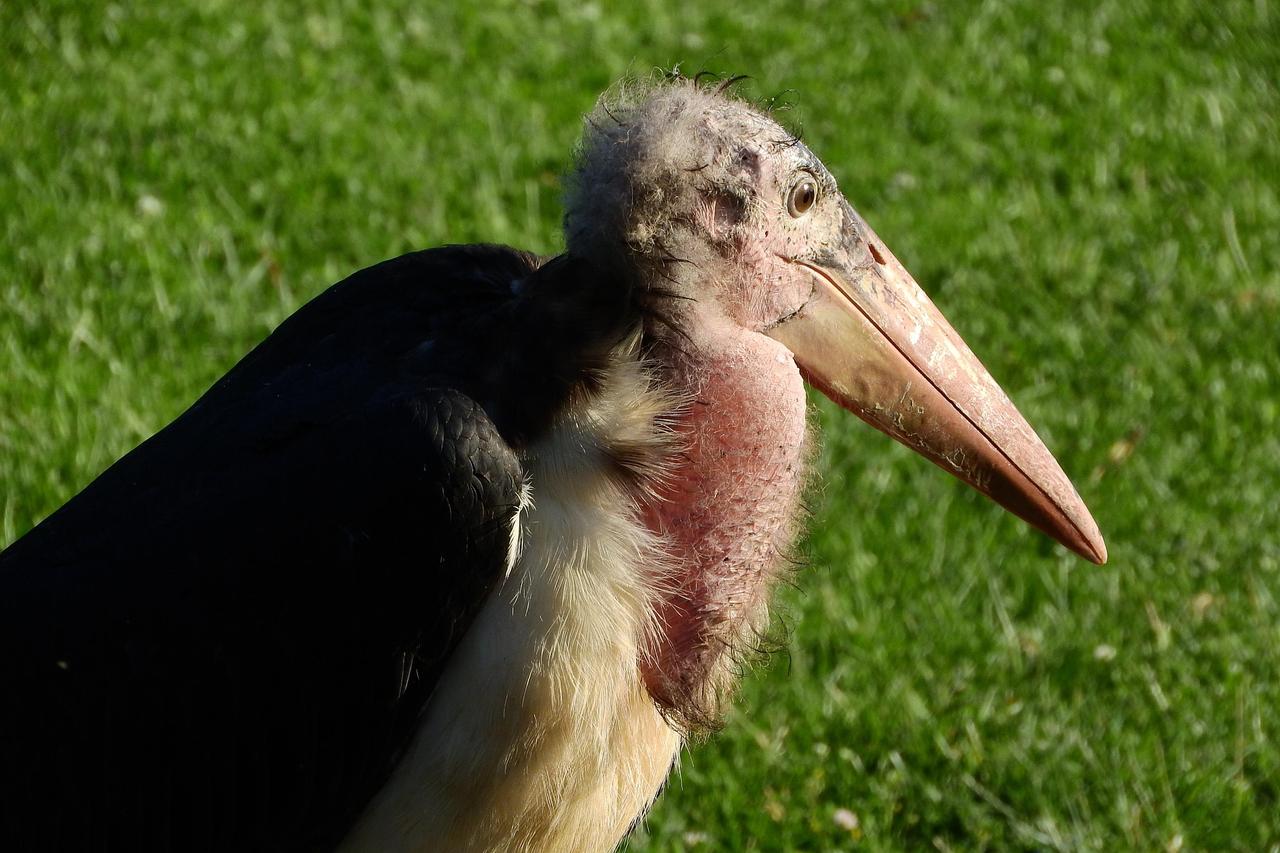
The marabou stork is a large bird that can stand up to approximately 1.5 meters tall, with long gray legs. Its upper body and wings are black or dark gray, while its underparts are white. The soft white tail feathers, known as marabou, are one of the species’ distinguishing features. Its head and neck are featherless, with bare skin in this region. A reddish, pendulous throat sac is present on the neck, used to produce sounds and visual displays during courtship rituals. The average body mass of adult individuals ranges between 8,000 and 9,000 grams.【1】
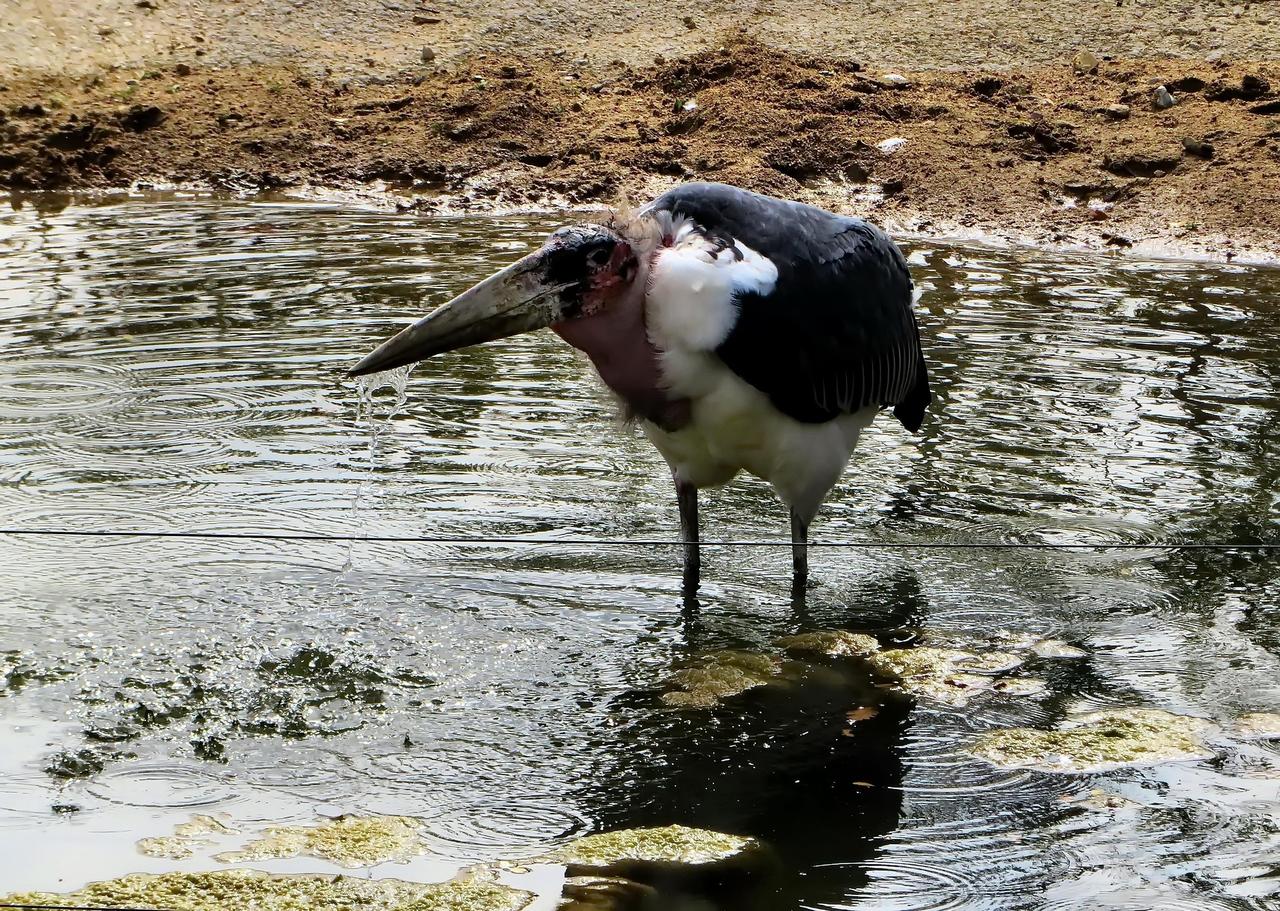
Marabou Stork (Pixabay)
The species exhibits a wide distribution across the African continent, particularly in the region between the Sahara Desert and southern Africa. Its natural habitats include wetlands, savannas, and arid regions. However, the marabou stork demonstrates high adaptability to human settlements and is frequently observed around landfills, fishing villages, and slaughterhouses. Populations in eastern and southern Africa are stable or increasing, while significant population declines and habitat fragmentation have been observed in western Africa in recent years.
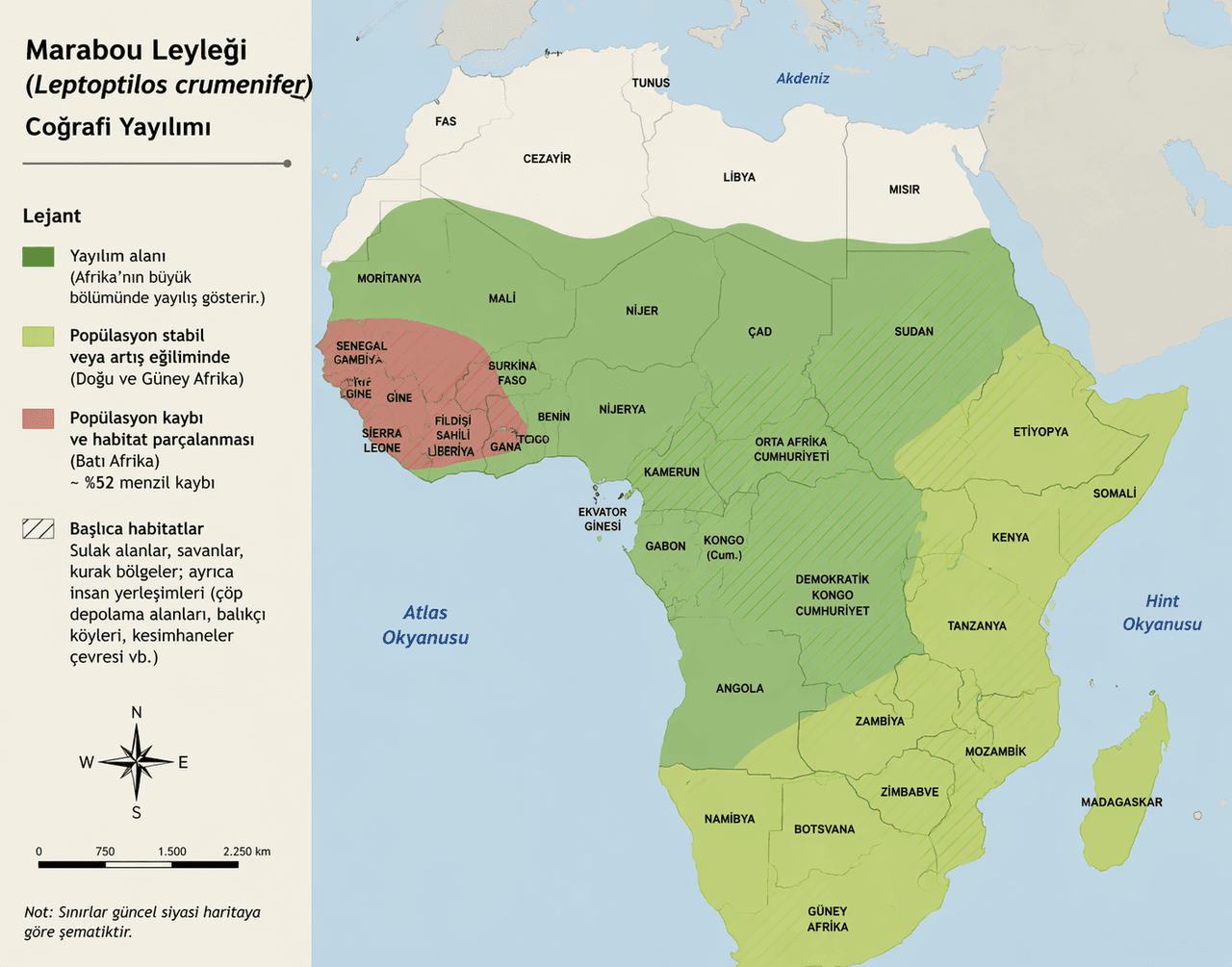
Geographic Distribution of the Marabou Stork (Generated by Artificial Intelligence)
The marabou stork is primarily a scavenger, playing a key role in preventing disease spread by cleaning up animal carcasses. Its diet is not limited to carrion but also includes opportunistic feeding on live prey such as fish, reptiles, frogs, and grasshoppers. In urban areas, it has adapted to feed on human waste, adopting an omnivorous diet. This adaptation has led to changes in the bird’s gut microbiota, enriching functions related to carbohydrate metabolism.
Marabou storks breed in colonies and reach sexual maturity at approximately four years of age, typically forming lifelong pair bonds. The breeding season coincides with the dry season, when water levels are low and foraging is easier. They build their nests on the tops of tall trees such as baobabs, using branches and shrubs. On average, two or three eggs are laid per season, with an incubation period of about 30 days. In the wild, their average lifespan is 25 years, while in captivity they have been recorded to live up to 41 years.【2】
This species is social and often gathers in large groups near lakes or rivers. Although generally silent, marabou storks can produce rasping, clattering, or bill-clapping sounds during courtship by inflating their throat sacs. Young individuals are known to disperse over thousands of kilometers, facilitating gene flow between populations and the establishment of new colonies.
The marabou stork is listed as Least Concern on the IUCN Red List, with an overall global population trend showing an increase. However, it faces serious threats in certain regions such as western Africa. Major threats include hunting for meat or traditional medicine, habitat loss, and the felling of large trees used for nesting. Additionally, illegal trade in countries like Nigeria and persecution by fishermen who view the birds as competitors and destroy their nests exert pressure on local populations.
Ehlers Smith, David A., Brent Coverdale, Ben Hoffman, Christopher Kelly, Yvette C. Ehlers Smith, and Colleen T. Downs. "Home range and landscape use by a marabou stork and the breeding success of Africa's most southerly breeding colony." *African Journal of Ecology* 59, no. 3 (2021): 773–79. Accessed April 15, 2026. https://doi.org/10.1111/aje.12874
Gula, J. and C. R. Barlow. "Decline of the marabou stork (Leptoptilos crumenifer) in West Africa and the need for immediate conservation action." African Journal of Ecology 61, no. 1 (2023): 102–117. Accessed April 15, 2026. https://doi.org/10.1111/aje.13087
Muckley, A. "Leptoptilos crumeniferus." Animal Diversity Web. 2001. Accessed April 15, 2026. https://animaldiversity.org/accounts/Leptoptilos_crumeniferus/
Pixabay. "marabou leptoptilos crumenifer." Pixabay. Accessed April 15, 2026. https://pixabay.com/tr/photos/marabou-leptoptilos-crumenifer-2478343/
Pixabay. "marabout kuş leptoptilos crumenifer." Pixabay. Accessed April 15, 2026. https://pixabay.com/tr/photos/marabout-ku%c5%9f-leptoptilos-crumenifer-5148403/
Pixabay. "marabu leptoptilos crumeniferus kuş." Pixabay. Accessed April 15, 2026. https://pixabay.com/tr/photos/marabu-leptoptilos-crumeniferus-ku%c5%9f-359253/
Tsuchida, Sayaka, Atsushi Ueda, Steven Kakooza, Torahiko Okubo, Eddie M. Wampande, Takuji Yamada, and Kazunari Ushida. "The fecal microbiomes analysis of Marabou storks (*Leptoptilos crumenifer*) reveals their acclimatization to the feeding environment in the Kampala urban areas, Uganda." *Journal of Veterinary Medical Science* 85, no. 4 (2023): 450–58. Accessed April 15, 2026. https://doi.org/10.1292/jvms.22-0580
[1]
A. Muckley, "Leptoptilos crumeniferus," Animal Diversity Web, 2001, access date: 15 April 2026, https://animaldiversity.org/accounts/Leptoptilos_crumeniferus/
[2]
A. Muckley, "Leptoptilos crumeniferus," Animal Diversity Web, 2001, access date: 15 April 2026, https://animaldiversity.org/accounts/Leptoptilos_crumeniferus/

No Discussion Added Yet
Start discussion for "Marabou Stork (Leptoptilos crumenifer)" article
Morphological Structure and Physical Characteristics
Geographic Distribution and Habitat Preferences
Feeding Habits and Ecological Role
Reproductive Biology and Life Cycle
Behavior and Communication
Conservation Status and Threats