


+1 More

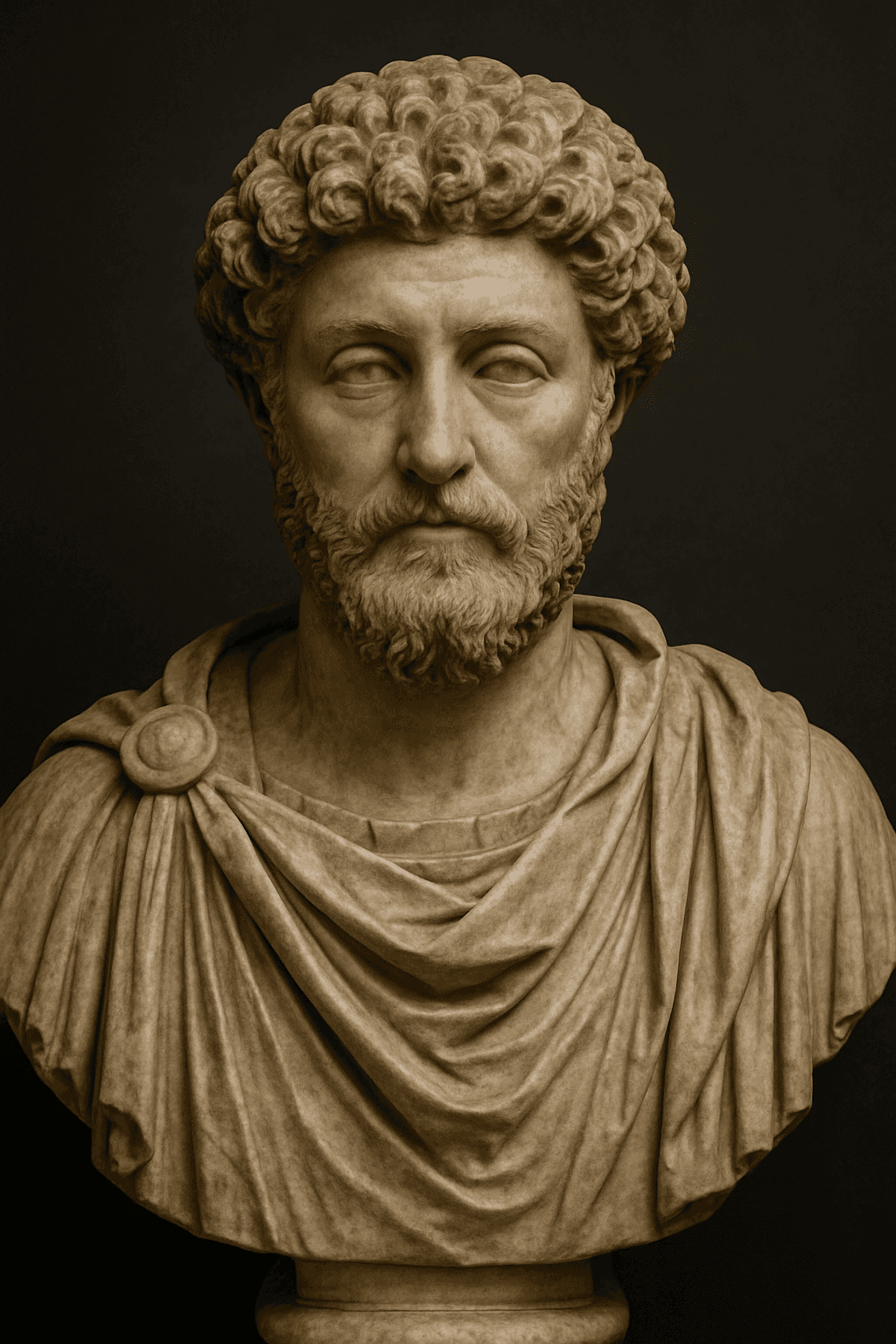
Marcus Aurelius (generated with YZ)
Name(s) | Marcus Aurelius Antoninus | ||||||||
|---|---|---|---|---|---|---|---|---|---|
Birth | MS 121, Rome | ||||||||
Death | MS 180, around the Danube frontier (on campaign) | ||||||||
Title(s) | co-emperor with Lucius Verus (AD 161–169) Roman Emperor (AD 161–180) | ||||||||
Philosophical Orientation | Stoicism; 'Meditations' (personal notes) | ||||||||
Spouse(s) | Faustina Minor | ||||||||
Events of the Period | Parthian campaigns; Antonine Plague; Marcomannic Wars | ||||||||
Çocuk | lived until the 3rd century) Vibia Aurelia Sabina (birth year unknown Hadrianus (died in infancy) Marcus Annius Verus (AD 162–169) Commodus (Emperor AD 161–192) Titus Aurelius Fulvus Antoninus (AD 161–165) Annia Cornificia Faustina Minor (AD 160–212) Annia Aurelia Fadilla (AD 159–192) T. Aelius Antoninus (died in infancy) Gemellus Lucillae (twins died in infancy) Annia Aurelia Galeria Lucilla (AD 148–182) | ||||||||
Marcus Aurelius (121–180 CE) was a ruler at the end of the tradition of the “Five Good Emperors” of the Roman Empire. According to the common framework of sources, he ascended the throne at the close of a period of prosperity and relative stability, during which the empire’s external borders came under pressure and epidemics spread widely. During his reign, consecutive military campaigns occurred along both the eastern and northern frontiers of Rome. This context led him to spend much of his rule engaged in warfare and campaign organization.
The period also carried cultural and intellectual characteristics of transition. A mindset emerged in which Stoic thought was reinterpreted within the context of late antiquity, emphasizing personal education, discipline, and virtue. Marcus Aurelius’s philosophical interests and writings are among the concrete examples of this intellectual climate.
Imperial administrative practices also took shape within this context. Continuity was maintained in agendas such as preserving relations with the Senate, updating legal regulations, and overseeing provincial governance. Sources emphasize that despite extraordinary conditions such as war and plague, the administration worked to sustain order, implementing measures concerning grain supply, financial arrangements, and military provisioning.

Marcus Aurelius (generated by artificial intelligence)
Marcus Aurelius was born into an aristocratic family and received a strong education in rhetoric and philosophy from an early age. His familiarity with the texts of Stoic thinkers dates back to his youth. His mentors and advisors included leading figures of the era, reinforcing his focus on moral philosophy and self-discipline.
Youthful preparation for public life was not limited to literary and philosophical texts. Marcus gained practical experience in judicial and administrative procedures, as well as military discipline. This process facilitated his adaptation to the responsibilities he would later assume.
Family connections and patronage networks influenced his career progression. By being part of the adoption chain initiated by Hadrian and continued by Antoninus Pius, he became part of an institutional line of legitimacy leading to the imperial throne. This lineage reflects a phase in Rome where dynastic continuity was established through legal and political mechanisms.
Marcus Aurelius ascended the throne following the death of Antoninus Pius and established a co-emperorship with Lucius Verus. This dual administration was seen as functionally effective, particularly in managing eastern campaigns and the Parthian War. The division of governance allowed Rome to project power simultaneously across different fronts.
The co-emperorship model required specific balances in authority sharing, command structures, and decision-making mechanisms. During the time Verus was occupied with eastern campaigns, Marcus Aurelius focused on administrative affairs in the capital and western provinces. This division of labor created capacity to address concurrent challenges across the empire’s vast geography.
After Verus’s death, Marcus Aurelius continued to rule as sole emperor, obliged to ensure administrative continuity. At this stage, pressures along the northern frontier became more visible, laying the groundwork for the Marcomannic Wars, which would occupy him until the end of his life.
Marcus Aurelius’s reign was shaped by the Parthian campaigns and the subsequent conflicts along the northern frontier. Operations in the east aimed to preserve Rome’s influence in the Mesopotamian basin. Gains achieved during this period depended on the protection of logistical and supply lines.
During the same period, a large-scale epidemic known in history as the Antonine Plague affected the empire’s population and armies. The plague weakened military capacity and the economic functioning of provinces, creating additional difficulties in achieving military objectives. Its prolonged duration also disrupted tax collection and grain flows, forcing the central administration to reassess its priorities.
Continuing conflicts with the Marcomanni, Quadi, and Sarmatian groups compelled the empire to reevaluate its defense strategy along the Danube frontier. Measures applied repeatedly during this period included strengthening border fortifications, enhancing legion mobility, and pursuing diplomatic arrangements. Marcus Aurelius’s campaigns were conducted alongside prolonged encampments and winter quarters.
In domestic administration, updating legal practices and defining the jurisdictions of praefects and governors were key priorities. Balancing delegation of authority and oversight was a fundamental method for maintaining order in the provinces. Sources refer to the emperor’s principles in evaluating legal petitions and responding to demands for justice.
Financial and supply policies were addressed with different priorities under conditions of war and plague. Grain procurement, price stability, and funding of military logistics were recurring crises of the period. Central budgetary pressures led to extraordinary decisions on taxation and resource allocation.
Preservation of social order was supported by practices that enhanced the role of local elites in urban and rural governance. Municipal councils continued their duties and public service obligations; standards applied across the empire upheld public order.
Marcus Aurelius’s philosophical orientation centered on Stoicism. The text composed of personal notes, commonly known as “Meditations,” contains his reflections on inner discipline, living in accordance with nature, and a sense of duty. Rather than a systematic philosophical treatise, the work functions as a record of personal accountability and self-examination.
In these notes, the guiding role of human reason and the determinative power of internal attitude toward external circumstances are emphasized. Virtuous conduct, control of anger, awareness of transience, and obligations to society recur as central themes. The philosophical framework served as a guide both for private life and for administrative decision-making.
The language and examples in the text reflect the cultural climate of the era. The tradition that these personal notes were written during military campaigns has led to interpretations emphasizing the importance of mental discipline during times of crisis. Sources note that the text circulated in various languages in subsequent centuries and came to be regarded as one of the foundational texts of Stoic literature.
A quotation from “Meditations”:
The only thing you need to focus on is becoming better at what you do. Focus on your work. Become better at your work. Everything else is a complete waste of time. 【1】
Marcus Aurelius’s private life reflects the marriage and kinship patterns of the Roman aristocracy. His marriage to Faustina Minor held significance for dynastic continuity and alliance networks. It is recorded that multiple children were born into the family, among whom Commodus reached adulthood and inherited the political legacy.
Family relationships became visible through public roles and ceremonial representation. The imperial family fulfilled representational functions in both religious rites and public events, contributing to the symbolic continuity of social order. Faustina’s position within the imperial cult reflects the era’s practices of honor and commemoration.
In private life, the influence of tutors and advisors within the family was also evident. The education of children and preparation of dynastic members for public roles remained a continuous concern within the imperial household. Within this framework, young princes were expected to gain experience in administration and military affairs.
Marcus Aurelius died in 180 CE while on campaign. Sources mention centers near the Danube frontier as the location of his death; although accounts vary, it is clear he died under campaign conditions. His death occurred before the Marcomannic Wars had been fully resolved.
The throne passed to his son Commodus. This succession marked a return to hereditary transfer, departing from the previous tradition of selecting heirs through adoption. Governance style and political priorities underwent significant changes with this transition.
After Marcus Aurelius’s death, the sustainability of his policies and frontier security were reevaluated. The effects of plague and economic pressures shaped the decision-making frameworks of his successors.
Academia.edu. Orhun, Murat. Roma’nın Filozof İmparatoru Marcus Aurelius / Roman Philosopher Emperor Marcus Aurelius. Accessed October 1, 2025. https://www.academia.edu/78956226/
Aurelius, Marcus. *Kendime Düşünceler*. Trans. Yunus Emre Ceren. Istanbul: İş Kültür Yayınları, 2018. Accessed October 1, 2025. https://www.iskultur.com.tr/kendime-dusunceler.aspx
Aurelius, Marcus. *Kendime Düşünceler*. Trans. Yunus Emre Ceren. Istanbul: İş Kültür Yayınları, 2018. Accessed October 1, 2025. https://www.iskultur.com.tr/kendime-dusunceler.aspx
Aurelius, Marcus. Kendime Düşünceler. Trans. Yunus Emre Ceren. İstanbul: İş Kültür Yayınları, 2018. Accessed October 1, 2025. https://www.iskultur.com.tr/kendime-dusunceler.aspx
Aurelius, Marcus. Kendime Düşünceler. Trans. Yunus Emre Ceren. İstanbul: İş Kültür Yayınları, 2018. Accessed October 1, 2025. https://www.iskultur.com.tr/kendime-dusunceler.aspx
Bey, Yekta Ali. “Bir Filozof Kral: Marcus Aurelius.” Accessed October 1, 2025. https://www.fokusplus.com/portre/bir-filozof-kral-marcus-aurelius
Bey, Yekta Ali. “Bir Filozof Kral: Marcus Aurelius.” Accessed October 1, 2025. https://www.fokusplus.com/portre/bir-filozof-kral-marcus-aurelius
Bey. Yekta Ali. “Bir Filozof Kral: Marcus Aurelius.” Accessed October 1, 2025. https://www.fokusplus.com/portre/bir-filozof-kral-marcus-aurelius
Dailystoic.com. "Marcus Aurelius." Accessed October 1, 2025. https://dailystoic.com/marcus-aurelius/
Dailystoic.com. "Marcus Aurelius." Accessed October 1, 2025. https://dailystoic.com/marcus-aurelius/
Dailystoic.com. "Marcus Aurelius." Accessed October 1, 2025. https://dailystoic.com/marcus-aurelius/
Dailystoic.com. "Marcus Aurelius." Accessed October 1, 2025. https://dailystoic.com/marcus-aurelius/
Donald Robertson. “The 10 Most Surprising Facts About Marcus Aurelius.” August 10, 2022. Accessed October 1, 2025. https://donaldrobertson.name/2022/08/10/the-10-most-surprising-facts-about-marcus-aurelius-2/
Donald Robertson. “The 10 Most Surprising Facts About Marcus Aurelius.” August 10, 2022. Accessed October 1, 2025. https://donaldrobertson.name/2022/08/10/the-10-most-surprising-facts-about-marcus-aurelius-2/
Donald Robertson. “The 10 Most Surprising Facts About Marcus Aurelius.” August 10, 2022. Accessed October 1, 2025. https://donaldrobertson.name/2022/08/10/the-10-most-surprising-facts-about-marcus-aurelius-2/
Donald Robertson. “The 10 Most Surprising Facts About Marcus Aurelius.” August 10, 2022. Accessed October 1, 2025. https://donaldrobertson.name/2022/08/10/the-10-most-surprising-facts-about-marcus-aurelius-2/
EBSCO. "Marcus Aurelius." Research Starters: History. Accessed October 1, 2025. https://www.ebsco.com/research-starters/history/marcus-aurelius
EBSCO. "Marcus Aurelius." Research Starters: History. Accessed October 1, 2025. https://www.ebsco.com/research-starters/history/marcus-aurelius
EBSCO. "Marcus Aurelius." Research Starters: History. Accessed October 1, 2025. https://www.ebsco.com/research-starters/history/marcus-aurelius
EBSCO. "Marcus Aurelius." Research Starters: History. Accessed October 1, 2025. https://www.ebsco.com/research-starters/history/marcus-aurelius
Fokusplus. "Bir Filozof Kral: Marcus Aurelius." Accessed October 1, 2025. https://www.fokusplus.com/portre/bir-filozof-kral-marcus-aurelius
Fs.blog. "Marcus Aurelius." Intellectual Giants. Accessed October 1, 2025. https://fs.blog/intellectual-giants/marcus-aurelius/
Güzel, Serkan, and Eylem Güzel. “Cicero’nun Marcus Antonius Stratejisi: Philippicae Söylevleri.” Akademik Tarih ve Düşünce Dergisi, Volume IV, Issue XIII, December 2017. Dergipark. Accessed October 1, 2025. https://dergipark.org.tr/tr/download/article-file/451309
Güzel, Serkan, and Eylem Güzel. “Cicero’nun Marcus Antonius Stratejisi: Philippicae Söylevleri.” Akademik Tarih ve Düşünce Dergisi, Volume IV, Issue XIII, December 2017. Dergipark. Accessed October 1, 2025. https://dergipark.org.tr/tr/download/article-file/451309
Güzel, Serkan, and Eylem Güzel. “Cicero’nun Marcus Antonius Stratejisi: Philippicae Söylevleri.” Akademik Tarih ve Düşünce Dergisi, Volume IV, Issue XIII, December 2017. Dergipark. Accessed October 1, 2025. https://dergipark.org.tr/tr/download/article-file/451309
Güzel, Serkan, and Eylem Güzel. “Cicero’nun Marcus Antonius Stratejisi: Philippicae Söylevleri.” Dergipark. Accessed October 1, 2025. https://dergipark.org.tr/tr/download/article-file/451309
Orhun, Murat. "Roma’nın Filozof İmparatoru Marcus Aurelius / Roman Philosopher Emperor Marcus Aurelius." Diyalektolog Sosyal Bilimler Dergisi, no. 29 (Spring 2022): 99–131. Accessed October 1, 2025. https://www.academia.edu/78956226/
Orhun, Murat. "Roma’nın Filozof İmparatoru Marcus Aurelius / Roman Philosopher Emperor Marcus Aurelius." Diyalektolog Sosyal Bilimler Dergisi, no. 29 (Spring 2022): pp. 99–131. Accessed October 1, 2025. https://www.academia.edu/78956226/
Orhun, Murat. Roma’nın Filozof İmparatoru Marcus Aurelius / Roman Philosopher Emperor Marcus Aurelius. Diyalektolog Sosyal Bilimler Dergisi, Spring 2022, no. 29, pp. 99–131. Accessed October 1, 2025. https://www.academia.edu/78956226/
Soydan, Nuray Yaşar. “Marcus Aurelius’un Düşünceler Adlı Eserinin Etik Açıdan İncelenmesi.” Dergipark. Accessed October 1, 2025. https://dergipark.org.tr/tr/download/article-file/3561026
Soydan, Nuray Yaşar. “Marcus Aurelius’un Düşünceler Adlı Eserinin Etik Açıdan İncelenmesi.” Türkiye Biyoetik Dergisi 11, no. 1 (2024): 39–41. Dergipark. Accessed October 1, 2025. https://dergipark.org.tr/tr/download/article-file/3561026
Soydan, Nuray Yaşar. “Marcus Aurelius’un Düşünceler Adlı Eserinin Etik Açıdan İncelenmesi.” Türkiye Biyoetik Dergisi 11, no. 1 (2024): 39–41. Dergipark. Accessed October 1, 2025. https://dergipark.org.tr/tr/download/article-file/3561026
Soydan, Nuray Yaşar. “Marcus Aurelius’un Düşünceler Adlı Eserinin Etik Açıdan İncelenmesi.” Türkiye Biyoetik Dergisi 11, no. 1 (2024): 39–41. Dergipark. Accessed October 1, 2025. https://dergipark.org.tr/tr/download/article-file/3561026
The Collector. "Who Was Marcus Aurelius?" Accessed October 1, 2025. https://www.thecollector.com/who-was-marcus-aurelius/
The Collector. "Who Was Marcus Aurelius?" Accessed October 1, 2025. https://www.thecollector.com/who-was-marcus-aurelius/
The Collector. "Who Was Marcus Aurelius?" Accessed October 1, 2025. https://www.thecollector.com/who-was-marcus-aurelius/
The Collector. "Who Was Marcus Aurelius?" Accessed October 1, 2025. https://www.thecollector.com/who-was-marcus-aurelius/
What Is Stoicism. "Marcus Aurelius: The Stoic Emperor." Accessed October 1, 2025. https://whatisstoicism.com/stoicism-resources/marcus-aurelius-the-stoic-emperor/
What Is Stoicism. "Marcus Aurelius: The Stoic Emperor." Accessed October 1, 2025. https://whatisstoicism.com/stoicism-resources/marcus-aurelius-the-stoic-emperor/
What Is Stoicism. "Marcus Aurelius: The Stoic Emperor." Accessed October 1, 2025. https://whatisstoicism.com/stoicism-resources/marcus-aurelius-the-stoic-emperor/
What Is Stoicism. “Marcus Aurelius: The Stoic Emperor.” Accessed October 1, 2025. https://whatisstoicism.com/stoicism-resources/marcus-aurelius-the-stoic-emperor/
Yale University Press. “Who Was Marcus Aurelius?” February 6, 2024. Accessed October 1, 2025. https://yalebooks.yale.edu/2024/02/06/who-was-marcus-aurelius/
Yale University Press. “Who Was Marcus Aurelius?” February 6, 2024. Accessed October 1, 2025. https://yalebooks.yale.edu/2024/02/06/who-was-marcus-aurelius/
Yale University Press. “Who Was Marcus Aurelius?” February 6, 2024. Accessed October 1, 2025. https://yalebooks.yale.edu/2024/02/06/who-was-marcus-aurelius/
Yale University Press. “Who Was Marcus Aurelius?” February 6, 2024. Accessed October 1, 2025. https://yalebooks.yale.edu/2024/02/06/who-was-marcus-aurelius/
Özgan, Ali. “Filozof Bir Kralın Ahlak ve Siyaset Felsefesi: Marcus Aurelius Örneği.” Adıyaman Üniversitesi Sosyal Bilimler Enstitüsü Dergisi, Year 15, no. 40, August 2022. ISSN: 1308–9196. Dergipark. Accessed October 1, 2025. https://dergipark.org.tr/tr/download/article-file/1747741
Özgan, Ali. “Filozof Bir Kralın Ahlak ve Siyaset Felsefesi: Marcus Aurelius Örneği.” Adıyaman Üniversitesi Sosyal Bilimler Enstitüsü Dergisi, Year 15, no. 40, August 2022. ISSN: 1308–9196. Dergipark. Accessed October 1, 2025. https://dergipark.org.tr/tr/download/article-file/1747741
Özgan, Ali. “Filozof Bir Kralın Ahlak ve Siyaset Felsefesi: Marcus Aurelius Örneği.” Adıyaman Üniversitesi Sosyal Bilimler Enstitüsü Dergisi, Year 15, no. 40, August 2022. ISSN: 1308–9196. Dergipark. Accessed October 1, 2025. https://dergipark.org.tr/tr/download/article-file/1747741
Özgan, Ali. “Filozof Bir Kralın Ahlak ve Siyaset Felsefesi: Marcus Aurelius Örneği.” Dergipark. Accessed October 1, 2025. https://dergipark.org.tr/tr/download/article-file/1747741
[1]
Aurelius, Marcus. Kendime Düşünceler. Çev. Yunus Emre Ceren. İstanbul: İş Kültür Yayınları. 2018. Erişim 1 Ekim 2025. https://www.iskultur.com.tr/kendime-dusunceler.aspx

Marcus Aurelius (generated with YZ)
Name(s) | Marcus Aurelius Antoninus | ||||||||
|---|---|---|---|---|---|---|---|---|---|
Birth | MS 121, Rome | ||||||||
Death | MS 180, around the Danube frontier (on campaign) | ||||||||
Title(s) | co-emperor with Lucius Verus (AD 161–169) Roman Emperor (AD 161–180) | ||||||||
Philosophical Orientation | Stoicism; 'Meditations' (personal notes) | ||||||||
Spouse(s) | Faustina Minor | ||||||||
Events of the Period | Parthian campaigns; Antonine Plague; Marcomannic Wars | ||||||||
Çocuk | lived until the 3rd century) Vibia Aurelia Sabina (birth year unknown Hadrianus (died in infancy) Marcus Annius Verus (AD 162–169) Commodus (Emperor AD 161–192) Titus Aurelius Fulvus Antoninus (AD 161–165) Annia Cornificia Faustina Minor (AD 160–212) Annia Aurelia Fadilla (AD 159–192) T. Aelius Antoninus (died in infancy) Gemellus Lucillae (twins died in infancy) Annia Aurelia Galeria Lucilla (AD 148–182) | ||||||||
Origins, Education, and Youth
Rise to Power and Co-Emperorship
Foreign Policy, Wars, and Plague
Domestic Policy, Law, and Administration
Philosophical Orientation and “Meditations”
Private Life and Family Relationships
Death and Succession