

This article was automatically translated from the original Turkish version.
+2 More
Registration Number | 1430 | ||||||||
|---|---|---|---|---|---|---|---|---|---|
Registration Date | 28.07.2023 | ||||||||
Application Number | C2022/000344 | ||||||||
Application Date | 14.10.2022 | ||||||||
Name of the Geographical Indication | Mardin Firkiye | ||||||||
Product / Product Group(s) | Food / Meals and Soups | ||||||||
Type of Geographical Indication | Mahreç Sign | ||||||||
Applicant/Registrant(s) | Mardin Artuklu University | ||||||||
Address of the Registrant | Nur Mah. Diyarbakır Bul. 47200 Artuklu / MARDİN | ||||||||
Geographical Boundary | Mardin Province | ||||||||
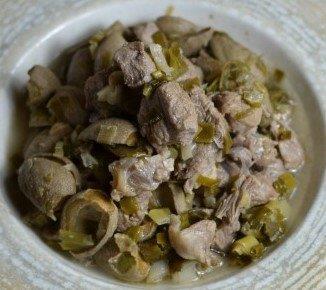
Mardin Firkiye is a traditional dish unique to Mardin Province, protected under geographical indication. It is prepared with fatty cubed lamb meat, fresh onions, and pitted chagla fruits grown within the geographical boundaries. The meat and onions are slowly cooked over low heat for an extended period, after which the boiled chagla fruits are added. The dish is served hot, with lemon juice poured over it. Its name derives from the Arabic word “firk”.
Mardin Firkiye is a hot-served dish made with fatty cubed lamb meat, fresh onions, and pitted chagla fruits. It is presented with the addition of lemon juice. The dish’s distinctive character lies in its unique flavor profile, resulting from the combination of the lamb’s richness and the tart aromatic taste of the chagla. A fundamental condition of the geographical indication is that the chagla used in production must be grown exclusively within the boundaries of Mardin Province.
The historical roots of Mardin Firkiye in the regional cuisine are deep, and the dish holds a significant place in Mardin’s gastronomic cultural heritage. Consequently, there is a strong link between the product and its geographical origin.
For the standard production of Mardin Firkiye, portion sizes for 4 to 6 people are used. The ingredients and their quantities are as follows:
The selection and quantities of these ingredients are crucial in determining the dish’s characteristic flavor and texture. Particularly, the cultivation of chagla fruits within this specific region strengthens the product’s connection to its geographical indication.
The production process of Mardin Firkiye consists of distinct stages. First, the chagla fruits are pitted and halved. These halves are then boiled in hot water until softened.
Separately, the cubed lamb meat, finely chopped fresh onions, and water are placed in a pot and simmered over low heat for approximately two hours. Once the meat begins to tenderize, the boiled chagla fruits and salt are added. The mixture is cooked for an additional 20 minutes to achieve the final consistency. The addition of fresh lemon juice at serving enhances the dish’s characteristic tart flavor.
All stages of Mardin Firkiye production are carried out within the boundaries of Mardin Province. The primary reason is the close historical and cultural association of the dish with this region. Additionally, the chagla fruits used in production must be cultivated within these geographical limits. Therefore, Mardin Firkiye is shaped by region-specific elements both in terms of its ingredients and production process.
The name “Mardin Firkiye” and its geographical indication emblem must appear on the product packaging. When it is not feasible to include this marking on the packaging, the designation “Mardin Firkiye” and the geographical indication emblem must be displayed in a clearly visible location within the production facility. This requirement ensures compliance with geographical indication regulations.
The production, processing, and sales processes of Mardin Firkiye are subject to regular inspections. These inspections are coordinated by Mardin Artuklu University and conducted by a three-member inspection body composed of experts from the Mardin Chamber of Commerce and Industry, the Mardin Provincial Directorate of Agriculture and Forestry, and the Department of Gastronomy and Culinary Arts at Mardin Artuklu University’s Faculty of Tourism.
Inspections are carried out at least once per year but may be conducted at any time if deemed necessary or upon receipt of a complaint. The main criteria assessed during inspections are:
The inspection body may receive support from public institutions or private sector entities, or from individuals or legal persons employed by such institutions, or may procure services for this purpose. The registering entity is responsible for safeguarding the rights arising from the geographical indication and managing legal proceedings.
Turk Patent and Trademark Office. "Mardin Firkiye Coğrafi İşaret Tescil Belgesi." Accessed July 15, 2025. https://ci.turkpatent.gov.tr/Files/GeographicalSigns/44854a24-d5b7-4524-af2e-f948cf23507d.pdf.
Türk Patent ve Marka Kurumu. “Mardin Firkiye.” Accessed July 15, 2025. https://ci.turkpatent.gov.tr/cografi-isaretler/detay/7744.

Registration Number | 1430 | ||||||||
|---|---|---|---|---|---|---|---|---|---|
Registration Date | 28.07.2023 | ||||||||
Application Number | C2022/000344 | ||||||||
Application Date | 14.10.2022 | ||||||||
Name of the Geographical Indication | Mardin Firkiye | ||||||||
Product / Product Group(s) | Food / Meals and Soups | ||||||||
Type of Geographical Indication | Mahreç Sign | ||||||||
Applicant/Registrant(s) | Mardin Artuklu University | ||||||||
Address of the Registrant | Nur Mah. Diyarbakır Bul. 47200 Artuklu / MARDİN | ||||||||
Geographical Boundary | Mardin Province | ||||||||
Distinctive Characteristics
Ingredients
Recipe/Production Method
Geographical Boundary and Production Conditions
Usage Format
Inspection and Control