


This article was automatically translated from the original Turkish version.
+2 More
Mars colonies are among the most comprehensive concepts considered within humanity’s long-term extraterrestrial settlement goals. Evidence suggesting that Mars once hosted water and may have experienced habitable periods has made the planet a priority target for both scientific research and human habitation. Mars colonies are not merely a settlement project but a multidimensional research field integrating advanced engineering, life sciences, planetary science, and systems engineering.
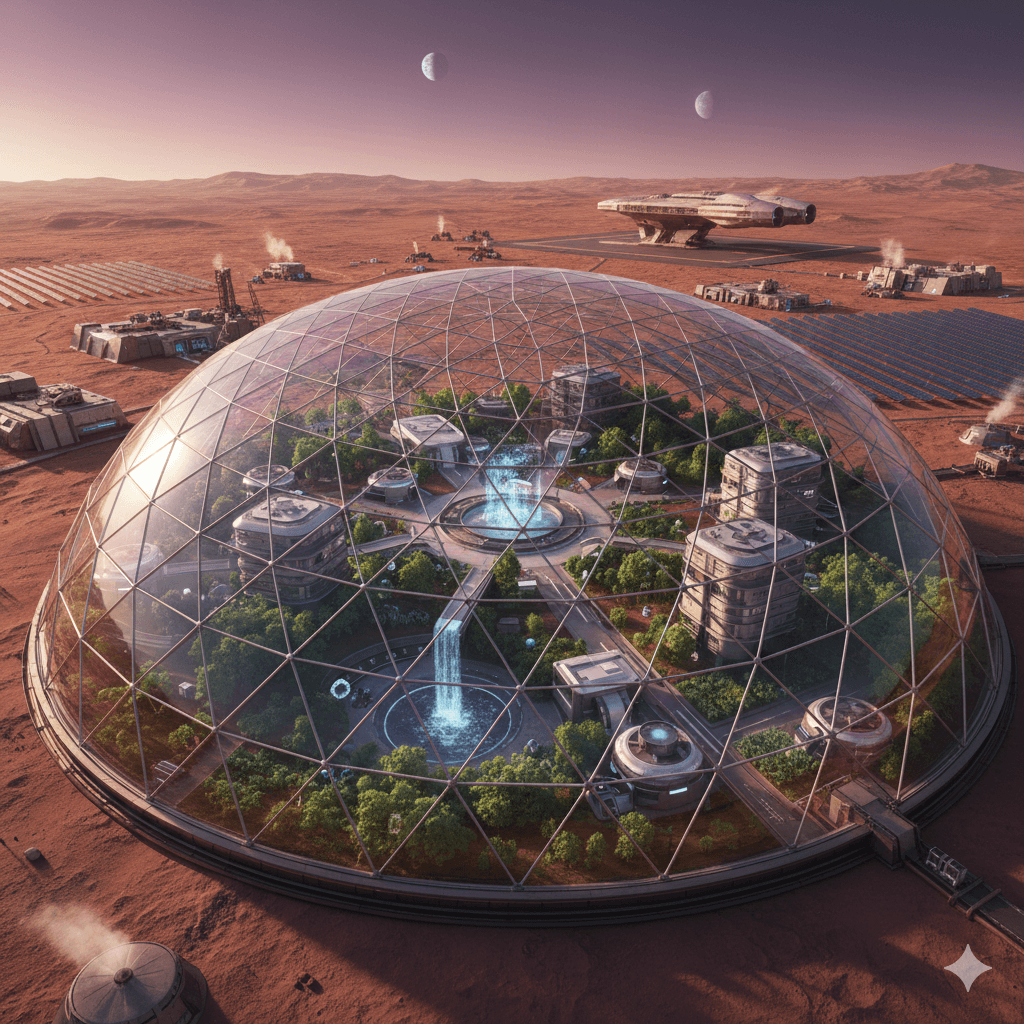
Mars Colonies (Generated by Artificial Intelligence.)
Mars presents an extremely hostile environment for human life due to its thin atmosphere, high radiation levels, low gravity, and extreme temperature fluctuations. The atmosphere, composed largely of carbon dioxide, and its very low surface pressure make surface life impossible without pressurized habitats. The absence of a global magnetic field allows cosmic radiation to reach the surface unimpeded. These conditions necessitate the design of colonies as enclosed, controlled living environments.
Proposed architectural approaches for Mars colonies are generally categorized into surface-based and subsurface habitats. Surface structures consist of modular, pressurized habitats and offer advantages in rapid deployment. Subsurface habitats, however, are considered more viable for long-term settlement due to the natural radiation shielding provided by the regolith layer. The foundation of this approach lies in tunnels and voids excavated by autonomous robots and reinforced using local materials.
The sustainability of Mars colonies is closely tied to the direct use of resources available on the planet. In situ resource utilization encompasses processes such as extracting water from ice deposits, producing oxygen from the atmosphere, and manufacturing construction materials from regolith. This approach reduces dependence on continuous resupply from Earth, enabling long-term colony viability. Additionally, generating fuel and sustaining life support systems using local resources enhances the autonomy of the colonies.
Life support systems in Mars colonies operate on closed-loop principles. Air, water, and waste management rely on continuous recycling processes. Plant cultivation systems play a critical role in both food production and oxygen regeneration. Designed as micro-ecosystems, these systems aim to maintain biological equilibrium during extended missions. The effects of reduced gravity and radiation on human health are also integrated into the design of these systems.
Energy production on Mars is a fundamental element for colony operations. Solar energy is the most widely available source on the surface, but it is insufficient on its own due to dust storms and limited sunlight duration. As a result, compact nuclear-based energy systems are considered as alternatives to ensure continuous and reliable power. The energy infrastructure is planned holistically to support life support, communication, and production systems.
The role of biological systems in Mars colonies is increasingly recognized. Studying microorganisms capable of surviving extreme conditions on Earth contributes to developing biological processes adapted to Martian environments. The potential of microorganisms to improve soil quality, transform toxic compounds, and support closed ecosystems is being evaluated as part of the colony’s biological infrastructure. This approach envisions colonies relying not only on engineering solutions but also on biological processes.
Mars colonies do not aim solely to extend human life to another planet. They also serve as a vital scientific platform for investigating past or present signs of life on Mars, understanding the planet’s geological evolution, and gathering comparative data relevant to Earth’s future. In the long term, they lay the societal and technological foundations for humanity’s goal of becoming a multiplanetary species.
Mars colonies represent a convergence of current technological capabilities and long-term scientific objectives. These colonies require the integration of advanced engineering solutions, closed-loop life support systems, in situ resource utilization, and biological adaptation strategies. Settlements established on Mars are regarded as a critical milestone toward humanity’s permanent presence in space.
Abel, Anthony J., Aaron J. Berliner, Mia Mirkovic, William D. Collins, Adam P. Arkin, and Douglas S. Clark. “Photovoltaics-Driven Power Production Can Support Human Exploration on Mars.” *Frontiers in Astronomy and Space Sciences* 9 (April 2022). Accessed December 12, 2025. http://dx.doi.org/10.3389/fspas.2022.868519
Bier, Henriette, Edwin Vermeer, Arwin Hidding, and Krishna Jani. “Design-to-Robotic-Production of Underground Habitats on Mars.” *arXiv Preprint* (2021). Accessed December 12, 2025. https://arxiv.org/abs/2105.02619
Correll, Randall R., and Simon P. Worden. “Engineering Microbial Symbiosis for Mars Habitability.” *arXiv Preprint* (2025). Accessed December 12, 2025. https://arxiv.org/abs/2503.23015
Levchenko, I., S. Xu, S. Mazouffre, M. Keidar, and K. Bazaka. “Mars Colonization: Beyond Getting There.” *Global Challenges* 3, no. 1 (2018): 1800062. Accessed December 12, 2025. https://doi.org/10.1002/gch2.201800062
NASA Headquarters Library. “Space Colonization: Books, E-Books, Articles and Reports, Websites.” *NASA*. Accessed December 12, 2025. https://www.nasa.gov/headquarters/library/find/bibliographies/space-colonization/
NASA. “Humans to Mars.” NASA. Accessed December 12, 2025. https://www.nasa.gov/humans-in-space/humans-to-mars/
Neukart, Florian. “Towards Sustainable Horizons: A Comprehensive Blueprint for Mars Colonization.” *Heliyon* 10, no. 4 (2024): e26180. Accessed December 12, 2025. https://doi.org/10.1016/j.heliyon.2024.e26180


Environmental Conditions and Settlement Challenges on Mars
Core Architectural Approaches for Settlements
In Situ Resource Utilization
Life Support Systems
Energy Production and Infrastructure
Biological and Ecological Approaches
Scientific and Societal Objectives