This article was automatically translated from the original Turkish version.
+1 More
Maslenitsa is a traditional festival celebrated in the Russian folk calendar to mark the end of winter and the approach of spring. In the peasant calendar, this festival represents one of the key transitional periods of the year, signaling the conclusion of the winter wedding season and the beginning of the final week of feasting and merriment before Lent. Historically, the festival embodies a transitional period that incorporates both pre-Christian Slavic seasonal rituals and practices aligned with the Christian liturgical calendar. Throughout the Maslenitsa week, various rituals communal festivities and culinary traditions are observed. These practices symbolize both seasonal transformation and the reorganization of social relationships.
Maslenitsa traces its origins to seasonal rituals in Slavic societies that celebrated the arrival of spring and the end of winter. In early Russian communities, celebrations held around the spring equinox were later adapted into the Christian liturgical calendar and assigned to the week preceding Great Lent. Until the 14th century, when the Russian year began in March, Maslenitsa was sometimes associated with the start of the new year.
Orthodox church tradition regards Maslenitsa as the preparatory week before Great Lent. Although meat consumption is prohibited during this time, dairy products butter and cheese are permitted which is why the week is also popularly known as “butter week” or “cheese week.” The date of the festival varies annually according to the liturgical calendar and typically falls between late February and early March.
The ritual structure of Maslenitsa is linked to symbolic practices in peasant communities that mark the threshold of the year. In this context the festival is viewed as a rite of passage reflecting both the seasonal cycle and the rhythm of social life.

Boris M. Kustodiev's painting "Maslenitsa" (Shrovetide) (Google Arts & Culture)
One of the most distinctive elements of Maslenitsa is its ritual food. During this period blini (блины) pancakes made from various flours form the central dish of the celebration. These round golden pancakes are symbolic of the sun and represent the coming of spring. Throughout the festival week different types of pancakes are prepared using various flours and typically served with sour cream honey jam fish or caviar.

Blini (Блины) (Pexels)
Abundant food consumption is an important tradition during Maslenitsa. The practice of preparing lavish meals during this final week before Lent is associated with the belief that it will ensure a bountiful year ahead. One traditional custom involves setting aside the first pancake for the souls of the deceased. In some regions this pancake was given to the poor while in others it was left by the window in honor of ancestors.
Maslenitsa lasts one week with each day associated with specific rituals and social activities.
At the start of the festival a straw and old-clothing effigy of Maslenitsa is constructed and paraded through the village accompanied by songs to celebrate the arrival of the festival.
On Tuesday public festivities and sledding intensify. Masked plays are organized and opportunities for young people to meet and form romantic connections arise.
On Wednesday sons-in-law are invited to their mothers-in-law’s homes and treated to pancakes. This custom is linked to strengthening family bonds.
On Thursday the most intense celebrations occur. Fist fights the capture of snow forts and various folk games are held.
On Friday sons-in-law visit their mothers-in-law while on Saturday young brides host their relatives to reinforce social ties.
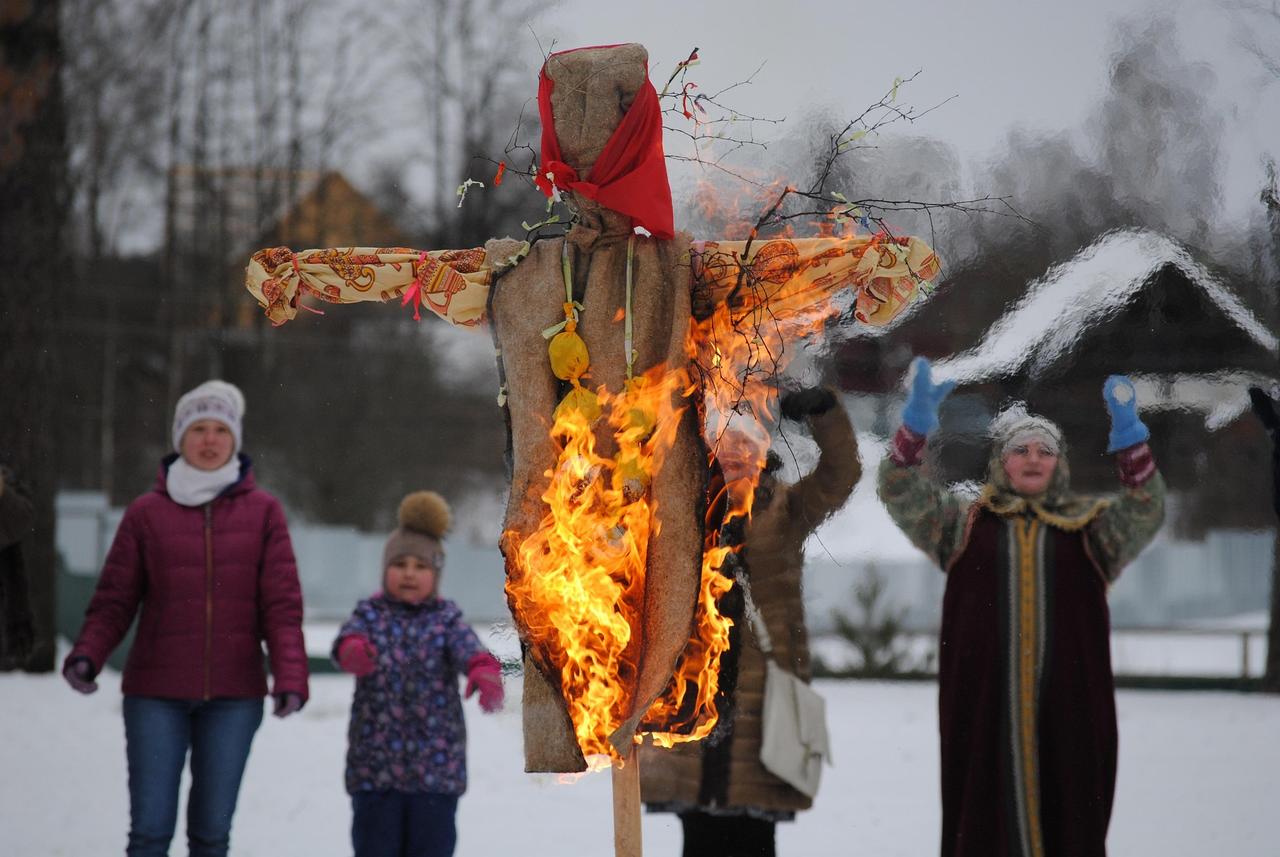
The final day of the week is known as “Forgiveness Sunday.” On this day people ask each other for forgiveness and the Maslenitsa effigy is burned to symbolically bid farewell to the festival.

The Burning of the Maslenitsa Effigy During the Festival (Pixabay)
Games and entertainment play a central role in Maslenitsa celebrations. These activities can be divided into two categories: competitive contests and festive amusements.
Competitive games include horse races fist fights and the capture of snow forts. Snow forts are typically built on frozen rivers or lakes and are contested between two groups.
Other popular activities include sledding descending icy hills and horse-drawn sleigh rides. In some regions these activities are believed to have magical significance and are thought to hasten the arrival of spring.

Maslenitsa Activities (Merve Sürücü)
One of the most striking rituals of Maslenitsa is the burning of the effigy at the end of the festival. The straw and old-clothing effigy is paraded through the village on the final day and then burned in a large bonfire. This ritual has been interpreted in various ways. Some scholars believe it symbolizes the end of winter while others see it as the expulsion of illness and misfortune. In some regions the ashes of the effigy are scattered over fields as a wish for fertility and a good harvest.

Maslenitsa Celebrations in Moscow (Anadolu Ajansı)
During the 20th century Maslenitsa celebrations underwent significant changes. In the Soviet era the festival was reimagined as a secular event called “Farewell to Russian Winter” stripped of its religious content. In this new form the festival was organized by state institutions through mass events parades and public entertainments.
In modern Russia Maslenitsa continues as a celebration that blends traditional elements with contemporary festival culture. Fairs concerts theatrical performances and various competitions form key components of the program. The festivities typically conclude with the burning of the Maslenitsa effigy.
Maslenitsa is recognized as an important folk festival in Slavic culture due to its historical roots and ritual structure representing seasonal transition.
On Monday the effigy is constructed and paraded through the village sometimes personified by an actual person. On Sunday the effigy is burned shredded or submerged in ice. This ritual is associated with the expulsion of winter the promotion of fertility and the assurance of good health. Pancakes and other foods are thrown into the fire as part of rites honoring the dead and invoking agricultural abundance.
Anadolu Ajansı. "Moskova'da halk festivali 'Maslenitsa' başladı." Accessed March 7, 2026. https://www.aa.com.tr/tr/pg/foto-galeri/moskovada-halk-festivali-maslenitsa-basladi/0
Gluşaev, A. L., and O. N. Kostitsina. “Maslenitsa, ili Provody Russkoy Zimy: Kak Konstruiruetsya Sovremennaya Prazdnichnaya Kultura.” *Kulturnıy Kod* 1 (2018): 22–32. Accessed March 7, 2026. https://cyberleninka.ru/article/n/maslenitsa-ili-provody-russkoy-zimy-kak-konstruiruetsya-sovremennaya-prazdnichnaya-kultura/viewer
Google Arts & Culture. "Boris Kustodiev - Shrovetide." Accessed March 24, 2026. https://artsandculture.google.com/asset/shrovetide/ZwF572j7IPGWnA?hl=en
Hrobostov, D. V., E. K. Guryanova, and V. L. Tutynin. “Maslenitsa.” *Tsentralnıy dom Rossiyskoy Armii imeni M. B. Frunze, Metodiçeskiy Otdel*. Moscow, 2022. Accessed March 7, 2026. https://cdra.ru/images/struktura/metodicheskiy_otdel/metodicheskie_posobia/2022/%D0%9C%D0%B0%D1%81%D0%BB%D0%B5%D0%BD%D0%B8%D1%86%D0%B0.pdf
Nilsson, Jenny. *Maslenitsa – Russkiy Narodnıy Prazdnik: Ego Osobennosti i Traditsii.* Reykjavík: Háskóli Íslands, 2010. Accessed March 6, 2026. https://skemman.is/bitstream/1946/4241/1/Maslenitsax_fixed.pdf
Pexels. Accessed March 7, 2026. https://www.pexels.com/tr-tr/fotograf/muhallebi-ile-krep-dolduran-kisi-3807512/
Pixabay. "Maslenitsa." Accessed March 7, 2026. https://pixabay.com/photos/pancake-week-stuffed-animal-fire-6102696/
Suiçer, Mehtap, and Tuğba Gökbayır. “Slav ve Türk Dünyasında Bahar Bayramlarının Ortak Motifleri: Malenitsa ve Nevruz.” *Uluslararası Türk Lehçe Araştırmaları Dergisi* 8 (2024): 377–389. Accessed March 6, 2026. https://dergipark.org.tr/tr/download/article-file/4324410

No Discussion Added Yet
Start discussion for "Maslenitsa Festival" article
Historical Background
Ritual Foods
Maslenitsa Week and Daily Rituals
Monday: Welcome
Tuesday: Games and Entertainment
Wednesday: Mother-in-Law’s Pancakes
Thursday: Grand Maslenitsa
Friday and Saturday: Family Visits
Sunday: Farewell and Forgiveness
Games and Entertainment
The Maslenitsa Effigy and Ritual Burning
Maslenitsa During the Soviet Era and Today
The Welcome and Farewell of Maslenitsa