


This article was automatically translated from the original Turkish version.
+2 More
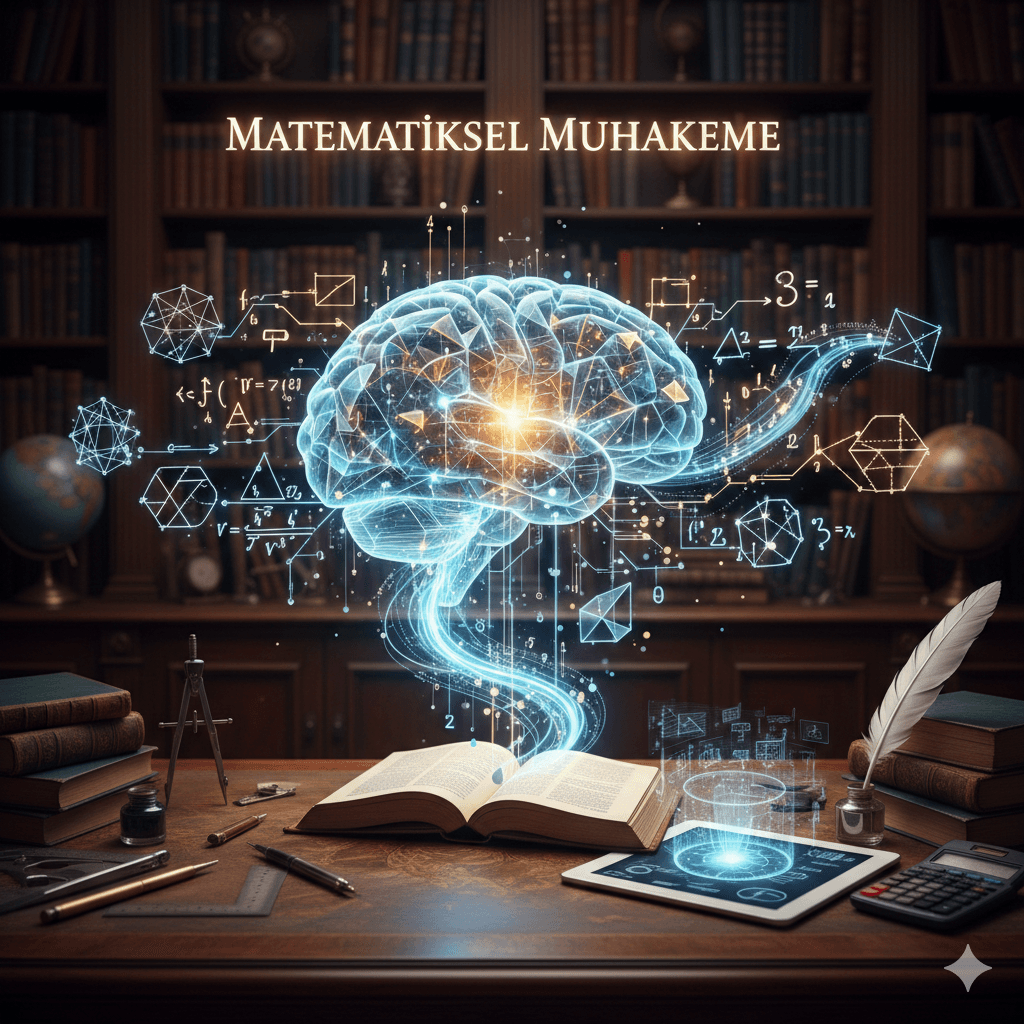
Mathematical Reasoning
(Generated with Artificial Intelligence)
Mathematical Reasoning
Definition(s) | Making logical inferences on data the process of justifying results | ||||||||
|---|---|---|---|---|---|---|---|---|---|
Educational Focus | Seeking answers to 'how' and 'why' questions, conceptual depth | ||||||||
Reasoning Approaches | Analytical (decompositional), holistic (integrative) | ||||||||
Related Skill Types | Critical thinking, creative thinking, abstract thinking | ||||||||
Basic Components | Analysis, generalization, making connections, decision-making, non-routine problem solving | ||||||||
Mathematical Reasoning is the process by which an individual thinks critically about data, draws logical inferences, analyzes a situation in all its dimensions, forms hypotheses, and justifies and defends the conclusions reached. As a higher-order form of thinking—one of the most fundamental characteristics of the human mind—this process goes beyond simple recall or procedural skill to involve the transfer of existing knowledge to new contexts and the application of logical foundations in problem solving. Recognized as one of the central components of mathematical proficiency, reasoning constructs the mental infrastructure necessary for understanding mathematical concepts, discovering relationships, and solving non-routine problems.【1】
The concept of reasoning etymologically refers to thorough reflection on a subject and arriving at a rational conclusion; in a mathematical context, this process is shaped by the examination of numerical and spatial relationships. Mathematical reasoning encompasses not only reaching a solution but also explaining how and why that solution was reached. This skill enables individuals to analyze new situations, make logical assumptions, and defend their thoughts within a coherent logical sequence.
In educational literature, reasoning is distinguished from lower-order cognitive skills such as recall and basic computation and is associated with critical and creative thinking. Individuals with strong mathematical reasoning abilities demonstrate skills in recognizing mathematical patterns, formulating conjectures, and testing those conjectures. This process reveals that mathematics is not merely a set of arithmetic operations but a mode of thinking used to interpret and understand the world.

Mathematical Reasoning Process
(Generated by Artificial Intelligence)
Mathematical reasoning has been examined through various international assessment frameworks and academic studies, which break it down into sub-dimensions. In particular, TIMSS (Trends in International Mathematics and Science Study) and NCTM (National Council of Teachers of Mathematics) standards serve as key reference points for defining the scope of this skill. According to the TIMSS framework, mathematical reasoning is analyzed through five core dimensions: analyzing, generalizing, making connections, deciding, and solving non-routine problems.【2】
The dimension of analyzing involves identifying relationships between variables or objects in mathematical situations and deriving valid conclusions. Generalizing entails deriving broader rules from specific cases and expressing these rules in mathematical terms. Making connections facilitates the integration of knowledge by establishing bridges between different mathematical concepts and ideas; the deciding dimension refers to forming judgments about the truth or falsity of a situation based on mathematical properties. Solving non-routine problems is the ability to handle situations that cannot be resolved by simply applying formulas, requiring instead reflection and strategy development.
In addition, academic studies have further detailed reasoning skills under subcategories such as evaluating the validity of solutions and outcomes, making predictions, recognizing patterns, and developing logical arguments about solutions. These components compel individuals to actively process and generate mathematical knowledge rather than passively receive it.
Individuals approach mathematical problems in different ways, leading to the emergence of various reasoning approaches. In the literature, these approaches are generally categorized into two main types: analytical (decompositional) and holistic. The analytical approach is based on breaking structures into parts, step-by-step calculation, and deductive reasoning. Individuals who adopt this approach tend to focus on rules and details. The holistic approach, by contrast, involves viewing phenomena from a broader perspective and focusing on the overall structure rather than individual relationships.
Additionally, distinctions are made between practical and abstract reasoning based on the method of solution. Practical reasoning is a style aimed at reaching functional and rapid conclusions in everyday life problems and professional applications. Abstract or theoretical reasoning, on the other hand, is a mode of thinking characterized by conceptual depth and is primarily used in mathematical proofs and academic research. Individuals may use these approaches independently depending on the nature of the problem they encounter, or they may combine them adaptively according to context.【3】
Mathematical reasoning ability is not independent of individual characteristics or cultural background. Individuals’ past learning experiences, knowledge accumulation, and mental schemas are significant factors influencing their reasoning styles. Individuals raised in different cultural environments may develop distinct reasoning strategies based on how they relate mathematical concepts to their everyday life experiences.
Research indicates that students’ gender, socioeconomic status, and learning styles contribute to diversity in reasoning approaches. However, educational systems that emphasize uniform thinking may hinder individuals from exploring and developing their unique reasoning styles. Flexible, discussion-oriented learning environments that encourage multiple solution pathways are essential to help students discover their own thinking styles.
Mathematics education is not merely about imparting computational skills; it is fundamentally built on developing reasoning ability. Changing global conditions demand individuals who do not simply store information but process it and adapt it to new situations. In this context, mathematical reasoning enables meaningful learning by encouraging students to ask “how” and “why” during problem-solving processes.
Teachers play a critical role in developing students’ reasoning skills. To guide students effectively through reasoning processes, teachers must first possess well-developed reasoning abilities themselves. Research has shown that teachers sometimes face difficulties in solving non-routine problems and establishing mathematical connections, which can affect instruction. Therefore, in mathematics teaching, it is essential that teachers provide rich learning opportunities, encourage students to articulate their thinking, and support diverse solution strategies to foster the development of reasoning skills.【4】
Benli, Aysu Nur, and Burçin Gökkurt Özdemir. "Matematik Öğretmenlerinin Matematiksel Muhakeme Becerilerinin TIMSS Standartlarına Göre İncelenmesi." *Akdeniz Eğitim Araştırmaları Dergisi* 15, no. 38 (2021): 1-28. Accessed February 20, 2026. https://mjer.inased.org/makale/2902.
Süleymanoğlu, Erdem, İrem Yıldız, and Esen Ersoy. "5. Sınıf Öğrencilerinin Matematiksel Muhakeme Becerileri Üzerine Bir Çalışma." *Turkish Studies (Elektronik)* 12, no. 17 (2017): 177-196. Accessed February 20, 2026. https://search.trdizin.gov.tr/tr/yayin/detay/276726.
Umay, Aysun. "Matematiksel Muhakeme Yeteneği." *Hacettepe Üniversitesi Eğitim Fakültesi Dergisi* 24 (2003): 234-243. Accessed February 20, 2026. https://dergipark.org.tr/en/download/article-file/87843.
Çoban, Halil, and Erdoğan Tezci. "Matematiksel Muhakeme Becerileri Değerlendirme Ölçeğinin Geliştirilmesi." *Uluslararası Toplum Araştırmaları Dergisi* 15, no. 22 (2020): 949-974. Accessed February 20, 2026. https://dergipark.org.tr/en/download/article-file/1027465.
[1]
Halil Çoban and Erdoğan Tezci, "Development of a Scale to Assess Mathematical Reasoning Skills," International Journal of Social Research 15, no. 22 (2020): 6, Access Date: February 20, 2026,https://dergipark.org.tr/en/download/article-file/1027465.
[2]
Aysu Nur Benli and Burçin Gökkurt Özdemir, "An Examination of Mathematics Teachers
[3]
Aysun Umay, "Mathematical Reasoning Ability," Hacettepe University Journal of Education 24 (2003): 237, Access Date: February 20, 2026,https://dergipark.org.tr/en/download/article-file/87843.
[4]
Erdem Süleymanoğlu, İrem Yıldız and Esen Ersoy, "A Study on the Mathematical Reasoning Skills of Fifth Grade Students," Turkish Studies (Electronic) 12, no. 17 (2017): 190, Access Date: February 20, 2026,https://search.trdizin.gov.tr/tr/yayin/detay/276726.
Mathematical Reasoning
(Generated with Artificial Intelligence)
Mathematical Reasoning
Definition(s) | Making logical inferences on data the process of justifying results | ||||||||
|---|---|---|---|---|---|---|---|---|---|
Educational Focus | Seeking answers to 'how' and 'why' questions, conceptual depth | ||||||||
Reasoning Approaches | Analytical (decompositional), holistic (integrative) | ||||||||
Related Skill Types | Critical thinking, creative thinking, abstract thinking | ||||||||
Basic Components | Analysis, generalization, making connections, decision-making, non-routine problem solving | ||||||||
No Discussion Added Yet
Start discussion for "Mathematical Reasoning" article
Conceptual Framework and Definition
Components and Standards
Approaches and Types
Influence of Individual and Cultural Factors
Role in Education and Teacher Competence