


This article was automatically translated from the original Turkish version.
+1 More
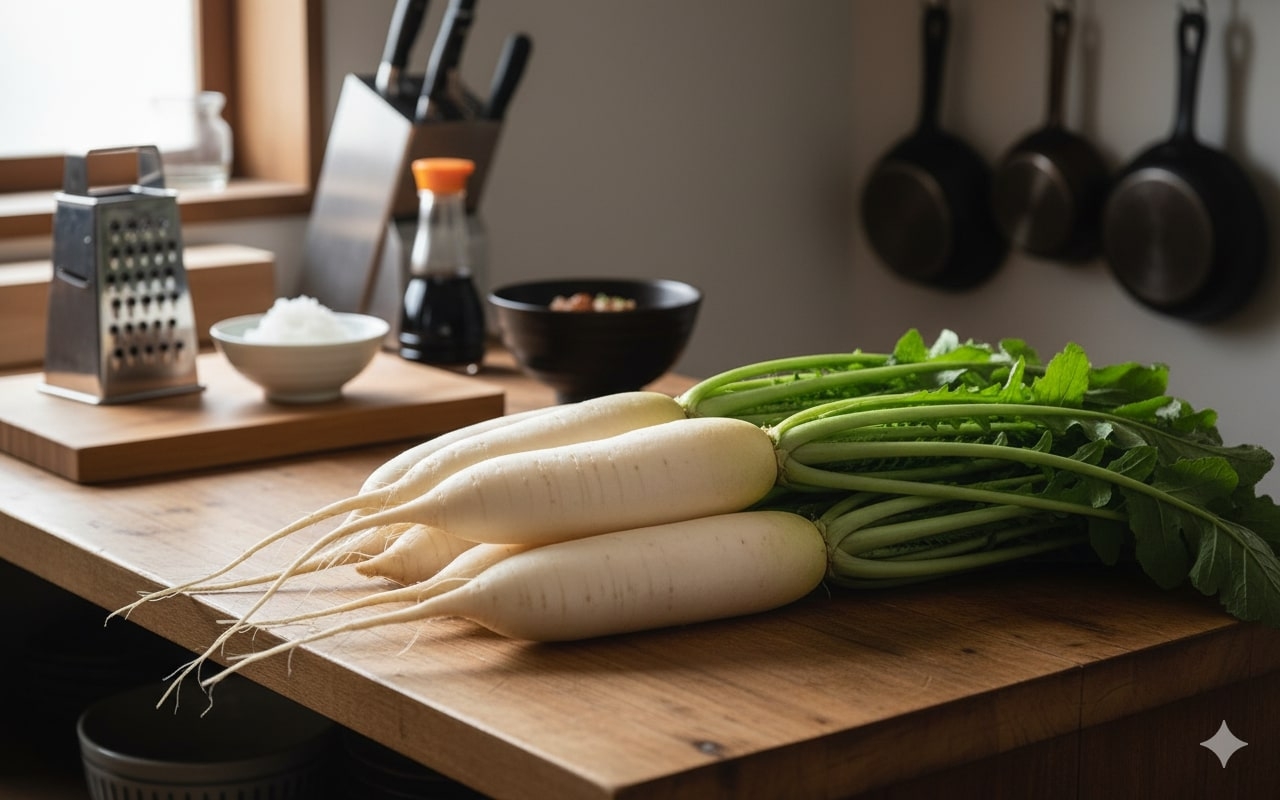
Matsudate Shibori Daikon (Yapay Zeka ile Oluşturulmuştur.)
Matsudate Shibori Daikon is a native variety of pungent radish traditionally cultivated in the Matsudate area of Kazuno City, Akita Prefecture, Japan. It is recognized as one of Japan’s Registered Geographical Indication (GI) products.
Matsudate Shibori Daikon is known for its sharp aroma, among the strongest of native pungent radishes. In addition to this pungency, it has a higher sucrose (sugar) content compared to other pungent radishes, which imparts sweet notes to its flavor and gives it a distinctive taste different from other varieties. Its low water content and firm flesh contribute to a long shelf life and extended storage life.
This radish is typically grated and squeezed; the extracted juice is used as a seasoning and sauce for various dishes such as soba, udon, hot pots (e.g., kaiyaki or boiled tofu), and sashimi.
About Matsudate Shibori Daikon (Geographical Indication Product Information Website)
Matsudate Shibori Daikon is cultivated in Matsudate, its production region, using the local variety Akita Onishibori. The production area features a rugged, mountainous topography that results in a cold climate with significant temperature differences between day and night. Such cold climatic conditions are ideal for this heat-sensitive radish.
The radish’s distinctive characteristics—including its size, aroma, and high sucrose content—are attributed to these topographic and climatic conditions, marked by cold winds blowing from surrounding mountains and early frosts. Under these conditions, varieties with greater resistance to low temperatures and frost, and reduced tendency to crack before harvest, have been selectively developed.
Matsudate Shibori Daikon has been grown for over a century in its production area, historically a mining region, as a cash crop during winter months. For a long time, it was cultivated in small quantities and primarily consumed locally. However, with the establishment of the Matsudate Shibori Daikon Production Group (now the Matsudate Shibori Daikon Cultivation Cooperative) in 1980, efforts began to promote its production and sale as a local specialty, gradually gaining recognition beyond the region.
Matsudate Shibori Daikon was granted Geographical Indication (GI) protection in 2018.

Matsudate Shibori Daikon (Yapay Zeka ile Oluşturulmuştur.)
No Discussion Added Yet
Start discussion for "Matsudate Shibori Daikon" article
Characteristics and Uses
Growing Area and Climate Influence
History and Geographical Indication Process