



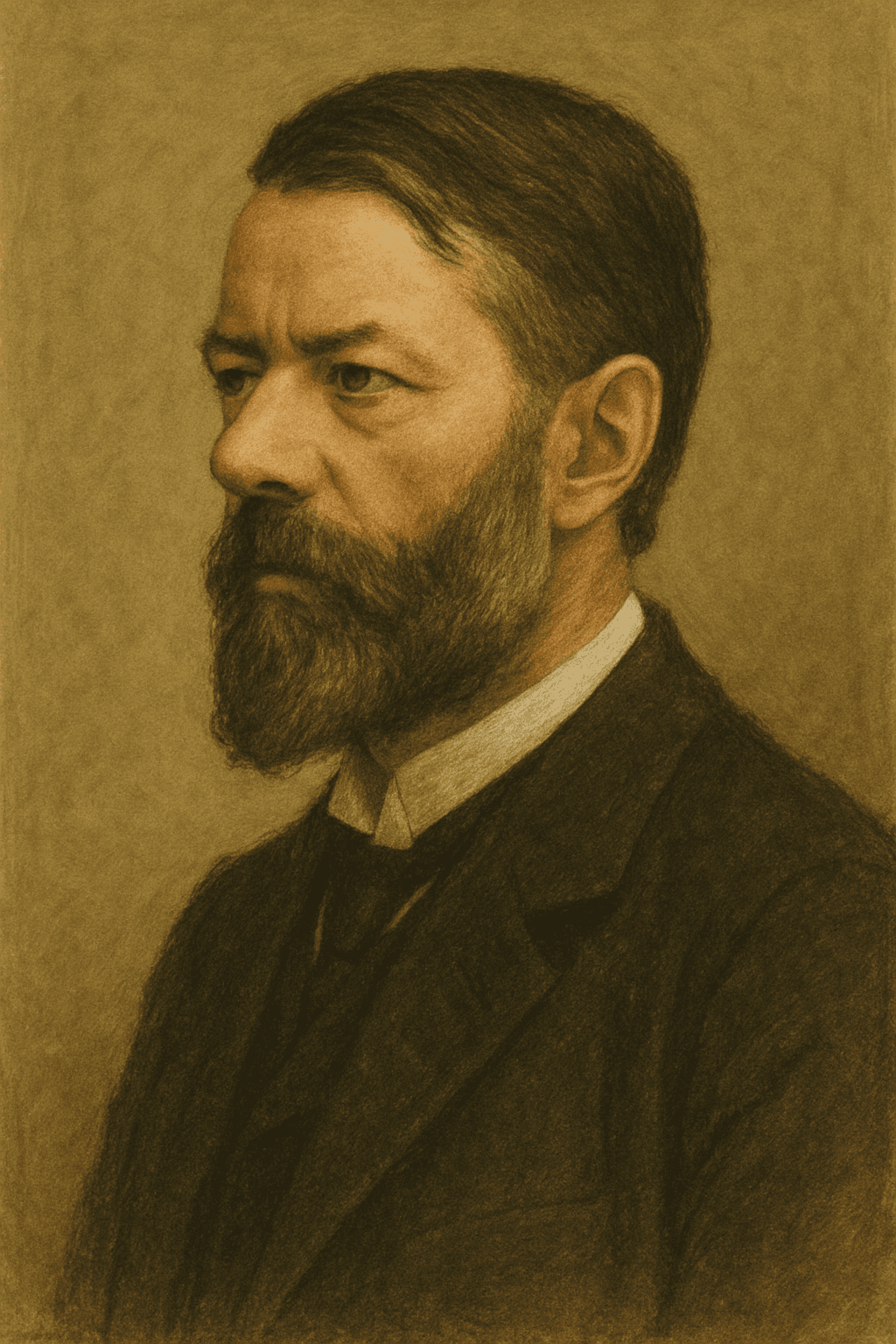
Max Weber
Birth | 21 April 1864 | ||||||||
|---|---|---|---|---|---|---|---|---|---|
Death | 14 June 1920 | ||||||||
Areas of Work | Modernity, Authority, Bureaucracy, Capitalism, Social Action, Sociology of Religion | ||||||||
Max Weber was a social scientist who sought to understand the emergence of the modern world by examining the political, social, and intellectual particularities of 19th-century Germany, analyzing this process through original concepts. Concepts such as “typology of authority,” “routinization of charisma,” “disenchantment of the world,” “rationalization,” “bureaucracy,” and “capitalism” form the foundational pillars of Weber’s analysis of modernity. These theoretical tools remain among the essential approaches still used today not only to comprehend his own era but also to analyze contemporary political and administrative structures.
Max Weber was born on 21 April 1864 in Erfurt, part of the Kingdom of Prussia. He was raised in a bourgeois and intellectual family; his father was a liberal politician and his mother a devout and cultured woman. Weber began showing interest in classical texts and historical works at an early age, a scholarly orientation that continued throughout his education.
He began his university studies in 1882 at Heidelberg University, where he pursued legal studies. After three years, he transferred to the University of Berlin, where he focused on law, economics, and history. During his time in Berlin, he also successfully completed the examinations required for practical service in the civil administration. In 1886 he began his doctoral studies in law and completed his dissertation in 1889 titled Die Entwicklung des Solidarhaftprinzips und das Sonderrecht der Kaufleute (The Development of the Principle of Joint Liability and the Special Law of Merchants).
In 1891 Weber entered academia with his habilitation thesis and became a professor at the University of Freiburg in 1894. In 1896 he moved to Heidelberg University, where he was appointed professor of political economy. However, following the death of his father in 1897, he suffered a profound psychological crisis that led him to suspend his academic work for an extended period. He returned to intellectual productivity from 1903 onward and wrote his most important works after this date.
Max Weber’s intellectual framework is nourished by the specific conditions of German political and economic structures yet offers universal theoretical explanations of modernity. His sociological approach follows a line that pays close attention to historical particularities while aiming to derive broader social generalizations from them. In this context, Weber’s methodology is both interpretive (ideal-typical) and open to positivist influences. His theory of the “ideal type” is a classic example of this approach: conceptual tools developed to analyze specific historical phenomena.
Weber’s approach to historical events employs what he called “elective affinity” (Wahlverwandtschaft), seeking to reveal interactive relationships between two social or cultural elements. Through this method, he was able to explain connections such as those between the Protestant ethic and the spirit of capitalism, or between capitalism and bureaucracy.
One of Weber’s most well-known contributions is his theory distinguishing legitimate authority into three ideal types:
According to Weber, charisma is the most powerful revolutionary force. However, it cannot endure and over time transforms into rational or traditional structures. This process of transformation leads to the mundane institutionalization of charismatic leadership and the emergence of a new mode of governance.
In modern society, the dominance of reason displaces traditional and charismatic structures. Weber termed this process the “disenchantment of the world.” Rationalization refers to the increasing calculability, order, and rule-bound nature of life in all domains.
According to Weber, bureaucracy is the most rational form of administration in modern society, characterized by specialization, hierarchy, written rules, and impersonal relationships. A strong elective affinity exists between capitalism and bureaucracy: bureaucracy provides the rational foundation necessary for sustaining the capitalist mode of production, while capitalism supplies the economic instruments required for the development of bureaucracy. Consequently, the rational modern society in which capitalism and bureaucracy co-evolve increasingly traps individuals in what Weber called a “steel cage.”
For Weber, politics encompasses all actions aimed at exercising dominance by one individual or group over others. The state is a human community that successfully claims the monopoly of legitimate physical violence within a given territory. Authority rests on the acceptance of this violence as legitimate.
In Weber’s approach to politics, economic and political behavior are conceptually distinct but practically intertwined. The relationship of domination operates on the level of command and obedience; its legitimacy is explained through the typology of authority.
Weber’s works do not merely define modernity, authority, bureaucracy, capitalism, and social rationalization; they also reveal their interrelationships. He is regarded as one of the foundational figures of modern political sociology and public administration. Today, debates in both sociology and political science frequently orient themselves around the framework he established.
Max Weber died on 14 June 1920 in Munich from the Spanish flu. At the time of his death, aged 56, he succumbed to the illness shortly after contracting it. In the final years of his life, he was working on his comprehensive study Wirtschaft und Gesellschaft (Economy and Society), having completed several of its sections. However, the final compilation and publication of the work were carried out after his death by his wife, Marianne Weber. Although his death left unfinished his ongoing contributions to sociology and the social sciences, the theoretical legacy he left behind has continued to exert influence on subsequent generations.
Eşki, Hülya. “Max Weber’i Okumak ve Bugünü Anlamak.” ZKÜ Sosyal Bilimler Dergisi 6, no. 11 (2010): 187–198. Accessed https://dergipark.org.tr/tr/pub/ijmeb/issue/54828/750562.
Simply Psychology. "Max Weber: German Sociologist." Simply Psychology. Accessed May 8, 2025. https://www.simplypsychology.org/max-weber-german-sociologist.html
Stanford Encyclopedia of Philosophy. Bruun, Hans Henrik. “Max Weber.” The Stanford Encyclopedia of Philosophy, edited by Edward N. Zalta. Spring 2020 Edition. Accessed https://plato.stanford.edu/entries/weber/.

Max Weber
Birth | 21 April 1864 | ||||||||
|---|---|---|---|---|---|---|---|---|---|
Death | 14 June 1920 | ||||||||
Areas of Work | Modernity, Authority, Bureaucracy, Capitalism, Social Action, Sociology of Religion | ||||||||
Life and Education
General Approach
Theories and Concepts
Typology of Authority
Routinization of Charisma
Disenchantment of the World and Rationalization
Bureaucracy and Capitalism
Politics, the State, and Authority
Major Works
Death