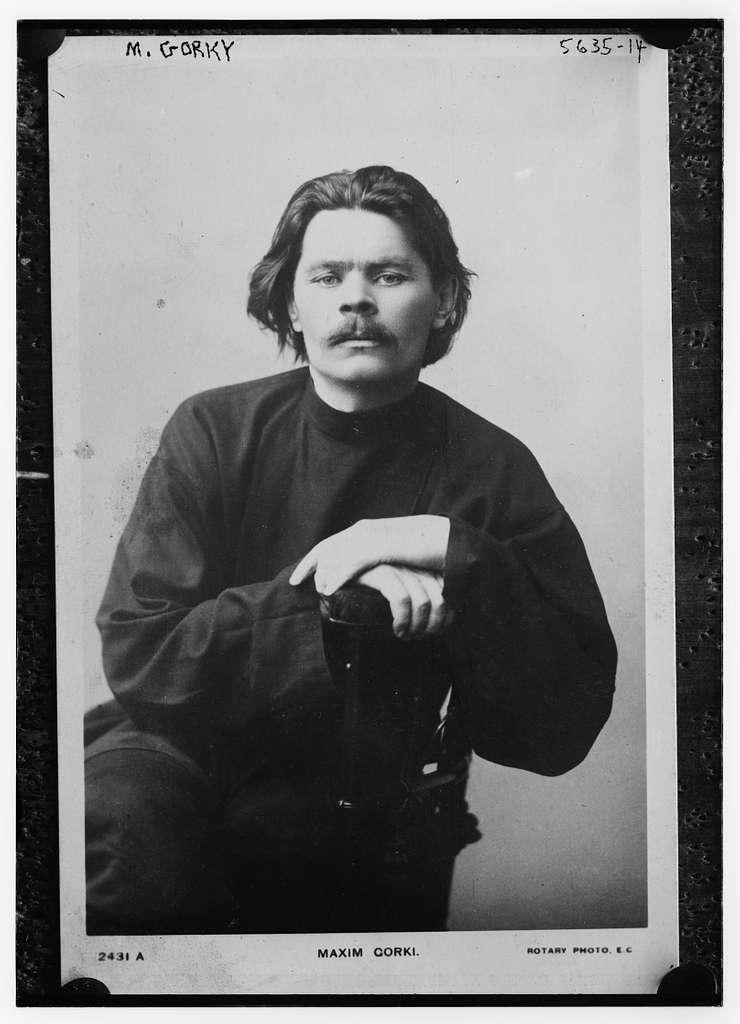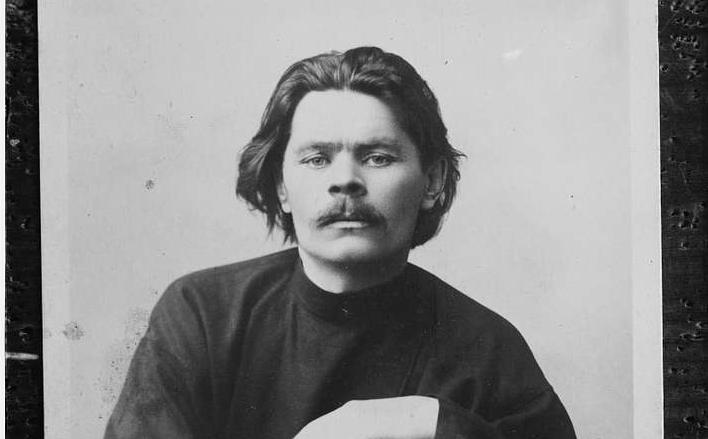

One of the influential figures in 20th-century Russian literature transformation, Maxim Gorky is a pioneer of socialist realism both theoretically and artistically. Author alongside his literary identity, he was also active in political and cultural spheres, particularly known for his works directed at the working class and his revolutionary discourse. In Gorky’s writings, a romantic idealism concerning individual freedom is juxtaposed with a realistic stance grounded in class consciousness. Throughout his life, he viewed literature not merely as an aesthetic domain but as an instrument of social transformation.
Maxim Gorky was born in 1868 in Nizhny Novgorod. Due to his family’s financial hardships, he was compelled to work at an early age, supporting himself through jobs such as shoemaking, baking, and seafaring such as. During his youth, he educated himself independently, encountered Marxist circles while living in Kazan, and deepened his intellectual world by reading the writings of Georgi Plekhanov idea. His lifelong immersion in the lives of ordinary people enabled him to portray the world of the “oppressed” with authentic narrative power.
Gorky’s literary career began in the 1890s with romantic short stories. Among his first notable works are Makar Chudra (1892), Chelkash (1894), Old Izergil (1895), The Song of the Falcon (1898), and The Song of the Stormy Petrel (1901) place. These works highlight themes of individualism, rebellion, freedom, and struggle. In particular, The Song of the Stormy Petrel earned Gorky the title “harbinger of the revolution.” His romanticism transcended individual emotions to assume a revolutionary character spirit.
In 1902, Gorky became the head of the Znaniye Publishing House, where he exerted influence not only as a writer but also as a publisher and cultural organizer. The literary movement that emerged around Znaniye is recognized as the forerunner of socialist realism. At Znaniye, Gorky facilitated the publication of numerous works that gave voice to workers, strengthened class consciousness, and critiqued bourgeois morality bourgeoisie.
Actively involved in the 1905 Revolution, Gorky produced political writings in both game and novel forms. His novel The Mother (1906) is regarded as one of the foundational texts of socialist realism. In the same year, he brought the issue of proletariat to the stage through his play The Enemies.
Gorky’s literary contributions can be examined along two main lines: early romantic realism and mature socialist realism. In both phases, his aim was to redefine the relationship between individual and society. He did not treat romanticism as mere aesthetic embellishment but as a narrative method capable of symbolizing collectivist ideals. He viewed art as a vehicle for educating and transforming the people; through his narratives of the oppressed classes, he paved the way for proletarian literature.
The literary works and theater plays he published under the Znaniye movement attracted attention not only in Russia but also internationally, playing a decisive role in the development of socialist literature.
In the 1930s, Gorky became an official figure endorsed by the Soviet Union’s state ideology and delivered a keynote speech at the first congress of the Union of Soviet Writers important. He emphasized art’s function as “the education of society” and articulated literature’s role in the formation of the socialist individual creation. Gorky died on 18 June 1936, and his death gave rise to various political speculations.
Maxim Gorky is remembered not merely as a writer but as an intellectual who regarded literature as a political action domain. With his novel The Mother, he laid the foundation of socialist realism and emerged as a pioneering figure in the development of Marxist literature through the Znaniye circle. The literary direction Gorky represented was later institutionalized by Soviet literature and officially adopted as doctrine in 1934 when socialist realism became the state-mandated aesthetic.
Biderci Dinç, Derya. “Sosyalist Gerçekçilik in Maksim Gorki’s *Mother* and Sabahattin Ali’s *Kuyucaklı Yusuf*.” *Korkut Ata Türkiyat Araştırmaları Dergisi*, Özel Sayı 1 (Cumhuriyetin 100. Yılına) (2023): 14–36. https://doi.org/10.51531/korkutataturkiyat.1357042 Öztürk, Emine and Mürüvvet Özlem Parer. “The Birth of a Socialist Realist: Maksim Gorki and Romanticism.” *Uluslararası Toplumsal Bilimler Dergisi* 5, no. 2 (2021): 59–83. Tetik, Kevser. “The Marxist Origins of Znanie Realism: Maksim Gorki and the Path to Socialist Literature.” *Folklor/Edebiyat* 31, no. 121 (2025): 223–244. https://doi.org/10.22559/folklor.2699
Library of Congress. "M. [i.e. Maxim] Gorki." Accessed March 3, 2026. https://itoldya420.getarchive.net/media/m-ie-maxim-gorki-lccn2014713135-de64d6?action=download&size=1024

Youth and Education
Literary Career and Periods
Contributions and Literary Approach
Later Years and Death
Legacy and Influence