This article was automatically translated from the original Turkish version.
Work Type | Mensur İskendernâme, (partially verse sections) | ||||||||
|---|---|---|---|---|---|---|---|---|---|
Language(s) | Late Chagatai Turkish | ||||||||
Period(s) | 19th century | ||||||||
Copy İnformation | Sweden, Lund University Library, Gunnar Jaring Collection, Brown binding, 104 folios | ||||||||
Prepared by | Aleyna Malkoç | ||||||||
Publisher(s) | Post Yayınevi | ||||||||
Year(s) | 2025 | ||||||||
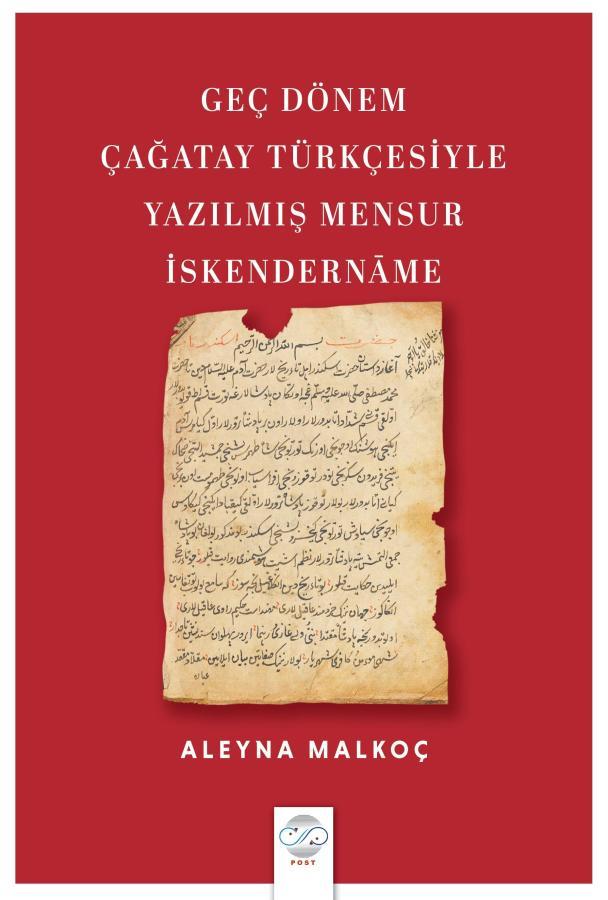
Mensur İskendernâme Written in Late Chagatai Turkish is a work dating to the 19th-century Chagatai Turkish period and is held within the “Gunnar Jaring Collection” of the Lund University Library in Sweden. The work consists of 104 folios and is written in Nastaʿlīq script.
“This İskender-nāme book was completed by Mollā Ebū’l Ḳāsım on the Wednesday of the month of Shawwāl in the year one thousand two hundred and seventy-seven (1277).” In this statement, the author, copyist, or merely the reader who finished the work identifies himself as Mollā Ebū’l Ḳāsım. The work is composed of multiple sections.
The work has been prepared for publication by Aleyna Malkoç, who added an introductory essay, grammar, and a dictionary, and was published by Post Yayınevi in 2025. The study comprises 256 pages.
The work consists of four parts.
The first part discusses the life of Alexander the Great, Alexander in Western and Eastern sources, Alexander narratives in Turkic-Islamic literature, and the mensur İskendernâme written in Late Chagatai Turkish.
The second part examines the grammatical features of Chagatai Turkish in the İskendernâme, classified under Phonology and Morphology.
The third part contains the transcribed text of the 104-folio work.
The fourth part presents the dictionary.
The İskendernâme text is part of the Jaring Collection, donated to the Department of Eastern Turkic Manuscripts at Lund University in Sweden. Another copy is held at the British Library. The two copies share many similarities. The brown-bound work consists of 104 folios written in Nastaʿlīq script and contains a four-part narrative of Alexander. Various marginal notes, written by the author or copyist, appear intermittently throughout the text. Additionally, in folio 104v, the statement “This İskender-nāme book was completed by Mollā Ebū’l Ḳāsım on the Wednesday of the month of Shawwāl in the year one thousand two hundred and seventy-seven (1277).” identifies the author, copyist, or finishing reader as Mollā Ebū’l Ḳāsım. The work belongs to the final period of Chagatai Turkish.
The mensur İskendernâme contains occasional poetic passages. These poetic sections, composed in various aruz meters, are interspersed throughout the text to enhance and embellish expression, though they contain several aruz irregularities. At times, identifying the correct aruz meter has proven very difficult. In content, the İskendernâme shares similarities with Ferdowsi’s Shāhnāma and Nizami’s Iqbālnāma.
The work encompasses numerous themes, from Alexander’s birth to his wars, romantic adventures, and death. The section titles in the text are as follows:
Bismillāhirraḥmānirraḥīm: Ḥażret-i İskender-nāme
Aġāz-ı Dāsītān-ı Ceng-i İskender
Āġāz-ı Dāsitān-ı Rāvī
Āġāz-ı Dāsītān-ı İskender Dārā’nıñ Ḫazīne vü Defīnesini Tüşüp Alġanı
Āġāz-ı Dāsītān-ı İskender ʿĀlemni Musaḫḫar Ḳılġanı, Leşker Tartġanı
Āġāz-ı Dāsītān-ı Pādşā İskender Herāt Şehri Birle Semerḳand Şehrini Binā Ḳılġan Leşker Yürütgeli
Āġāz-ı Dāsitān-ı İskender Mollā Ẓulmāt’ġa Bėrkip Ot Birle Şimālni Uġurlaġanı
Āġāz-ı Dāsitān-ı Keşmīrdin Çıḳıp Hindūstān’ġa Barġanları
Āġāz-ı Dāsitān-ı İskender Hindūstān’dın Çıḳıp Ḫıṭāy’ġa Barġanı
Āġāz-ı Dāsitān-ı Ḫāḳān Pādşā İskender’ni Teklīf Ḳılıp Mihmāndārlıḳ Ḳılġanı
Āġāz-ı Dāsitān-ı Pādişāh İskender Rūşenk ile Mihrināz’nı Toy Ḳılıp Öz Nikāhıġa Alġanı
Āġāz-ı Dāsitān-ı Pādişāh Leşker-i İskender Vaḥşīlerni Alġalı Leşker Yürütgeni
Āġāz-ı Dāsitān-ı Pādişāh İskender Ḳıran Mülkide Ye’cūc Me’cūc’nıñ Çıḳadurġan Yėrige Ṣed Baġlaġanı
Āġāz-ı Dāsitān-ı Pādişāh İskender Āb-ı Ḥayāt’nı İstep Ẓulmāt’ġa Kirgenleri
Āġāz-ı Dāsitān-ı İskender Deryā-yı Sīr’ni İḫtiyār Ḳılıp Kėme Ötgeli Yarlıġ Ḳılġanı
Āġāz-ı Dāsitān-ı Pādişāh İskender Ḫünkār’nıñ ʿÖmr-i Bahārını Ecel Ṣarṣarı Uçurġanı
Āġāz-ı Dāsitān-ı İskender Beranduḳ ʿAşḳıġa Mübtelā Bolup Esīrler Kėbi Selāsīl Ḳırıġa Giriftār Bolġanı
Dāsitān-ı İskender’ni Beranduḳ Törtünci Nevbet Basruḳ Ḳılġanı
Dāsitān-ı Mekīnā Ḥākimdin
Beranduḳ İskender’ni Bėşinci Nevbet Basruḳ Ḳılġanı
Beranduḳ İskender’ni Altıncı Nevbet Basruḳ Ḳılġanı
Pādişāh İskender’niñ Yėtinci Nevbet Basruḳ Ḳılġanı
Dāsitān-ı Ḥażret-i Ḫıżrī ʿAleyhisselām’dın Boyaḳı Buba Yėne Kėldi
Āġāz-ı Dāsitān-ı Ḥażret-i İskender Maḳṣūd Kāmın Tafıp Yunan Mülki Nā-būd Ḳılġanı
Rāvī aytadur kim: Eflāṭūn bir kün...
Āġāz-ı Dāsitān-ı İskender Yėtte Deryā’nı Seyrī Ḳılıp On Ėkki Miñ Cezīre
Şehrlerini Musaḫḫar Ḳılıp Deryā-yı Muḥīt’ġa Barġanları
Āġāz-ı Dāsitān-ı İskender Tiriglikdin Ümīd Üzüp Anasıġa Tola Nāle vü Feryād Ḳılmasun dėp Nāme Ėbergeni
Āġāz-ı Dāsitān-ı Yėtte Ḥükemā Kirip Pādişāh İskender’niñ Analarıġa Taʿzīyet Yėtkürgenleri
Prof. Dr. Kudret Altun offers the following evaluation of the study:
“The mensur İskendernâme written in Late Chagatai Turkish is an original contribution to our literature and serves as a valuable source for the broader field of Turkic language and literary studies.
In this work, which discusses the historical figure of Alexander the Great and the İskendernâmeler in Turkic literature, the mensur text composed in the late period of Chagatai Turkish is analyzed alongside the general grammatical features of Chagatai Turkish. Furthermore, the inclusion of a dictionary provides a valuable resource for identifying the lexical inventory of Chagatai Turkish.
With this original work, Aleyna Malkoç offers a fresh perspective on the kinship between Chagatai Turkish—rooted firmly in a shared heritage yet flourishing in different geographical branches—and Turkish as spoken in Türkiye, thereby contributing significantly to linguistic research in the Turkic world.【1】
[1]
Post Yayınevi. "Geç Dönem Çağatay Türkçesiyle Yazılmış Mensur İskendernāme." Son Erişim: 19.10.2025. https://www.postkitap.com/gec-donem-cagatay-turkcesiyle-yazilmis-mensur-iskendername

Work Type | Mensur İskendernâme, (partially verse sections) | ||||||||
|---|---|---|---|---|---|---|---|---|---|
Language(s) | Late Chagatai Turkish | ||||||||
Period(s) | 19th century | ||||||||
Copy İnformation | Sweden, Lund University Library, Gunnar Jaring Collection, Brown binding, 104 folios | ||||||||
Prepared by | Aleyna Malkoç | ||||||||
Publisher(s) | Post Yayınevi | ||||||||
Year(s) | 2025 | ||||||||
No Discussion Added Yet
Start discussion for "Measured Iskendername (Book) Written in Late Chagatai Turkish" article
Structure
Content
Assessment by Prof. Dr. Kudret Altun