

This article was automatically translated from the original Turkish version.
+1 More
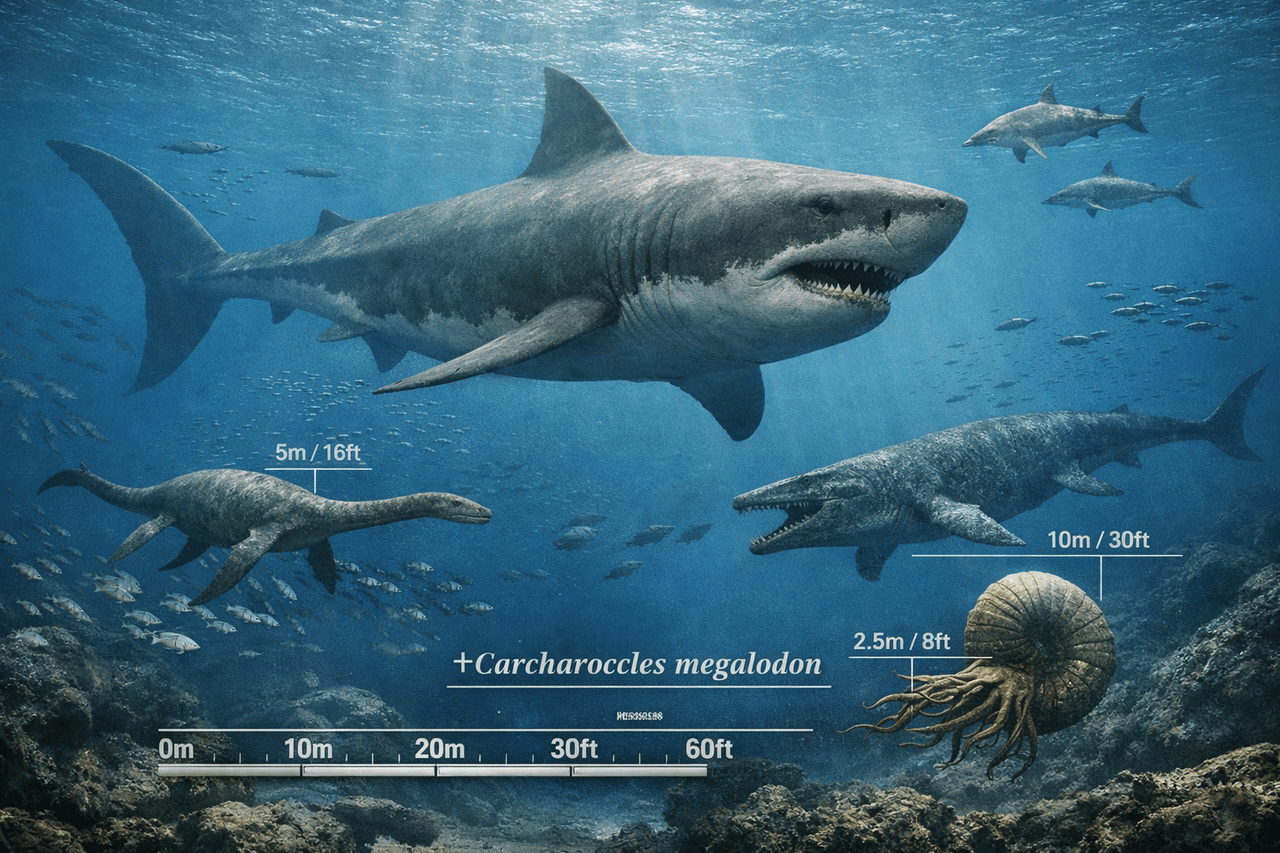
Megalodon ve Dönemin Diğer Dev Deniz Canlıları
(Yapay Zeka ile Oluşturulmuştur)
Megalodon (Otodus megalodon) is an extinct giant shark species that lived approximately 23 million to 3.6 million years ago during the Miocene and Pliocene epochs and is regarded by scientists as one of the largest marine predators to have ever existed. Fossil evidence indicates that megalodon inhabited large parts of the world’s oceans. Because it had a skeleton composed largely of cartilage, like modern sharks, most remains preserved today consist of teeth and vertebrae. Its triangular, serrated teeth can reach up to 18 centimeters in some specimens. Scientific estimates suggest its length ranged between 10 and 18 meters, and it was a powerful apex predator that fed on large marine animals, particularly whales. Researchers believe the species went extinct around 3.6 million years ago due to climate change, a decline in prey populations, and environmental shifts in the marine ecosystem.
Virtual Audio Tour with Carcharocles Megalodon at the Sant Ocean Hall
Megalodon is defined as a large shark species that lived in prehistoric oceans. Fossil records indicate this species had a massive body structure. In particular, tooth fossils provide significant insights into its size and feeding behavior. The size and structure of its teeth suggest that megalodon possessed a powerful jaw and likely fed on large marine animals.【1】
Megalodon’s teeth are triangular with sharp edges. These teeth have been found as fossils across various regions worldwide. Scientists have made various estimates regarding megalodon’s body length and weight by analyzing the size of these teeth.【2】

Megalodon (Otodus megalodon)
According to fossil evidence, megalodon had a wide geographic range in prehistoric oceans. Teeth fossils found on different continents suggest this species likely inhabited warm and temperate seas. It is believed that megalodon’s habitat extended from coastal regions to the open ocean.
Fossil records indicate that this species occurred in diverse marine ecosystems. This suggests megalodon had a broad geographic distribution and was capable of adapting to various environmental conditions.【3】
Information about megalodon’s feeding habits has been largely derived from the study of its teeth and other fossil remains. The structure and size of its teeth indicate that it was a powerful predator.
Megalodon is believed to have fed on large marine animals and occupied the position of an apex predator in marine ecosystems. Fossil evidence includes bite marks on bones of marine mammals, suggesting that megalodon hunted large marine mammals.

Megalodon (Carcharocles megalodon) and Other Giant Marine Life of Its Time
(Generated by Artificial Intelligence)
Scientific research confirms that megalodon no longer exists and is considered an extinct species. Fossil records show that this species lived millions of years ago. Researchers suggest its extinction may be linked to various environmental factors, including changes in the marine ecosystem, climatic fluctuations, and a decline in food resources.【4】
The extinction of megalodon occurred approximately 2.6 million years ago, toward the end of the Pliocene epoch. Scientists believe this extinction was not caused by a single factor but by a combination of environmental changes. Climate shifts led to a drop in ocean temperatures and major transformations in marine ecosystems. Additionally, the formation of the Isthmus of Panama, which closed the water passage between the Pacific and Atlantic oceans, altered ocean currents and the distribution of nutrients.
As a result of these changes, populations of small whales and other large marine mammals—megalodon’s primary prey—declined, making it increasingly difficult for this giant predator, which required substantial energy, to survive.
Due to the decline in prey resources and the impact of environmental changes, megalodon gradually disappeared and vanished entirely from the fossil record approximately 2.6 million years ago.
Accessed November 26, 2025. https://www.aa.com.tr/tr/kultur/ahlatta-acilan-kurslarla-geleneksel-tas-isciligi-yasatiliyor/3116279.
National Geographic Kids. "Megalodon Facts." Accessed March 5, 2026. https://kids.nationalgeographic.com/animals/fish/facts/megalodon
Natural History Museum. "Megalodon: The Truth About the Largest Shark That Ever Lived." Accessed March 5, 2026.
Pimiento, Catalina, and Meghan A. Balk. “Body‑size Trends of the Extinct Giant Shark Carcharocles megalodon: A Deep‑Time Perspective on Marine Apex Predators.” Paleobiology 41, no. 3 (2015): 479–490. Accessed March 5, 2026. https://doi.org/10.1017/pab.2015.16
Smithsonian Ocean. "Megalodon." Accessed March 5, 2026.
Smithsonian’s National Museum of Natural History. “Narrated Virtual Tour: Carcharocles Megalodon in the Sant Ocean Hall.” YouTube video, 4:21. 2022. Accessed March 5, 2026. https://youtu.be/_wBk8JBbgzw
https://ocean.si.edu/ocean-life/sharks-rays/megalodon
[1]
Smithsonian Ocean. “Megalodon.” Accessed March 5, 2026, https://ocean.si.edu/ocean-life/sharks-rays/megalodon
[2]
National Geographic Kids, “Megalodon Facts,” Accessed March 5, 2026, https://kids.nationalgeographic.com/animals/fish/facts/megalodon
[3]
Natural History Museum, “Megalodon: The Truth About the Largest Shark That Ever Lived,” Accessed March 5, 2026, https://www.nhm.ac.uk/discover/megalodon--the-truth-about-the-largest-shark-that-ever-lived.html
[4]
Natural History Museum, “Megalodon: The Truth About the Largest Shark That Ever Lived,” Accessed March 5, 2026, https://www.nhm.ac.uk/discover/megalodon--the-truth-about-the-largest-shark-that-ever-lived.html

Megalodon ve Dönemin Diğer Dev Deniz Canlıları
(Yapay Zeka ile Oluşturulmuştur)
No Discussion Added Yet
Start discussion for "Megalodon (Carcharocles megalodon)" article
General Characteristics
Habitat and Distribution
Feeding Behavior
Extinction