This article was automatically translated from the original Turkish version.
+2 More
Origin(s) | Mersin Türkiye | ||||||||
|---|---|---|---|---|---|---|---|---|---|
Main Material | Sarı Havuç | ||||||||
Registration Type | Mahreç İşareti | ||||||||
Shape | Dilimlenmiş Dikdörtgen veya Rulo | ||||||||
Consumption Area | Tatlı, Atıştırmalık, Hediyelik | ||||||||
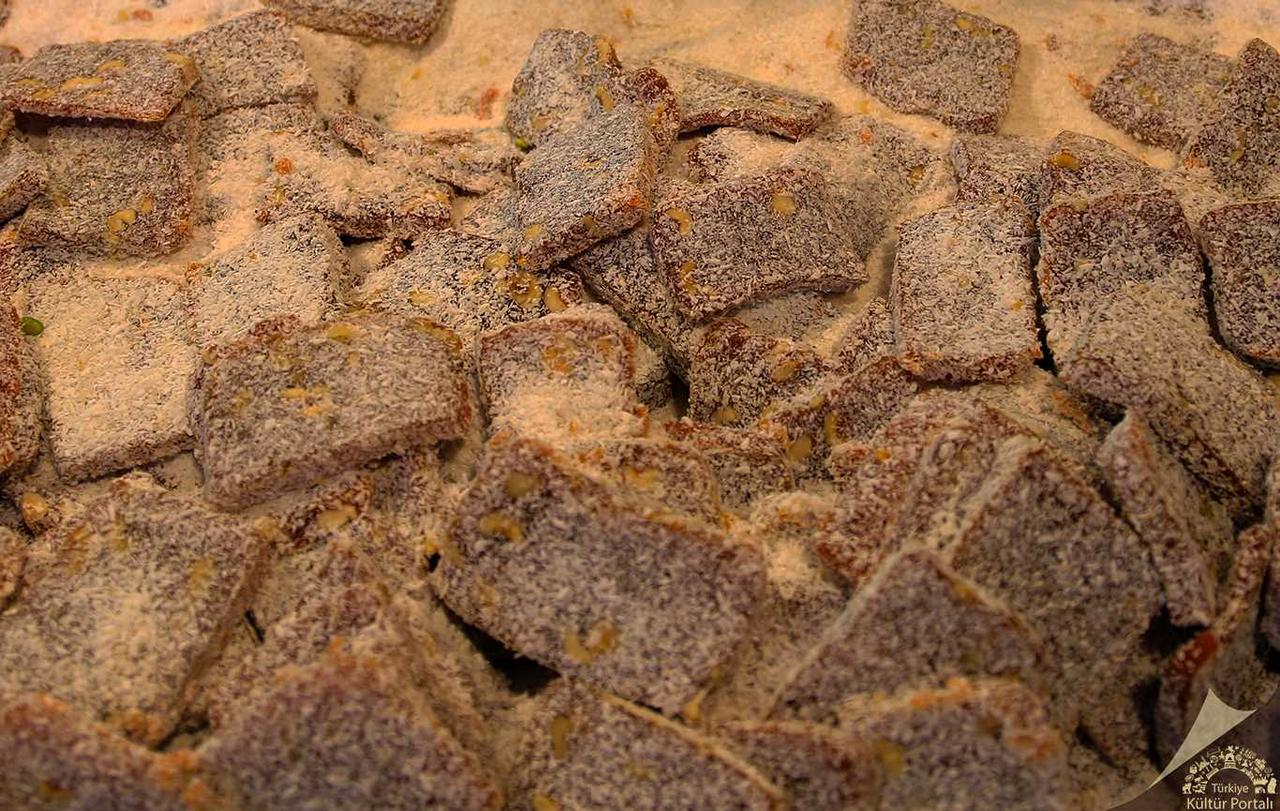
Mersin cezeryesi is a regional sweet with a jelly-like texture, made by cooking carrots and nuts in sugar, and officially registered as a geographical indication product. Derived its name from the Arabic word “cezer” (carrot), this product is particularly associated with the city of Mersin in Türkiye’s Mediterranean Region. Cezerye attracts attention due to its natural ingredients, long shelf life, and distinctive consistency, and is included among locally produced goods protected by geographical indication. Produced both through traditional methods and industrial processes, cezerye is an important part of the regional culinary culture and reflects the economic and tourist potential of the area.

Mersin Cezeryesi (Türkiye Culture Portal)
Sources on Mersin cezeryesi indicate that its production began in the Mersin region from the early 20th century and was introduced by communities of Arab origin. The earliest documented activities related to cezerye production started in small-scale enterprises and later evolved into large-scale commercial manufacturing.
Mersin cezeryesi was registered as a geographical indication under the category of designation of origin by the Turkish Patent and Trademark Office in 2008. The registration certificate provides detailed descriptions of the product’s unique ingredients, production process, physical characteristics, and quality criteria. Geographical indication protection ensures not only the safeguarding of the product’s name but also the preservation of its place of production, traditional methods, and local knowledge.
The main ingredient of cezerye is yellow carrot. In addition, powdered sugar, lemon salt, water, and optionally nuts such as walnut, hazelnut, or pistachio are used. No additives are included in the product; it is produced exclusively with natural ingredients.
According to the geographical indication registration certificate, Mersin cezerye has the following technical properties:
These criteria are accepted as quality standards by both traditional producers and regulatory authorities.
Cezerye holds a significant place in Mersin’s gastronomic tourism. Due to its long shelf life, portability, and variety of packaging options, it is also regarded as a souvenir item. It is among the most frequently purchased regional products by visitors to Mersin. Moreover, cezerye production contributes economically to small and medium-sized enterprises in the region.
Güler, Ozan, and Metin Öztürk. “Pazarlama Karmasından Hareketle Coğrafi İşaretli Ürün Algısı: Mersin Örneği.” *Gastroia: Journal of Gastronomy and Travel Research* 5, no. 2 (August 16, 2021): 277–301. https://dergipark.org.tr/en/download/article-file/1686347 (Accessed June 25, 2025).
Ministry of Culture and Tourism of the Republic of Türkiye. “Cezerye – Mersin.” *Türkiye Kültür Portalı*. https://www.kulturportali.gov.tr/turkiye/mersin/nealinir/cezerye (Accessed June 25, 2025).
Süslü, Cemil, Gamze Eryılmaz, and Elif Demir. “Coğrafi İşaretli Ürünlerin Gastronomi Kapsamında Değerlendirilmesi: Mersin İli Örneği.” *Journal of Recreation and Tourism Research* 7, no. 2 (June 30, 2020): 135–49. https://www.jrtr.org/index.php/jrtr/article/view/59/59 (Accessed June 25, 2025).
T.C. Kültür ve Turizm Bakanlığı. “Mersin Cezeryesi.” *Kültür Portalı*. Accessed June 25, 2025. https://www.kulturportali.gov.tr/portal/mersin-cezeryesi
T.C. Turkish Patent and Trademark Office. “Mersin Cezeryesi Coğrafi İşaret Dosyası.” PDF. https://ci.turkpatent.gov.tr/Files/GeographicalSigns/44.pdf Accessed June 25, 2025.
Özbek, Çağla, and Nuray Güzeler. “Mersin Mutfağının Gastronomik Ürünleri.” *Aydın Gastronomy* 6, no. 2 (2022): 311–24. https://dergipark.org.tr/en/download/article-file/1997794 (Accessed June 25, 2025).

Origin(s) | Mersin Türkiye | ||||||||
|---|---|---|---|---|---|---|---|---|---|
Main Material | Sarı Havuç | ||||||||
Registration Type | Mahreç İşareti | ||||||||
Shape | Dilimlenmiş Dikdörtgen veya Rulo | ||||||||
Consumption Area | Tatlı, Atıştırmalık, Hediyelik | ||||||||
History and Geographical Indication Process
Production Process
Ingredients
Preparation Steps
Physical and Sensory Characteristics
Consumption and Touristic Value