


This article was automatically translated from the original Turkish version.
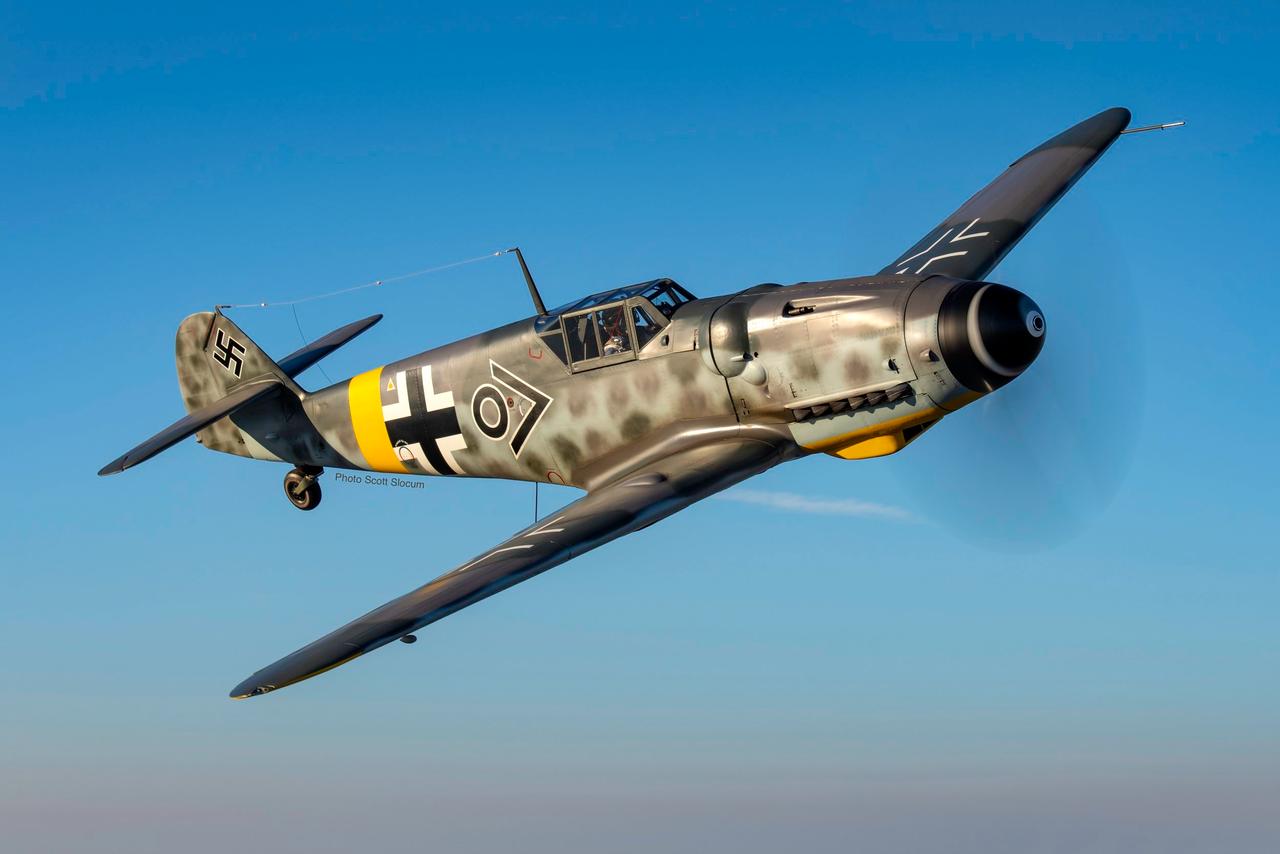
Bf 109G-6 (Photo: Scott Slocum)
Length(s) | 8.95 metres | ||||||||
|---|---|---|---|---|---|---|---|---|---|
Manufacturer(s) | Bayerische Flugzeugwerke (BFW) later became Messerschmitt AG | ||||||||
Origin(s) | Germany | ||||||||
Category | Fighter aircraft | ||||||||
Engine and Power | 1475 PS (1454 horsepower) Daimler-Benz DB 605A-1 | ||||||||
Gross Weight | Approximately 3400 kg for the Bf 109G-6 model | ||||||||
Empty Weight | Approximately 2600 kg for the Bf 109G-6 model | ||||||||
Turn Time | Approximately 20 seconds depending on specific conditions | ||||||||
Maximum Altitude | Approximately 12000 metres for the Bf 109G-6 model | ||||||||
Takeoff Distance | Approximately 400 metres | ||||||||
Maximum Speed | Approximately 640 km/h for the Bf 109G-6 model | ||||||||
Service Dates | 1937–1945 (Germany), until 1965 in other countries | ||||||||
Year of Production | 1935 | ||||||||
Production Number | 33984 | ||||||||
Users | Romania Hungary Italy Finland Bulgaria Spain Luftwaffe | ||||||||
Weapons | rate of fire approximately 10 rounds per second) 1 x 20 mm MG 151/20 cannon (200 rounds rate of fire approximately 14 rounds per second) 2 x 13 mm MG 131 machine guns (300 rounds each | ||||||||
Wingspan | 9.92 metres | ||||||||
Designer | Willy Messerschmitt and Robert Lusser | ||||||||
The Messerschmitt Bf 109 is one of the symbolic and most produced fighter aircraft of World War II. This single-engine, low-wing aircraft, which made its first flight in 1935, was effectively deployed by the German Air Force (Luftwaffe) across various battlefronts, primarily on the European front. The Bf 109, designed by the renowned engineer Willy Messerschmitt and his team, was equipped with inline engines developed by Daimler-Benz and became one of the most competitive aircraft of its era in terms of speed, climb rate, and maneuverability.
Different variants of the aircraft (such as the Bf 109E, F, G, and K) gained significant advantages in aerial combat due to their increased engine power, heavier armament, and aerodynamic improvements. These variants formed a continuously upgraded platform throughout the war, enabling the Bf 109 to fulfill critical roles in both defensive and offensive operations. Additionally, some countries continued its production or use under license after the war. Aviation historians regard the Bf 109 as one of the most effective examples of modern combat aviation due to its modular design, which allowed for easy maintenance, and its innovative contributions to air superiority doctrine.
The Messerschmitt Bf 109 was developed during the early 1930s as part of Germany’s rearmament program. The basic design concept was prepared in May of that year, while a more comprehensive design model was completed in January 1935. The Reichsluftfahrtministerium (RLM) assigned the next available number in the block allocated to BFW, resulting in the project being designated “Bf 109” in 1934.
The design process for the Bf 109 began shortly after the development contract was signed, in the early months of 1934. Considering the aviation trends of the time, the aircraft was intended to have a lightweight and aerodynamic fuselage, high-altitude performance, and a powerful engine. Since new German engines had not yet entered full production, temporary use of foreign engines such as the Rolls-Royce Kestrel ensured that prototype flight tests could proceed without delay.
During the development of the Bf 109, Messerschmitt and his team implemented several innovations in fuselage design and engine integration. The low-mounted wings and the use of lightweight yet durable materials in the fuselage structure enhanced the speed and maneuverability required by contemporary combat doctrine. These design features quickly gave the Bf 109 an advantage over other contemporary fighters and accelerated ongoing prototype development.
The first prototype of the aircraft was designated “Versuchsflugzeug 1” or V1. Completed in May 1935, it was registered with the civil registration code D-IABI. Since German engines were not yet available, Rolls-Royce Kestrel engines were procured for flight testing, and the engine mounts were modified to accommodate the vertical orientation of these engines. The V1 made its first flight at the end of May 1935 and, after approximately four months of testing, was sent to the Luftwaffe’s test center at Erprobungsstelle Rechlin.

Bf 109 V1 (Photo: Ronnie Bell, flickr.com)
Following the V1, the introduction of the Jumo 210 series engines in late 1935 provided new momentum to the Bf 109 development program. The V2 prototype, powered by these engines, was completed in October 1935, and shortly thereafter, designers prepared the V3 prototype to test weapon systems. The V3 was the first to combine the Bf 109’s intended combat armament and performance, but delays in engine supply prevented it from flying until mid-1936. These prototypes laid the groundwork for later improvements in the E, F, G, and K series, enabling the Bf 109 to undergo continuous refinement throughout World War II.
Thus, the Bf 109 became a striking symbol of German air power, embodying the aviation technology of the 1930s. With approximately 33,000 units produced, the Bf 109 became one of the most widely produced fighter aircraft models in aviation history.
Germany faced severe restrictions on military aircraft production following World War I under the Treaty of Versailles. Nevertheless, production proceeded with remarkable efficiency despite limited resources and intense wartime conditions. In addition to main factories in Germany, production also took place in allied countries such as Chile, Hungary, and Romania.
The development of the Bf 109 demonstrated Germany’s determination to circumvent international restrictions and assert national independence. This situation reflects the political and strategic motivations underlying the technological innovations of the aircraft.
The Messerschmitt Bf 109 is not only one of the most recognizable fighter aircraft of World War II but also stands out for its advanced design features. This single-engine, single-seat, low-wing aircraft was designed from its inception to maximize speed, maneuverability, and firepower. The fuselage structure employed an all-metal monocoque construction, one of the most advanced technologies of the era, achieving an optimal balance between strength and lightness.
Another key feature was the use of liquid-cooled, inverted V-type Daimler-Benz engines. These engines were positioned within the fuselage to optimize aerodynamic efficiency, allowing for a narrow nose profile. The wings featured automatic leading-edge slats and a relatively narrow structure, enabling more controlled flight at low speeds and providing pilots with significant advantages during takeoff and landing.

Bf-109 technical drawings (Photo: Blueprints)
Although the landing gear of the Bf 109 was advanced for its time, its narrow track required careful handling during ground movement. However, the fully retractable main landing gear reduced aerodynamic drag, positively contributing to the aircraft’s speed and climb performance. The cockpit, designed with maximum aerodynamic efficiency in mind, had a relatively narrow field of view.
Structurally, the engine unit in the forward fuselage and the nose-mounted armament helped position the center of gravity as far forward as possible, enhancing stability. This design approach supported the aircraft’s controllability at high speeds and during vertical maneuvers. Taken together, these elements demonstrate that the Messerschmitt Bf 109’s design pushed the engineering limits of its time and made significant contributions to the modern fighter aircraft concept.
The Bf 109 encountered a wide variety of enemy aircraft across different theaters of war, including the Spitfire, P-51 Mustang, and Yak-3. The aerial battles during the Battle of Britain, particularly between the Bf 109 and the Spitfire, became one of the most important comparisons of technical capabilities between two fighter aircraft. The Bf 109’s primary missions were escorting bombers and providing close air support.
It is estimated that the Bf 109 shot down approximately 15,000 enemy aircraft, one of the highest scores achieved by any single aircraft model, cementing its historical prominence.

Messerschmitt Bf-109G-4 (Photo: Charlie Jackson, flickr.com)
Despite its significant achievements, the Bf 109 was criticized for certain weaknesses. The most prominent was its narrow landing gear, which caused instability during takeoff and landing and posed risks to pilots. Additionally, engine performance declined at high altitudes, creating a disadvantage against enemy aircraft operating at very high altitudes or on long-range missions. Limited fuel capacity also restricted operational flexibility.

Messerschmitt Bf 109 landing gear (Photo: Martin Morris, flickr.com)
The cockpit was designed to be narrow, low, and compact, with thick metal panels severely restricting the pilot’s field of view.

Bf-109 cockpit (Photo: Pete Feign, quora.com)
Bf 109 pilots generally praised its maneuverability and speed. However, they also highlighted the difficulties caused by the narrow cockpit and landing gear design. Erich Hartmann, one of the Luftwaffe’s most successful pilots, demonstrated the aircraft’s effectiveness by achieving approximately 350 aerial victories while flying the Bf 109.

Erich Hartmann (Photo: Rolf Steiner, flickr.com)
Pilot feedback revealed that the Bf 109 was more compact and effective than most of its contemporaries. However, controlling the aircraft, especially for new pilots, was often challenging.
One of the most well-known tactics employed by Bf 109 pilots was the “Boom and Zoom” technique. This strategy involved diving from a higher altitude to attack an enemy, then using the aircraft’s speed to climb back to altitude and regain energy. The Bf 109’s vertical maneuverability and energy retention made it highly effective for this tactic.
Additionally, tactics known as “energy warfare,” which exploited the aircraft’s speed and potential energy, were frequently used. Although pilots faced difficulties in turning engagements against Spitfires, the Bf 109’s superior speed and straight-line performance compensated for this disadvantage.
Blueprints (n.d.). *Messerschmitt Bf 109 Blueprint [JPG].* Drawingdatabase. Accessed https://drawingdatabase.com/messerschmitt-bf-109/
Britannica. "Messerschmitt Bf 109." Accessed January 18, 2025. https://www.britannica.com/technology/Bf-109
Charlie, Jackson. "Messerschmitt Bf-109G-4 [JPG]." Flickr. Accessed October 24, 2015. https://flic.kr/p/Ac3oKH
Hooton, E.R. Eagle in Flames: The Fall of the Luftwaffe. Brockhampton, 1999.
Imperial War Museums (IWM). "Messerschmitt Bf 109 G-2." Accessed January 18, 2025. https://www.iwm.org.uk/
Jan, Forsgren. Messerschmitt Bf 109: The Design and Operational History. Fonthill Media, 2017.
Kenneth Munson, Lindsay T. Peacock, Susan Bushell. Jane's All the World's Aircraft 2009-2010. Jane’s Information Group, 2009.
Pete, Feign (2023). *What is the difference between a Spitfire and a Bf-109 in terms of cockpit visibility? [JPG].* Quora. Accessed https://www.quora.com/What-is-the-difference-between-a-Spitfire-and-a-Bf-109-in-terms-of-cockpit-visibility
Rolf, Steiner (April 1, 2018). *Erich Hartmann_0_500402 [JPG].* Flickr. Accessed https://flic.kr/p/HyWVDy
Ronnie, Bell. (June 21, 2019). *Messerschmitt BF.109 of the 4th Squadron of the 2nd group of the 77th Fighter at airport (Værnes) Trondheim 1940. [JPG].* Flickr. Accessed https://flic.kr/p/2ghFhU1
Scott, Slocum. *Bf 109G-6 [JPG].* Accessed https://www.midwestaero.com/work/messerschmitt-bf109-restoration?itemId=8endky9ikqd48yl36w33bdspouuvar
The National WWII Museum. “Bf 109: Germany’s Legendary Fighter.” Accessed January 18, 2025. https://www.nationalww2museum.org/
Williamson, Murray. Strategy For Defeat: The Luftwaffe, 1933-1945. Almanya: Tannenberg Yayınları, 2015.
martin_vmorris. "Hispano Buchon (Messerschmitt Bf 109) [JPG]." Flickr. Accessed October 14, 2012. https://flic.kr/p/djGuQY

Bf 109G-6 (Photo: Scott Slocum)
Length(s) | 8.95 metres | ||||||||
|---|---|---|---|---|---|---|---|---|---|
Manufacturer(s) | Bayerische Flugzeugwerke (BFW) later became Messerschmitt AG | ||||||||
Origin(s) | Germany | ||||||||
Category | Fighter aircraft | ||||||||
Engine and Power | 1475 PS (1454 horsepower) Daimler-Benz DB 605A-1 | ||||||||
Gross Weight | Approximately 3400 kg for the Bf 109G-6 model | ||||||||
Empty Weight | Approximately 2600 kg for the Bf 109G-6 model | ||||||||
Turn Time | Approximately 20 seconds depending on specific conditions | ||||||||
Maximum Altitude | Approximately 12000 metres for the Bf 109G-6 model | ||||||||
Takeoff Distance | Approximately 400 metres | ||||||||
Maximum Speed | Approximately 640 km/h for the Bf 109G-6 model | ||||||||
Service Dates | 1937–1945 (Germany), until 1965 in other countries | ||||||||
Year of Production | 1935 | ||||||||
Production Number | 33984 | ||||||||
Users | Romania Hungary Italy Finland Bulgaria Spain Luftwaffe | ||||||||
Weapons | rate of fire approximately 10 rounds per second) 1 x 20 mm MG 151/20 cannon (200 rounds rate of fire approximately 14 rounds per second) 2 x 13 mm MG 131 machine guns (300 rounds each | ||||||||
Wingspan | 9.92 metres | ||||||||
Designer | Willy Messerschmitt and Robert Lusser | ||||||||
No Discussion Added Yet
Start discussion for "Messerschmitt Bf 109" article
Historical Development and Initial Prototypes
Design Features
Opposing Aircraft, Achievements, and Missions
Chronic Issues
Pilot Evaluations
Combat Strategies of Pilots