
This article was automatically translated from the original Turkish version.
+2 More
North American P-51 Mustang is a single-engine, single-seat, long-range fighter and fighter-bomber aircraft used by the Allied air forces during World War II and the Korean War, particularly by the United States Army Air Forces (USAAF). Designed by North American Aviation (NAA), the aircraft is regarded as one of the most significant platforms to alter the course of air warfare in Europe, primarily due to its long-range escort capability for strategic bombers.【1】 Over 15,000 Mustangs were produced in total, excelling both in establishing air superiority and in ground attack missions.

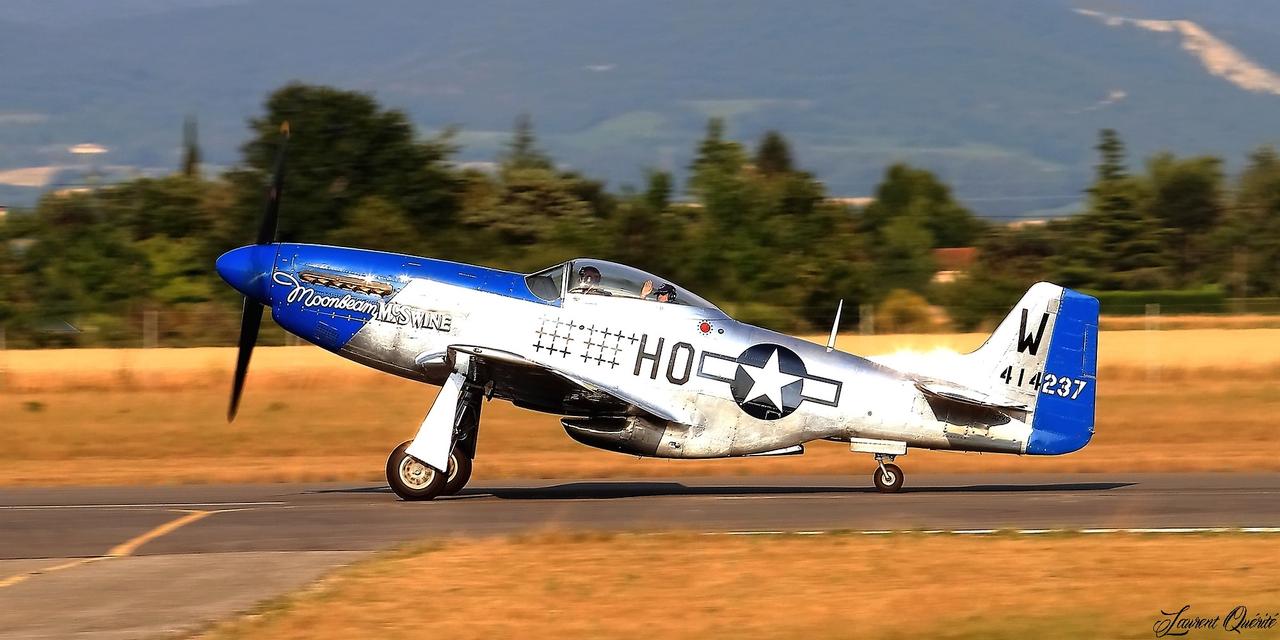
North American P-51 Mustang (Laurent Quérité)
The P-51 was produced in various variants following the performance improvements brought by the Merlin engine:
P-51 Mustang Low Flybys (AirshowStuffVideos)
The Mustang’s origins stem from an urgent requirement by the British Purchasing Commission in 1940 for a new fighter aircraft. Britain requested that North American Aviation produce the Curtiss P-40 Warhawk under license. North American Aviation, however, argued that the P-40 represented outdated technology and proposed an entirely new design using the same Allison V-1710 engine but with far superior aerodynamics. Upon British approval, the prototype designated NA-73X was completed in approximately 102 days after the contract was signed and made its first flight on 26 October 1940.
The initial production models (Mustang Mk I, P-51A, and A-36 Apache) were powered by the 1,200 hp Allison V-1710 engine. These models performed well at low altitudes thanks to their “laminar flow” wing design and a fuselage structure that generated thrust from the radiator cooling system (Meredith Effect). They could match the speed and maneuverability of aircraft like the Spitfire below 15,000 feet (approximately 4,500 meters). However, the single-stage supercharger of the Allison engine caused a significant loss of power at high altitudes. Due to this technical limitation, early Mustangs were primarily used for tactical reconnaissance and dive bombing/ground attack roles, as in the case of the A-36 variant, rather than high-altitude interception.

Allison V-1710 (Aerofosille2012)
The technical transformation that changed the aircraft’s strategic destiny occurred in 1942 following a proposal by British test pilot Ronald Harker. Harker recognized the aerodynamic potential of the Allison-powered Mustang and reported that its high-altitude performance could be dramatically improved by replacing the engine with the Rolls-Royce Merlin 61 used in the Spitfire Mk IX. Trials conducted in Britain on five test aircraft (Mustang X) demonstrated excellent results with the integration of the two-stage, two-speed supercharged Merlin engine. The aircraft’s service ceiling rose to 42,000 feet (approximately 12,800 meters), and its maximum speed exceeded 430 mph (approximately 692 km/h). Following this success, production of the engine under license in the United States began at Packard, where it was designated the V-1650.【3】
The P-51B (California-built) and P-51C (Texas-built) models, equipped with this engine, entered service over Europe in late 1943 as the first variants capable of high-altitude performance and long-range escort.

Rolls Royce Merlin Engine Mk 61 (Michael Gaylard)
Until 1943, Allied bombers (B-17 and B-24) suffered heavy losses during daylight raids deep into Germany. Fighter aircraft such as the P-47 Thunderbolt and Spitfire lacked the range to escort bombers all the way to their targets. Merlin-powered P-51s equipped with external fuel tanks could fly from England to Berlin and return, achieving an internal range of approximately 1,000 miles and an extended range of 1,650 miles with external tanks.
The arrival of the P-51s led to a sharp decline in bomber losses. In early 1944, General Jimmy Doolittle changed the tactics of Mustang pilots, ordering them not only to closely protect the bombers but also to actively hunt down German fighter aircraft (Luftwaffe). By the end of the war, P-51s had shot down 5,000 enemy aircraft in the air, achieving a higher kill score than any other Allied fighter in the European theater.【4】
In the Pacific, P-51s escorted B-29 bombing raids against the Japanese home islands, taking off from bases on Iwo Jima. After World War II, in 1947, with the establishment of the United States Air Force, the aircraft was redesignated as the F-51 (Fighter).
During the Korean War, which began in 1950, F-51D Mustangs were recalled to active duty due to the limited range and runway requirements of early jet aircraft. In Korea, they were primarily employed in ground attack and close air support (CAS) roles, valued for their long endurance and payload capacity rather than air superiority missions. The P-51 was fully retired from U.S. military inventory in 1957.

Major Raymond H. Littge of Altenburg, Missouri, broke his own record by destroying nine ground targets in two days (National Archives Catalog)
Over 15,000 P-51 Mustangs were produced during World War II. Although production ceased after the war, the aircraft continued to serve in military operations. In 1947, with the reorganization of the United States Air Force (USAF), the aircraft’s designation changed from “P” (Pursuit) to “F” (Fighter), becoming the F-51.
When Korean War began in 1950, despite the advent of the jet age, F-51D Mustangs were once again called into active service. Early jet fighters of the period suffered from limited range and endurance, making them inadequate for certain missions. In contrast, Mustangs possessed the long range and durability to fly from bases in Japan to targets in Korea and return. Due to these capabilities, F-51s were heavily used until the end of the conflict in 1953, primarily for close air support (CAS) and interdiction missions.
The Mustang was not confined to U.S. inventory after the war; it was also operated by numerous foreign air forces, including the Royal Canadian Air Force (RCAF). The U.S. Air National Guard (ANG) retained the aircraft until 1957, and the last military Mustang squadrons worldwide remained in service until 1984. Additionally, the U.S. Army used some Mustangs as chase aircraft in test programs until 1968.
Today, the P-51 Mustang is regarded as one of the most sought-after “Warbirds” in aviation history. Used in air races and airshows in civilian aviation, it is also a key exhibit in museums worldwide. Approximately 164 P-51 Mustangs remain airworthy today.

North American P-51 Mustang (Laurent Quérité)
163d Attack Wing - Air National Guard. "NORTH AMERICAN P-51 MUSTANG." 163d Attack Wing. Accessed December 25, 2025. https://www.163atkw.ang.af.mil/
AOPA. "North American Aviation P-51D Mustang." AOPA. Accessed December 25, 2025. https://www.aopa.org/
Aerofossile. “North American Aviation P-51D Mustang.” Flickr. Accessed December 25, 2025. https://www.flickr.com/photos/aerofossile2012/24604308624/in/photolist-DucvKE-LKJbkr-LKJ8vP-LKJciZ-LKJcBK-2nFebod-nCNjr-hixk6-2k4amKn-nCNo5-2mrexbn-2mrewae-2mr5MAK-2mr5Myk-2mraUKA-2mraVF3-2mr5DkX-2mrewUk-2mr5M5e-2mr9LbM-2mrdtYm-2mraPb4-2mr5LKG-2mr5Map-2mraVem-2mresSY-2mrdthM-2mrexxz-2mrduLd-2mraV6v-2mraVRd-2mraWcZ-2mrevHs-2mrdtR2-2mr9MdB-2mrex4Z-2mrewQT-2mraPu5-2mraVn7-2mrdsrU-2mraUyt-2k49Ewv-2iCe9YX-CE4TBH-2qGwN2Y-kB8BUx-2oMtkmc-2ew2iCY-2eACz7Z-bpRQYx
AirCorps Aviation. "P-51 Mustang - Blueprints, Drawings & Documents." *AirCorps Library*. Accessed December 25, 2025. https://www.aircorpsaviation.com/
AirshowStuffVideos. "P-51 Mustang Low Flybys! Gathering of Warbirds 2017." YouTube. Accessed December 25, 2025. https://www.youtube.com/watch?v=3Okx0T5vpFc
American Airpower Museum. "North American P-51D “Mustang”." American Airpower Museum. Accessed December 25, 2025. https://americanairpowermuseum.com/
Curious Droid. "Focke-Wulf FW-190 vs P-51 Mustang – Which was better?" Curious Droid. Accessed December 25, 2025. http://www.curious-droid.com
Defense Media Network. "P-51 Mustang’s Switch to Merlin Engine Made it the World-beater of World War II." *Defense Media Network.* Accessed December 25, 2025. https://defensemedianetwork.com/
Gaylard, Michael. “North American P-51D Mustang.” Flickr. Accessed December 25, 2025. https://www.flickr.com/photos/mgaylard/49604876172/in/photolist-2izpXtJ-9NGYu8-9NH11D-7ZkWpL-7YH176-7ZhJWD-7YGZAn-7ZhK5P-7ZkW4C-daAzat-7ZkWaL-7Zmb25-7ZkVdd-7YLfCL-7YGZNc-7Zgxzb-7YHViU-7YLg43-7ZhKfM-7YH1mV-7ZkWW9-7ZkWMd-7ZhJ4B-7ZkVy5-7ZgwF1-7Zdmpr-7ZdmbF-8QVVe7-8QSPQK-8QVUWC-2pcbAo9-Qe51fC-d6VhWm
Military Aviation Museum. "North American P-51D Mustang." Military Aviation Museum. Accessed December 25, 2025. https://militaryaviationmuseum.org/
National Archives and Records Administration. "North American P-51D Mustang." *National Archives Catalog.* Accessed December 25, 2025. https://catalog.archives.gov/id/204878226
Quérité, Laurent. “North American P-51D Mustang.” Flickr. Accessed December 25, 2025. https://www.flickr.com/photos/laurent_spotter/49773912126/in/photolist-2iQmiYJ-feqoT1-amgeXt-2mGDCXU-7jiL4s-4KReBE-2id313x-2kDzkgt-nhWW9v-suZsz4-e91DVs-FFCajA-DWdEGB-2mFXXBU-bSMHnK-2kmhton-2o45y71-2hLcKTQ-2oqNnAn-2mGEBcD-2kTAeeB-q8hUXP-6uRGoR-2pXA41i-2pMFySS-8AnMLB-2nADxvC-6FkVKZ-2ng7eyr-kUHMkN-2pfti5Z-sMgsUL-2iyKKXx-feqnMm-ZvDxTB-2iCH1eh-2jy12BL-s5piej-6zknPC-26LALX1-qtEwd3-2o6sKWz-2kVp7Dd-2iCKFa7-2oQrsGd-7Xhw5m-93yBmj-nCj1Mi-SZCjLG-7ukhUN
Simple Flying. "P-51 Mustang: The Fighter That Changed WWII." Simple Flying. Accessed December 25, 2025. https://simpleflying.com/
The Flying Bulls. "North American P-51D Mustang." The Flying Bulls. Accessed December 25, 2025. https://www.flyingbulls.at/
The National WWII Museum. "The North American P-51 Mustang: A “Little Friend” with a Big Impact." The National WWII Museum. Accessed December 25, 2025. https://www.nationalww2museum.org/war/articles/north-american-p-51-mustang
[1]
163d Attack Wing - Air National Guard. "NORTH AMERICAN P-51 MUSTANG." 163d Attack Wing. Erişim tarihi: 25 Aralık 2025. https://www.163atkw.ang.af.mil/
[2]
The National WWII Museum. "The North American P-51 Mustang: A “Little Friend” with a Big Impact." The National WWII Museum. Erişim tarihi: 25 Aralık 2025. https://www.nationalww2museum.org/war/articles/north-american-p-51-mustang
[3]
The National WWII Museum. "North American P-51 Mustang." The National WWII Museum. Erişim tarihi: 25 Aralık 2025. https://www.nationalww2museum.org/war/articles/north-american-p-51-mustang
[4]
The National WWII Museum. "North American P-51 Mustang." The National WWII Museum. Erişim tarihi: 25 Aralık 2025. https://www.nationalww2museum.org/war/articles/north-american-p-51-mustang

No Discussion Added Yet
Start discussion for "North American P-51 Mustang" article
Technical Specifications and Variants
Development History and the Allison Engine Era
Merlin Engine and the P-51B/C Models
Operational History
European Theater and Bomber Escort
Pacific Theater and Postwar Service
Postwar Use and Legacy
Korean War
International Use and Retirement