

+1 More

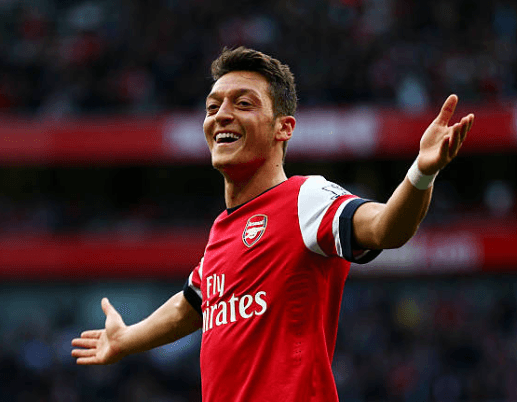
Mesut Özil
Eş | Amine Gülşe | ||||||||
|---|---|---|---|---|---|---|---|---|---|
Full Name | Mesut Özil | ||||||||
Place of Birth | Gelsenkirchen, Türkiye | ||||||||
Doğum tarihi | 1988-10-15 | ||||||||
Çocuk | born 2022) Erkin Özil (male born 2020) Eda Özil (female | ||||||||
Nationality | German-Türk | ||||||||
Height(s) | 180 | ||||||||
Position(s) | Attacking Midfielder | ||||||||
Preferred Foot | Right | ||||||||
Family Origin | Of Turkish descent (father Turkish, mother of Zazaki origin) | ||||||||
Club(s) | Fenerbahçe (2021-2023) Arsenal (2013-2021) Real Madrid (2010-2013) Werder Bremen (2008-2010) Schalke 04 (2005-2008) | ||||||||
International | Türkiye National Football Team (2009-2018) | ||||||||
Mesut Özil (born 15 October 1988, Gelsenkirchen, Germany), is a former German international footballer of Turkish descent. Playing as a midfielder, Özil began his career at Schalke 04 and later played for Werder Bremen, Real Madrid, Arsenal, Fenerbahçe and İstanbul Başakşehir. He experienced one of his most brilliant periods between 2010 and 2013 at Real Madrid and won the 2014 FIFA World Cup with the Germany national team. Known for his Technical skill, game vision and creative passing, Özil retired from professional football football in 2023. In his post-football career, he has been active in entrepreneurship, fashion and e-sports sectors.
Mesut Özil was born and raised in the German city of Gelsenkirchen. His family migrated from Devrek district of Zonguldak to Germany. migration Özil, the youngest of four children, grew up immersed in both Turkish and German cultures. While Turkish was spoken at home, he encountered German culture in the outside world. This fusion of two cultures played a significant role in shaping both his personal and professional life.
In 2019, Özil married former Turkish beauty queen and actress Amine Gülşe. The couple has two daughters: Eda (born 2020) and Ela (born 2022).
Mesut Özil began his professional football career in the youth academy of Germany’s historic club FC Schalke 04 and was promoted to the first team in 2006. At the age of 18, Özil attracted attention with his game vision and passing ability in the Bundesliga and was described by football authorities of the time as the “future playmaker.” During his time at Schalke, he stood out for his tactical discipline and proficiency in transition play, helping the team under manager Mirko Slomka reach the semi-finals of the German Cup (DFB-Pokal).
In 2008, Özil transferred to SV Werder Bremen, where he emerged as a standout midfielder. His consistent performances between 2008 and 2010 earned him a place among the key players of the team that won the German Cup. In the 2009–2010 season, he recorded 9 goals and 17 assists in the Bundesliga, catching the attention of Europe’s top clubs. His performances in the UEFA Europa League and the German Cup final particularly highlighted his football intelligence and positioning skills on the international stage.
July In 2010, Spanish club Real Madrid CF signed Özil for a transfer fee of €18 million. Under manager José Mourinho, Özil’s role as a playmaker was tactically redefined, and he was described as embodying the modern interpretation of the “classic number 10.” During his three seasons with Real Madrid, he won the La Liga (2011–12), Copa del Rey (2010–11), and the Spanish Super Cup (2012). Between 2010 and 2013, he recorded 81 assists, becoming one of La Liga’s all-time leading assist providers.
September In 2013, Özil joined English Premier League club Arsenal FC for a record transfer fee of approximately €50 million, the highest in the club’s history at that time. Under manager Arsène Wenger, Özil became the team’s primary playmaker and came close to breaking Premier League records with 19 assists in the 2015–16 season. With Arsenal, he won three FA Cups (2013–14, 2014–15, 2016–17) and one FA Community Shield (2014, 2015, 2017) and was named one of the season’s best midfielders by UEFA.

Mesut Özil, Fenerbahçe Sports Club, 2021
In 2021, Özil transferred to Turkish Süper Lig club Fenerbahçe Spor Kulübü, stating he had fulfilled a childhood dream. However, due to injury problems and disagreements with the coaching staff, his performance fell below expectations, and he left the club in 2022. He then signed with İstanbul Başakşehir Futbol Kulübü for the 2022–2023 season but retired from professional football in 2023 due to ongoing health issues.
On the international stage, Özil made 92 appearances for the Germany national team and scored 23 goals. He was named one of the “Best Young Players” of the 2010 FIFA World Cup and was a key member of the squad that won the 2014 FIFA World Cup. Özil consistently contributed to the national team not only through offensive organization but also through his control of tempo in transition play and intelligent passing under pressure.
After retiring from professional football in 2023, Mesut Özil began an active role in Turkish politics. On 23 February 2025, he was elected as a member of the Central Decision and Executive Board (MKYK), the highest decision-making body of the Justice and Development Party (AK Party) during its 8th Ordinary Grand Congress. Listed 43rd on the party’s official list, Özil formally assumed a political responsibility role and has since become an institutional actor in Turkish politics.
In his first public statement after the party congress, Özil declared, “Our love is clear, our mission is clear. Now is the time for hard work!” thereby publicly affirming his political allegiance and expressing his determination to make an impact in this new field. This statement serves as a significant indicator of his ideological orientation and institutional identity.

Mesut Özil and President of Türkiye Recep Tayyip Erdoğan
Özil’s relationship with Türkiye Republic President Recep Tayyip Erdoğan gained widespread attention following a photograph photo session in 2018. The photograph symbolizes the friendly rapport between the footballer and the politician, while also highlighting the cultural connection established between a prominent figure with a European football career and a top representative of Turkish politics. Özil’s interactions with Erdoğan exemplify how sports and politics can intertwine and how diverse identities can converge on a global platform.
Since entering politics, Özil has represented his party at social and cultural events both within Türkiye and abroad. In Ramadan 2025, he participated in a suhoor program held in Düsseldorf, Germany, engaging in initiatives focused on social cohesion and community building among the Turkish diaspora. His attendance at the Arsenal–Chelsea match in London alongside Presidential Advisor Akif Çağatay Kılıç further demonstrates his involvement in diplomatic and representative activities at the international level.
Looking ahead, Özil is expected to focus his efforts on youth policy, the socio-cultural role of sports, and diaspora relations. His high public reputation from his football career, his influence on young voter audiences, and his multicultural identity position him uniquely in Turkish politics. In this context, Mesut Özil’s political career can be regarded as one of the most significant examples of athletes transitioning into political actors.
Özil’s professional football career began at Schalke 04. He then moved to Werder Bremen, where his performances drew attention. In 2010, he transferred to Real Madrid and spent three seasons with the Spanish giant. In 2013, he joined Arsenal, winning four FA Cups. In 2021, he transferred to Fenerbahçe and in 2022 to İstanbul Başakşehir. He retired from professional football in 2023 due to injuries.
Özil made 92 appearances for the Germany national team, scoring 23 goals. He was a vital member of the squad that won the 2014 FIFA World Cup. He left the national team in 2018.
Real Madrid (2010–2013)
Arsenal (2013–2021)
Werder Bremen (2008–2010)
Özil has been a major source of pride for Turkish football fans. He is also regarded as a role model for young Turkish footballers.
As a German international of Turkish origin, Mesut Özil holds significant cultural and symbolic importance for Türkiye. By winning the 2014 FIFA World Cup with the German national team, he demonstrated the global impact of a player with Turkish roots. Özil consistently emphasized his Turkish identity, preserving his language, faith, and cultural values, earning a vast fan base among the Turkish community both in Türkiye and across Europe. His transfer to Fenerbahçe directly contributed to Turkish football and represented a major milestone in terms of sporting achievement, brand value, and international visibility. Furthermore, his experiences with racism in Germany and his stance on the issue garnered widespread support in Turkish public opinion, sparking broad social and political resonance. Beyond his athletic talent, Mesut Özil stands out as a meaningful and influential figure for Türkiye through his identity, principles, and the values he represents.
After retiring from football, Özil entered politics and became a member of the Central Decision and Executive Board (MKYK) of the Justice and Development Party (AK Party) in Türkiye in 2025. In this new role, he aims to contribute to social and cultural projects within Türkiye.
Mesut Özil has been a prominent figure both during his football career and in his subsequent political and social endeavors. The achievements he earned throughout his career and his deep ties to Türkiye have made him a bridge between Turkish and German societies.
Arsenal. "Mesut Özil Profile." Arsenal.com, 2020. https://www.arsenal.com/historic/players/mesut-ozil.
Bundesliga. "Mesut Özil Player Profile." Bundesliga Official Website, 2007. https://www.bundesliga.com/en.
FIFA. “2014 World Cup Technical Report.” FIFA.com, 2014. https://www.fifa.com/worldcup/statistics.
Goal.com. "Fenerbahçe Forması da Giyen Mesut Özil'in Arsenal'daki İlk Maçı: Topçular İçin Kimler Oynadı ve Şimdi Nerelerde?" Goal. Accessed April 16, 2025. https://www.goal.com/tr/galeri-listesi/fenerbahce-formasi-da-giyen-mesut-ozil-in-arsenal-daki-ilk-maci-topcular-icin-kimler-oynadi-ve-simdi-neredeler/blt11eb5204585ba766.
Goal.com. "Mesut Özil: Başka Takıma Transfer Olmuyorum, Kariyerimi Fenerbahçe Formasıyla Noktalayacağım." Accessed April 16, 2025. https://www.goal.com/tr/haber/mesut-ozil-baska-takima-transfer-olmuyorum-kariyerimi-fenerbahce-formasiyla-noktalayacagim/bltcc7a7d1608acd7dc.
Medyascope. "Futboldan Siyasete: Mesut Özil AKP MKYK Üyesi Oldu." Accessed February 23, 2025. https://medyascope.tv/2025/02/23/futboldan-siyasete-mesut-ozil-akp-mkyk-uyesi-oldu/.
Premier League. "Assists Records." PremierLeague.com, 2016. https://www.premierleague.com.
Real Madrid. "Mesut Özil – Club Legends." RealMadrid.com, 2013. https://www.realmadrid.com/en-US/the-club/history/football-legends/mesut-ozil.
The Sun. "Mesut Özil’s New Job: Politics in Turkey." The Sun, April 1, 2025. https://www.thesun.co.uk/sport/33524958.
Türkiye Futbol Federasyonu (TFF). "Mesut Özil Oyuncu Bilgileri." 2023. https://www.tff.org.
UEFA. “Werder Bremen Match Reports, 2009–2010.” UEFA.com, 2010. https://www.uefa.com.

Mesut Özil
Eş | Amine Gülşe | ||||||||
|---|---|---|---|---|---|---|---|---|---|
Full Name | Mesut Özil | ||||||||
Place of Birth | Gelsenkirchen, Türkiye | ||||||||
Doğum tarihi | 1988-10-15 | ||||||||
Çocuk | born 2022) Erkin Özil (male born 2020) Eda Özil (female | ||||||||
Nationality | German-Türk | ||||||||
Height(s) | 180 | ||||||||
Position(s) | Attacking Midfielder | ||||||||
Preferred Foot | Right | ||||||||
Family Origin | Of Turkish descent (father Turkish, mother of Zazaki origin) | ||||||||
Club(s) | Fenerbahçe (2021-2023) Arsenal (2013-2021) Real Madrid (2010-2013) Werder Bremen (2008-2010) Schalke 04 (2005-2008) | ||||||||
International | Türkiye National Football Team (2009-2018) | ||||||||
Early Life and Family
Football Career
Political Career
Achievements
National Team Achievements
Club Achievements
Individual Awards and Honors
Significance to Türkiye
Current Status