



Meteoroids
Rocks Circling in Space 💫
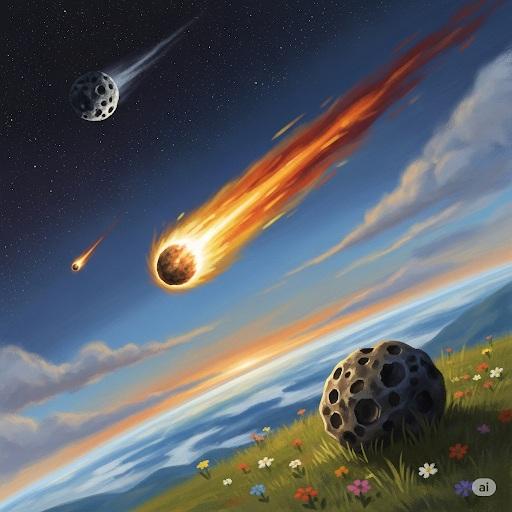
When you look up at the sky, you sometimes see quick streaks of light racing across it. These are small celestial bodies known as meteors. However, while they are traveling through space, they are called meteoroids. Meteoroids are rocks or metal fragments larger than a grain of sand that orbit the Sun. Just like Earth, they remain in orbit due to the Sun’s gravitational pull.

(Generated by artificial intelligence.)
How Are Meteoroids Formed? ☄️
Meteoroids are usually fragments broken off from larger celestial bodies. For example, when asteroids orbiting the Sun collide or when a comet approaches the Sun, the dust and rock debris they leave behind form meteoroids. These small fragments travel silently through the vacuum of space.

(Generated by artificial intelligence.)
What Is the Difference Between a Meteor, Meteorite, and Meteoroid? 🌠
These three terms can be confusing, but there is a simple distinction between them:
- Meteoroid: A rock fragment traveling through space before entering Earth’s atmosphere.
- Meteor: When a meteoroid enters Earth’s atmosphere, friction causes it to heat up and glow, leaving a bright trail of light in the sky. This luminous trail is called a meteor. This phenomenon is also known as a “shooting star.”
- Meteorite: If a meteor survives its passage through the atmosphere and reaches Earth’s surface, the remaining fragment is called a meteorite.
Time Travel: The Meteorite That Wiped Out the Dinosaurs 🦖
About 66 million years ago, a large meteorite struck Earth. Scientists believe this impact caused the extinction of many life forms, including the dinosaurs. This event is a significant example of how celestial bodies can influence life on Earth.

(Generated by artificial intelligence.)