

This article was automatically translated from the original Turkish version.
+1 More
Architect(s) | Jürgen Mayer H. | ||||||||
|---|---|---|---|---|---|---|---|---|---|
Building Type | Multifunctional Urban Structure Public Space | ||||||||
Cultural Significance | Structure Establishing a Relationship Between Urban Memory and Contemporary Architecture | ||||||||
Location | Plaza de la Encarnación Sevilla Spain | ||||||||
Primary Functions | Viewing and Circulation Spaces Archaeological Area Market Area Public Square | ||||||||
Urban Context | Historic City Center | ||||||||
Construction Year | 2011 | ||||||||
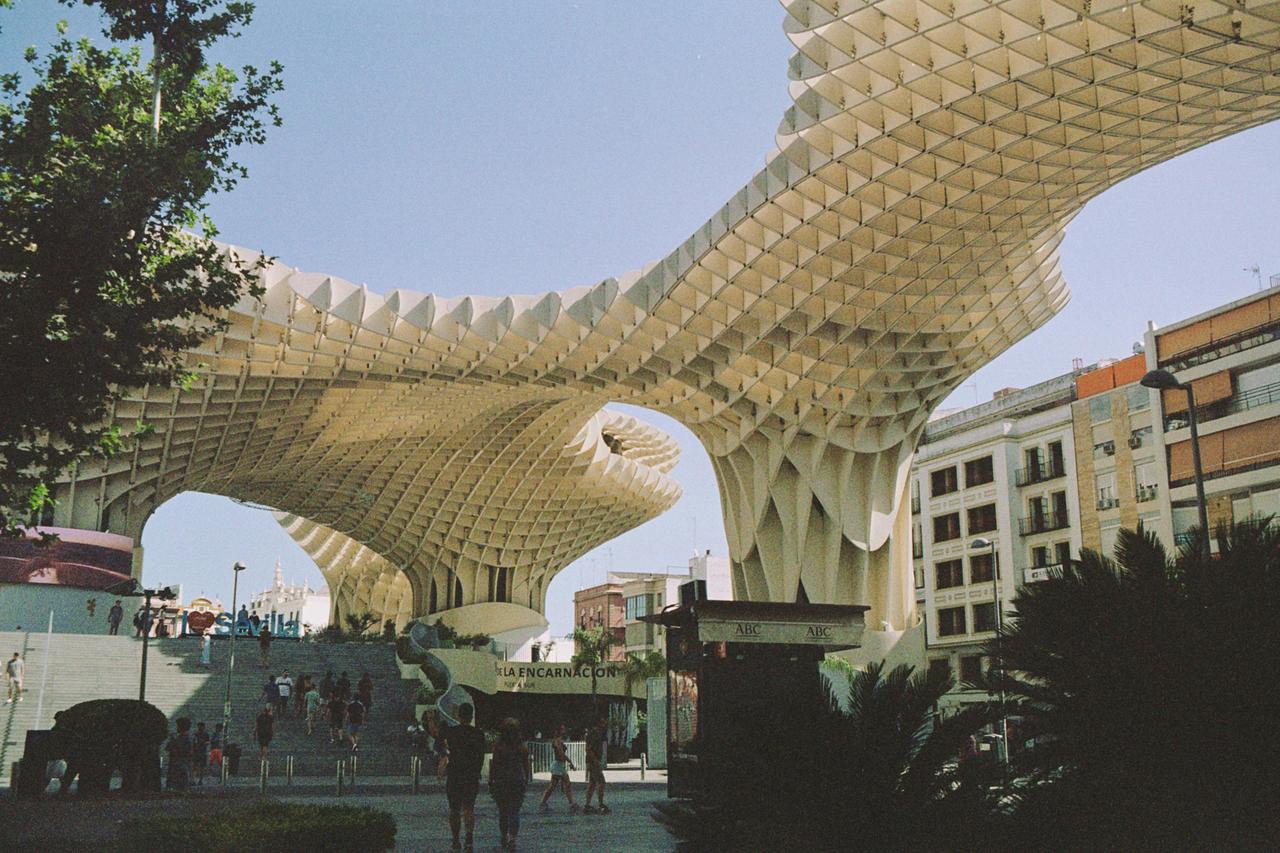
Metropol Parasol is a large-scale modern wooden structure located above Plaza de la Encarnación in the city of Seville, Spain. Designed by German architect Jürgen Mayer H., the structure creates a contemporary contrast with the city’s historic fabric through its distinctive form, functioning both as an architectural landmark and a public space. Its design is characterized by a broad body and modular wooden panels, and its relationship with the lower levels integrates the structure seamlessly with the surrounding square and urban uses.
The construction of Metropol Parasol began as part of a broader initiative to reevaluate the historic Plaza de la Encarnación area. Until 1973, the site housed a market; afterward, it remained vacant for decades in the heart of the city. In the early 2000s, the Seville City Council and the Andalusian government organized an international design competition to revitalize the space, selecting the project by German architect Jürgen Mayer H. named Metropol Parasol. Construction commenced in 2005 and was completed in 2011 after encountering various engineering challenges and public debates.

Metropol Parasol (Pexels)
During the implementation of the project, archaeological and historical remains were uncovered during excavations on the site, necessitating additional measures and adjustments to the construction process. Metropol Parasol became the subject of both technical and social debates during construction, with some critics arguing that it would overshadow the city’s traditional silhouette and historical values. However, upon completion, it established itself as a public structure that embodies urban modernization through its architectural scale and functional diversity.
Metropol Parasol is an architectural structure that engages with the historic fabric of Seville through a contemporary design approach. Its organic, undulating form is achieved by assembling modular wooden panels. The structure offers a spatial arrangement that responds to the scale of the square and establishes a dynamic relationship with its surroundings. While the lower levels are open for public use, the upper structure creates a distinctive profile within the city skyline. This integration enables the building to be perceived as a communal urban element.
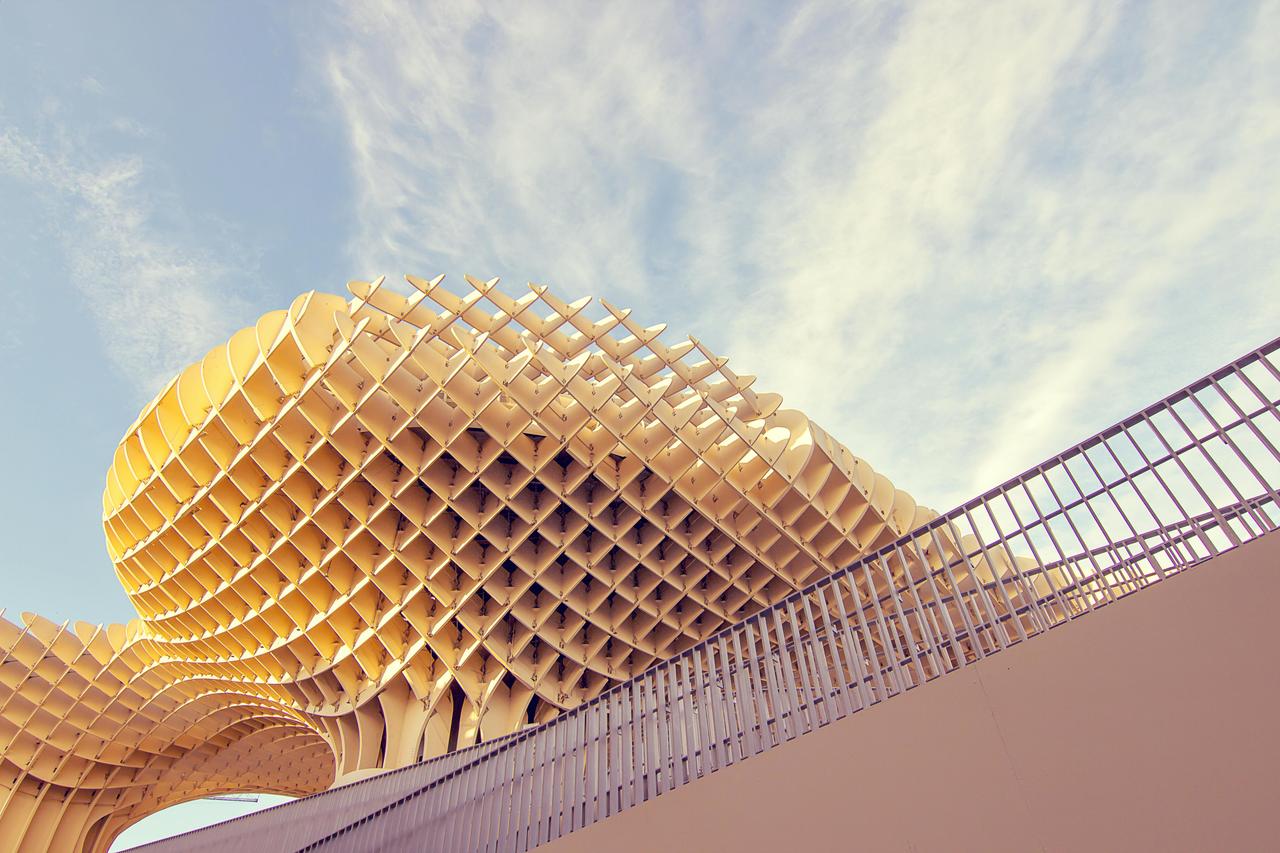
The structural system of Metropol Parasol is composed of large-scale modular wooden panels assembled into a lattice-like framework. This system, designed to support the building’s wavy form, allows for wide spans. The wooden elements are reinforced with specialized connection nodes and steel supports, ensuring the structure’s durability and stability through this combination.
Material selection was guided by both aesthetic and functional considerations. The primary material, wood, exhibits a distinct character compared to the surrounding historic fabric through its natural texture and tonal qualities, while also belonging to the category of sustainable building materials. Steel connections and supports enhance the load-bearing capacity of the wood and contribute to the structure’s longevity. This material and system combination defines both the visual identity and structural logic of Metropol Parasol.
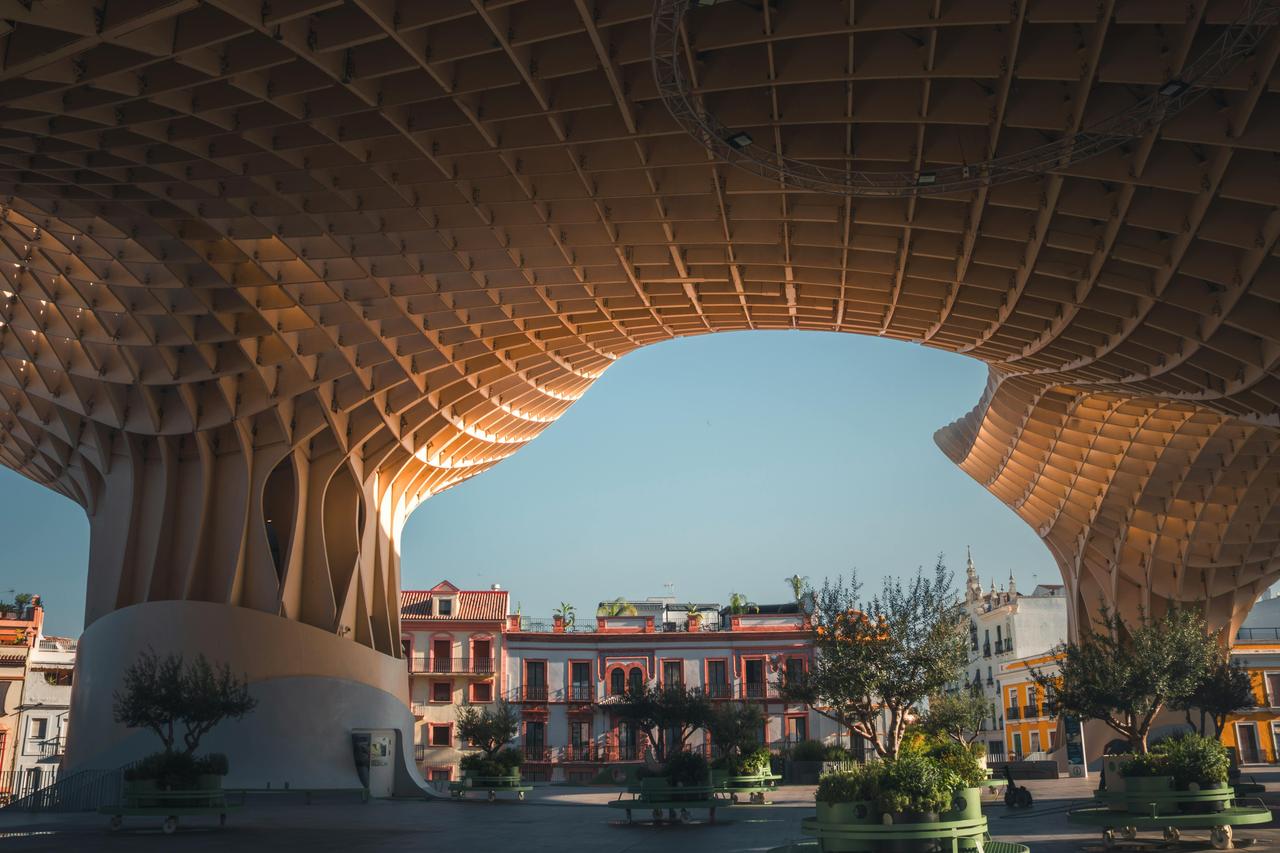
Metropol Parasol is a large-scale structure situated in Seville’s Plaza de la Encarnación, featuring an organic, mushroom-like form. Its horizontal dimensions measure approximately 150 meters in length and 75 meters in width, with a maximum height of 28 meters.【1】 The upper level features panoramic walkways and observation areas that redefine the scale of the square and significantly influence the urban skyline. The wooden panels, arranged on an orthogonal grid system, measure 1.5 by 1.5 meters, with thicknesses varying from 70 mm to 280 mm according to structural load requirements.【2】
Metropol Parasol (Pexels)
The building’s volumetric organization includes four levels and one basement. The basement houses an archaeological museum, while the ground floor contains traditional market and commercial spaces. The second level is an elevated platform designed for events and cultural performances, incorporating bars and commercial areas. The third level, described as the “sky square,” encompasses restaurants and cafés, and the top level offers a panoramic viewing experience via 250 meters of walkways. The structure’s six primary load-bearing structures support both its visual impact and the stability of its form, with the modular arrangement of wooden panels and steel reinforcements harmonizing aesthetics and functionality across the entire organic structure.
Metropol Parasol is designed as a structure that continuously and multilayeredly supports public life through its open and semi-open spaces at varying levels. The ground-level units preserve the square’s traditional public character with accessible market stalls, transit routes, and gathering areas. As one ascends, cultural, social, and recreational uses become more prominent. Elevated platforms are organized as spaces for events and gatherings, while restaurants and relaxation areas are positioned on upper levels. The circulation routes at higher levels redefine the concept of public space by extending it beyond the horizontal plane and creating a new urban experience connected to the cityscape. This multifunctional arrangement enables Metropol Parasol to be understood as a structure accommodating diverse communal uses.
Metropol Parasol is an intervention situated within the historical and urban context of Plaza de la Encarnación, forming a spatial relationship with the square. It functions as an overhead canopy system positioned in relation to the square and accommodating collective uses at different levels. Openings and permeable arrangements at ground level allow the continuation of public activities on the square, while the upper structure serves as a shading element. The organization linking archaeological layers, the market area, and open public space enables the simultaneous perception of the site’s historical and functional strata. In this context, Metropol Parasol acts as a connecting element that unites diverse communal uses of the square across multiple levels.
Metropol Parasol (Pexels)
The lower levels of the structure contain a spatial arrangement that integrates diverse public and commercial functions. The lowest level, housing the archaeological section, makes the historical continuity of the square visible and integrates with pedestrian circulation. Above it, the enclosed market area continues traditional commercial functions within a contemporary spatial framework and maintains direct connections with surrounding street patterns. Commercial units and service areas are organized as complementary elements supporting the market structure. This variety of uses at the lower levels enables the building to host multiple open public and commercial functions at ground level.
Metropol Parasol is a structure located in the historic center of Seville that reflects contemporary architectural approaches. It is designed to accommodate traditional market functions across multiple levels. This contemporary architectural intervention within the historic fabric allows the building to engage with the existing urban layers. As a result, it has been recognized as an architectural element embedded within its urban context. The social, artistic, and everyday uses occurring within the square demonstrate that Metropol Parasol embodies the characteristics of a structure aligned with contemporary urban practices.
Ayuntamiento de Sevilla. "Plaza de la Encarnación." Sevilla.org. Accessed February 5, 2026. https://www.sevilla.org/servicios/medio-ambiente-parques-jardines/parques/plazas-ajardinadas-o-arboladas/plaza-de-la-encarnacion
Azaklı, Ahmet. "Fotoğraf." Pexels. Accessed February 5, 2026. https://www.pexels.com/tr-tr/fotograf/34973546/
Condruz, Marian Florinel. "Sevilla'daki Metropol Şemsiye Yapısı." Pexels. Accessed February 5, 2026. https://www.pexels.com/tr-tr/fotograf/sevilla-daki-metropol-semsiye-yapisi-30741286/
Donati, Cristina. "Mayer H. Architekten: Metropol Parasol, Siviglia." *modulo*, no. 373 (2011): 2–12. Accessed February 5, 2026. https://www.academia.edu/43710923/MAYER_H_ARCHITEKTEN_METROPOL_PARASOL_SIVIGLIA?sm=b&rhid=37687212077
Garcia Prats, Antonio. "Fotoğraf." Pexels. Accessed February 5, 2026. https://www.pexels.com/tr-tr/fotograf/merdivenler-kent-sehir-kent-simgesi-18836166/
Giovannardi, Fausto, and Adriana Guisasola. "El metropol Parasol en Sevilla." Academia.edu (2014): 1–4. Accessed February 5, 2026. https://www.academia.edu/10266026/El_metropol_Parasol_en_Sevilla?sm=b&rhid=37687212077
Gonzalez, Javier. "Kahverengi Metal Yapı." Pexels. Accessed February 5, 2026. https://www.pexels.com/tr-tr/fotograf/kahverengi-metal-yapi-1143416/
González de León, María. "Identität durch Architektur: Berliner Schloss und Sevillas Metropol Parasol." Academia.edu (2017): 1–3. Accessed February 5, 2026. https://www.academia.edu/34336860/Identit%C3%A4t_durch_Architektur_Berliner_Schloss_und_Sevillas_Metropol_Parasol?sm=b&rhid=37687212077
Holcim Foundation for Sustainable Construction. "Metropol Parasol in Spain." Holcim Foundation. Accessed February 5, 2026. https://www.holcimfoundation.org/projects/metropol-parasol-spain
J. Mayer H. and Partner, Andre Santer. "Metropol Parasol." *J. Mayer H.* (2004–2011). Accessed February 5, 2026. https://jmayerh.de/metropol-parasol/
Jacqu, Hub. "Sevilla'daki Çağdaş Metropol Şemsiye Yapısı." Pexels. Accessed February 5, 2026. https://www.pexels.com/tr-tr/fotograf/sevilla-daki-cagdas-metropol-semsiye-yapisi-28987886/
Teixeira, Jose. "Fotoğraf." Pexels. Accessed February 5, 2026. https://www.pexels.com/tr-tr/fotograf/ahsap-tahta-isik-parlak-18909977/
[1]
Cristina Donati, "Metropol Parasol, Siviglia," Modulo, sy. 373 (Ekim 2011): 8, Son Erişim: 5 Şubat 2026, https://www.academia.edu/43710923/MAYER_H_ARCHITEKTEN_METROPOL_PARASOL_SIVIGLIA?sm=b&rhid=37687212077
[2]
Cristina Donati, "Metropol Parasol, Siviglia," Modulo, sy. 373 (Ekim 2011): 8, Son Erişim: 5 Şubat 2026, https://www.academia.edu/43710923/MAYER_H_ARCHITEKTEN_METROPOL_PARASOL_SIVIGLIA?sm=b&rhid=37687212077


Architect(s) | Jürgen Mayer H. | ||||||||
|---|---|---|---|---|---|---|---|---|---|
Building Type | Multifunctional Urban Structure Public Space | ||||||||
Cultural Significance | Structure Establishing a Relationship Between Urban Memory and Contemporary Architecture | ||||||||
Location | Plaza de la Encarnación Sevilla Spain | ||||||||
Primary Functions | Viewing and Circulation Spaces Archaeological Area Market Area Public Square | ||||||||
Urban Context | Historic City Center | ||||||||
Construction Year | 2011 | ||||||||
History
Architectural Features
Structural System and Material
Dimensions and Form
Public Space and Functions
Relationship with Plaza de la Encarnación
Lower Level Uses
Cultural Significance