


This article was automatically translated from the original Turkish version.
Micrometers are measuring and control instruments based on the screw-nut mechanism, used in operations requiring high precision. These devices can measure with much tighter small tolerances than calipers. In the metric system, measurement precision ranges from 0.01 mm to 0.001 mm, while in the imperial system it can reach levels of 0.001 inch to 0.0001 inch. Micrometers typically have specific measurement ranges and are classified by lengths such as 0–25 mm, 25–50 mm, 50–75 mm like fixed. This design was developed to minimize errors caused by external factors such as thermal expansion and yawn during measurement.
Micrometers contain various mechanical components to enable precise measurements. These components are described below:
Frame: The primary structural element of the micrometer. It is typically U-shaped and coated with insulating material to minimize the effect of body heat during measurement.
Anvil: A fixed reference point made of hardened and polished metal.
Spindle: The component that moves forward and backward movement when the thimble is rotated and comes into contact with the workpiece to complete the measurement.
Sleeve (Fixed Thimble): The part marked with metric or imperial graduations, serving as the primary scale for measurement.
Thimble (Moving Thimble): A rotating component with a vernier scale that provides measurement precision. One full rotation of the thimble moves the spindle 0.5 mm.
Ratchet Mechanism: Prevents inaccurate measurements by applying a consistent pressure during measurement. It applies approximately 250 grams of force.
Locking Lever: Secures the spindle in place and prevents movement during measurement to enhance accuracy.
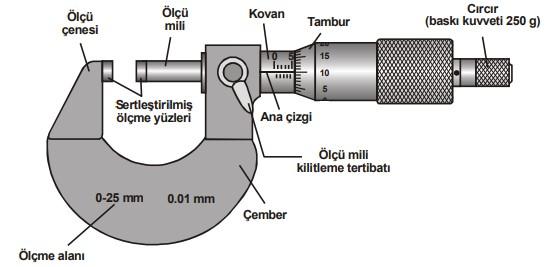
Micrometer and Its Components (Credit: Machine Technology, MEB, 2014.)
Micrometers use a screw mechanism to achieve precise measurements. Rotating the thimble moves the spindle closer to or farther from the workpiece. With each full rotation of the thimble, the spindle advances by 0.5 mm. Tambur, divided into 50 equal parts, provides a measurement precision of 0.01 mm per division. In vernier micrometers, this precision can be increased to 0.001 mm.
Micrometers are categorized according to the type of measurement and the system used scale.
Standard scale micrometers
Counter-indicator micrometers
Pointer micrometers
Vernier micrometers (0.001 mm precision)
Digital (electronic) micrometers
External micrometer: Used for measuring outer diameters and thicknesses.
Internal micrometer: Designed for measuring hole diameters.
Depth micrometer: Measures Canal and hole depths.
Module micrometer: Used to determine the thickness of gear teeth tooth.
Thread micrometer: Designed for precise measurement of thread root diameters.
Slot micrometer: Used for measuring slot width and depth.
Digital micrometers: Electronic system devices that display measurement results on a digital screen.
To obtain accurate measurements with a micrometer, the following steps must be followed:
Zeroing the micrometer: Before measurement, the anvil and spindle must be fully closed and the zero line checked for alignment.
Placing the workpiece: The object to be measured is placed between the anvil and spindle.
Precise adjustment: The thimble is rotated to bring the spindle into contact with the workpiece. A consistent pressure is applied using the ratchet mechanism upon contact.
Reading the measurement: First, read the whole millimeter value where the thimble edge crosses the sleeve scale. Then add the 0.01 mm values indicated by the thimble scale.
If a vernier scale is present, this value must also be included to determine the total measurement.
For example:
Whole measurement: 3 mm
Decimal measurement: 0.5 mm
Hundredth measurement: 0.06 mm
Total measurement: 3.56 mm
Regular maintenance and calibration are required for micrometers to function accurately.
Micrometers should be stored in a clean and dry environment.
Measurement faces must be kept away from abrasive materials.
They should be lubricated periodically with fine oil.
The measuring faces must not be allowed to impact hard surfaces.
Zero check: When the anvil and spindle are closed, the zero lines must align.
Parallelism test: The parallelism of the measuring surfaces must be verified using master gauges.
Accuracy test: Precision must be verified using standard calibration gauges.
Ankara Üniversitesi, *Malzeme Bilgisi: 11. Hafta*, Ankara University Publications, Accessed March 2025. [PDF].
Düzce Üniversitesi. *Mikrometreler ve Ölçme Teknikleri*. Düzce University Publications, Accessed March 2025. [PDF].
Türkiye Cumhuriyeti Millî Eğitim Bakanlığı. *Temel Tornalama İşlemleri 1*. Ankara: Millî Eğitim Bakanlığı, 2014. Accessed March 2025. [Accessed Adresi].

Structure and Working Principle of Micrometers
Main Components of a Micrometer
Working Principle
Types of Micrometers
Micrometers by Measurement Scale
Micrometers by Measurement Location
Performing and Reading Measurements with a Micrometer
Maintenance and Calibration of Micrometers
Maintenance
Calibration