This article was automatically translated from the original Turkish version.
Architect(s) | Mimar Sinan | ||||||||
|---|---|---|---|---|---|---|---|---|---|
Construction Date(s) | 1548 | ||||||||
Current Location | Üsküdar / İstanbul | ||||||||
Builder | Mihrimah Sultan | ||||||||
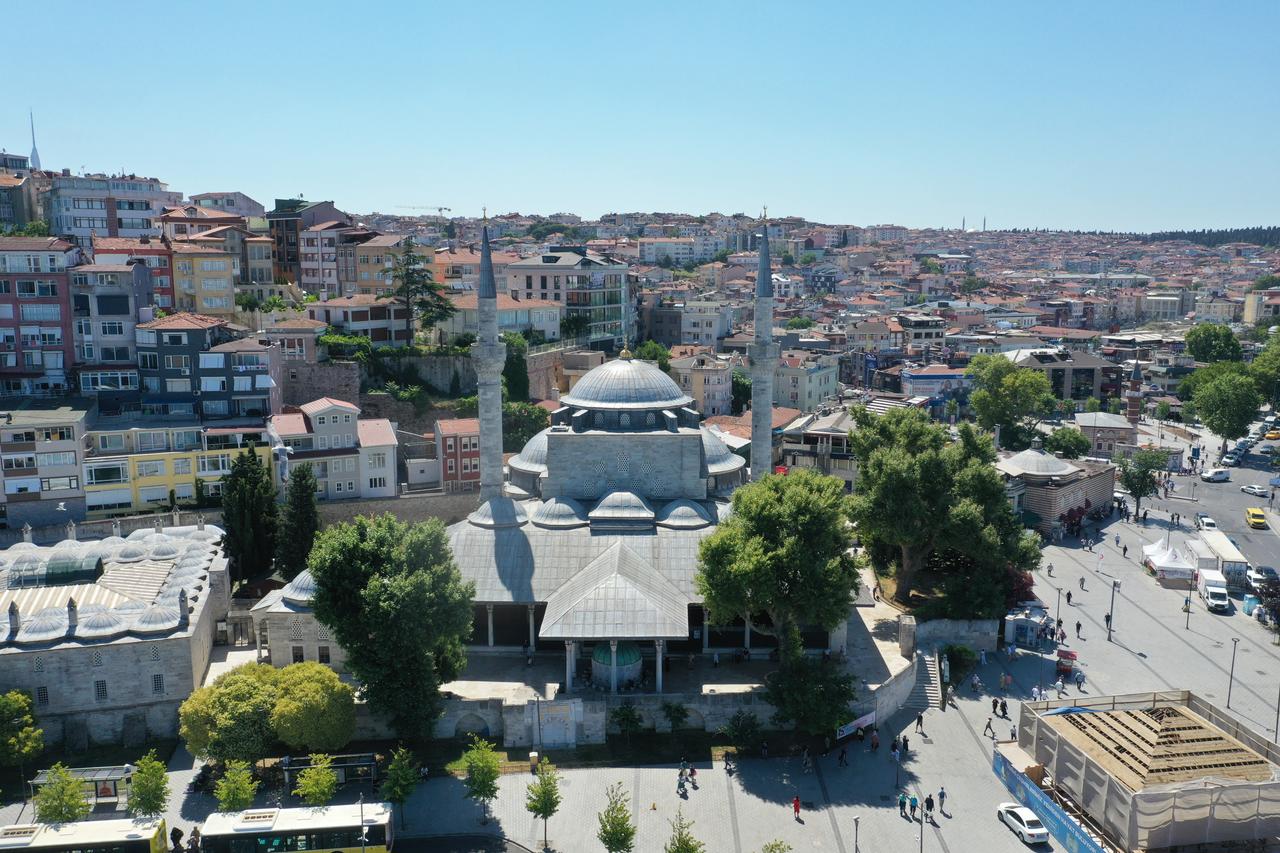
Mihrimah Sultan Camii, located on the pier square in the Üsküdar district of Istanbul, is an Ottoman-era mosque commissioned in the name of Mihrimah Sultan and designed by Mimar Sinan. The structure is characterized by a plan and dome system reflecting the features of classical Ottoman mosque architecture and is considered among Sinan’s early works.【1】

Interior of Mihrimah Sultan Camii (Üsküdar Bld.)
The Mihrimah Sultan Camii was commissioned in the name of Mihrimah Sultan, daughter of Ottoman Sultan Kanuni Sultan Süleyman. Mihrimah Sultan herself was the patron of the structure, and its construction was entrusted to Mimar Sinan, the chief architect of the Ottoman Empire during the 16th century.【2】
The mosque is dated to the early phase of Sinan’s architectural career, a period during which the formal elements of classical Ottoman mosque architecture were systematically developed. The building’s plan features a central dome supported by half-domes on three sides, an approach characteristic of Sinan’s early designs.【3】
The construction process took into account the mosque’s location on the Üsküdar pier square. The mosque is situated at a point connected to maritime transport and is carefully aligned with the topographical and urban characteristics of its surroundings. This positioning reflects its design as a public and functional center within the Ottoman urban planning framework.【4】
Mihrimah Sultan Camii is a rectangular structure. Its main dome, with a diameter of ten meters, is supported by half-domes on three sides, while no half-dome is present on the front facade. The mosque has two single-balconied minarets. Its muqarnas mihrab and marble minbar reflect elements of classical Ottoman architecture.【5】
The mosque’s high-ceilinged interior space follows the architectural principles of the classical period. A colonnaded gallery surrounds the rear prayer area. On the side facing the sea stands a twenty-sided marble şadırvan. The courtyard is narrower at the front compared to other historical mosques, but extends more widely to the right and along the qibla wall.【6】
Mihrimah Sultan Camii is not merely a place of worship but the central structure of a külliye comprising various social and functional units. Sources indicate that the complex originally included a medrese, sıbyan mektebi, han, türbe, and fountains.【7】
Over time, some structures belonging to the külliye have been lost. The imaret-tabhâne, han, kasır, and muvakkithane no longer survive; the hamam and han were demolished in 1936 and replaced by new constructions.
While some elements of the külliye still exist today, others have undergone functional changes or have been entirely removed. This reflects the transformations the complex has undergone throughout its historical development.【8】

View of Mihrimah Sultan Camii from the Üsküdar shoreline (Üsküdar Bld.)
Since its construction, Mihrimah Sultan Camii has undergone various physical and functional changes. Some structures附属 the külliye, including the imaret-tabhâne, han, kasır, and muvakkithane, were lost over time; the hamam and han were demolished in 1936 and replaced by new buildings.【9】
Certain elements of the structure have been repaired in different periods, and specific sections of the külliye have been repurposed. This process demonstrates the efforts made to preserve the building’s historical continuity while adapting it to changing needs.
Additionally, it is noted that in 1831, a tuğra belonging to Sultan Mahmud II was placed on the mirror stone of a fountain within the mosque complex.【10】
The location and naming of Mihrimah Sultan Camii are interpreted symbolically in sources. It is noted that from the mosque’s site and certain elevated vantage points, the sunrise between the minarets can be observed, particularly during the months of April and May.【11】
Similarly, it is reported that on certain days, the moonrise can also be observed between the minarets. This phenomenon is linked to the name “Mihr ü Mah,” meaning “Sun and Moon,” and is interpreted as establishing a symbolic connection between the structure and its name.【12】
Accessed January 20, 2026.
Accessed January 20, 2026.
Accessed January 20, 2026.
Dijital İstanbul. "Mihrimah Sultan Mosque (İskele Mosque)."
Kültür Envanteri. "Mihrimah Sultan Camii."
Üsküdar Belediyesi. "Mihrimah Sultan Camii (İskele Camii)."
[1]
Kültür Envanteri. “Mihrimah Sultan Camii.” Erişim 20 Ocak 2026.https://kulturenvanteri.com/yer/mihrimah-sultan-camii-turbesi/?detay=8321
[2]
Üsküdar Belediyesi. “Mihrimah Sultan Camii.” Erişim 20 Ocak 2026.https://www.uskudar.bel.tr/tr/main/pages/mihrimah-sultan-camii/39
[3]
Üsküdar Belediyesi. “Mihrimah Sultan Camii.” Erişim 20 Ocak 2026.https://www.uskudar.bel.tr/tr/main/pages/mihrimah-sultan-camii/39
[4]
Üsküdar Belediyesi. “Mihrimah Sultan Camii.” Erişim 20 Ocak 2026.https://www.uskudar.bel.tr/tr/main/pages/mihrimah-sultan-camii/39
[5]
Üsküdar Belediyesi. “Mihrimah Sultan Camii.” Erişim 20 Ocak 2026.https://www.uskudar.bel.tr/tr/main/pages/mihrimah-sultan-camii/39
[6]
Dijital İstanbul. “Mihrimah Sultan İskele Camii.” Erişim 20 Ocak 2026. https://dijitalistanbul.org/mihrimah-sultan-iskele-camii/
[7]
Üsküdar Belediyesi. “Mihrimah Sultan Camii.” Erişim 20 Ocak 2026. https://www.uskudar.bel.tr/tr/main/pages/mihrimah-sultan-camii/39
[8]
Dijital İstanbul. “Mihrimah Sultan İskele Camii.” Erişim20 Ocak 2026. https://dijitalistanbul.org/mihrimah-sultan-iskele-camii/
[9]
Dijital İstanbul. “Mihrimah Sultan İskele Camii.” Erişim 20 Ocak 2026. https://dijitalistanbul.org/mihrimah-sultan-iskele-camii/
[10]
Dijital İstanbul. “Mihrimah Sultan İskele Camii.” Erişim 20 Ocak 2026. https://dijitalistanbul.org/mihrimah-sultan-iskele-camii/
[11]
Üsküdar Belediyesi. “Mihrimah Sultan Camii.” Erişim 20 Ocak 2026.https://www.uskudar.bel.tr/tr/main/pages/mihrimah-sultan-camii/39
[12]
Üsküdar Belediyesi. “Mihrimah Sultan Camii.” Erişim 20 Ocak 2026.https://www.uskudar.bel.tr/tr/main/pages/mihrimah-sultan-camii/39

Architect(s) | Mimar Sinan | ||||||||
|---|---|---|---|---|---|---|---|---|---|
Construction Date(s) | 1548 | ||||||||
Current Location | Üsküdar / İstanbul | ||||||||
Builder | Mihrimah Sultan | ||||||||
No Discussion Added Yet
Start discussion for "Mihrimah Sultan Camii" article
Construction Process and Patron
Architectural Features
Külliye Complex
Changes Over Time
Symbolic Features