

This article was automatically translated from the original Turkish version.
Type of Geographical İndication | Mahreç Sign | ||||||||
|---|---|---|---|---|---|---|---|---|---|
Registration Number | 1633 | ||||||||
Registration Date | 23.08.2024 | ||||||||
Product / Product Group(s) | Processed and unprocessed meat products | ||||||||
Province(s) | Muğla | ||||||||
Applicant/Registrant(s) | Muğla Chamber of Commerce and Industry | ||||||||
Milas Köftesi is a traditional meat product unique to the Milas district of Muğla Province, officially registered with a geographical indication. Registered on 23 August 2024 by the Milas Chamber of Commerce and Industry under Law No. 6769 on Industrial Property, it has been protected since 12 August 2022. The product falls under the category of “köfte / processed and unprocessed meat products” and is a local culinary element intrinsically linked to the Milas district.
Milas Köftesi is prepared using lean minced meat obtained from the brisket or rib cuts of young male cattle, with no added animal fat or tail fat. The meat’s fat content ranges between 3–4.5%, and only stale bread crumb and salt are added. No spices, onions, or parsley are incorporated into the meat mixture; these ingredients are served only as accompaniments during serving. The quantity of stale bread crumb added is minimal: only 220 grams (one slice) of stale bread is used per 10 kilograms of minced meat. This simple ingredient profile and low-fat content determine the cooked köfte’s deep red color and distinctive texture.
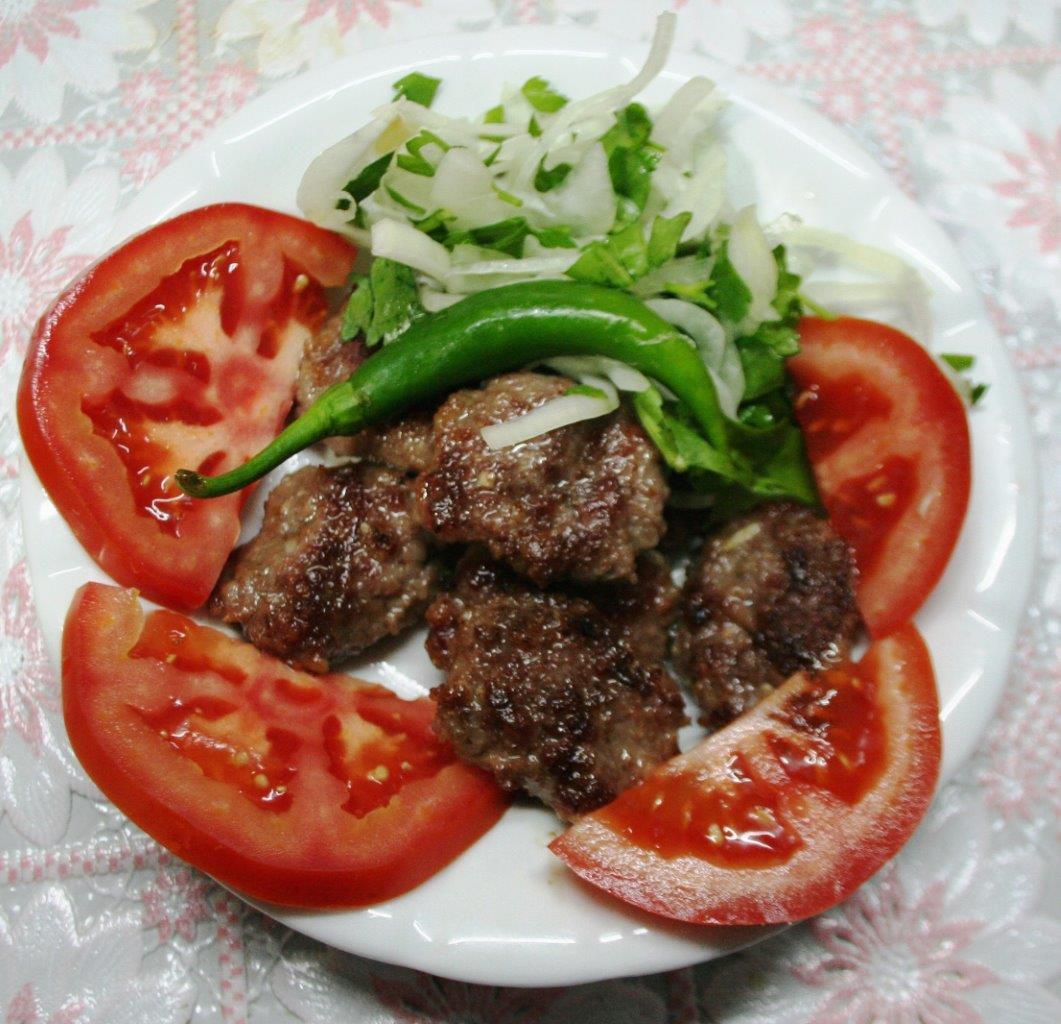
Traditionally, Milas Köftesi is grilled over lightly charred wood charcoal or olive pit charcoal. During cooking, a slice of pide bread is placed lengthwise over the top, allowing the aroma and rendered fat of the köfte to infuse into the bread. Serving is accompanied by dried onion sprinkled with sumac, charred green peppers, tomato slices, and parsley.
In the production of Milas Köftesi, meat from male cattle aged 1–2 years, raised in open pastures within the defined geographical area and fed on hay from fig, alfalfa, corn, wheat, barley, oats, rye, and triticale, is preferred. Meat from animals fed on sugar beet pulp is not used.
For köfte preparation, the meat is minced twice using a machine. The stale bread crumb is soaked, squeezed to remove excess water, and mixed with the minced meat. The mixture is kneaded for at least 10 minutes. The kneaded mixture is then rested for one hour in a cool place. Subsequently, the mixture is shaped by hand into köftes measuring 1 cm in thickness and 4–5 cm in diameter, ideally cooked immediately. Cooking temperature ranges between 150–180 °C, and the köftes are grilled and turned on a charcoal grill.
Milas Köftesi can be served fresh or sold in packaged form. Packaging must include information on the producer, packaging date, and best-before date. Cooked köftes can be stored in a refrigerator for up to 48 hours. Uncooked köftes can be preserved for 24 hours at +4 °C under modified atmosphere packaging, or for 30 days at -16 °C.
Milas Köftesi holds a deeply rooted place in the culinary culture of the Milas district. Its sale in small shops within the historic Arasta bazaar continues as an integral part of the local gastronomic tradition. This historical and cultural connection reinforces the product’s association with its geographical origin.
The production of Milas Köftesi and compliance with its registered conditions are monitored by a four-member oversight body coordinated by the Milas Chamber of Commerce and Industry. This body includes representatives from the Milas District Directorate of Agriculture and Forestry, the Culinary Program of Milas Vocational School at Muğla Sıtkı Koçman University, and the Milas Association of Food Producers and Sellers. Inspections are conducted at least once annually, and additionally in response to complaints or specific needs.
Turk Patent and Trademark Office. "Milas Köftesi Geographical Indication Registration Certificate." Accessed October 19, 2025. https://ci.turkpatent.gov.tr/Files/GeographicalSigns/b5a3b358-4c49-45e5-b289-8ae90aed0ba8.pdf.
Turk Patent and Trademark Office. "Milas Köftesi." *Geographical Indications Portal.* Accessed October 19, 2025. https://ci.turkpatent.gov.tr/cografi-isaretler/detay/7323.

Type of Geographical İndication | Mahreç Sign | ||||||||
|---|---|---|---|---|---|---|---|---|---|
Registration Number | 1633 | ||||||||
Registration Date | 23.08.2024 | ||||||||
Product / Product Group(s) | Processed and unprocessed meat products | ||||||||
Province(s) | Muğla | ||||||||
Applicant/Registrant(s) | Muğla Chamber of Commerce and Industry | ||||||||
Product Characteristics
Preparation
Serving and Storage
Cultural Context
Monitoring