This article was automatically translated from the original Turkish version.
+2 More
Location | Kocaaliler Burdur Bucak | ||||||||
|---|---|---|---|---|---|---|---|---|---|
Period(s) | Hellenistic and Roman | ||||||||
Prominent Structures | Small theater, walls, necropolis, sacred areas | ||||||||
Cultural Connections | Phrygian cultural traces | ||||||||
The Milias (Milyos) Archaeological Site, located within the boundaries of the Kocaaliler township in the Bucak district of Burdur Province, is a significant archaeological area situated on the Taurus Mountains and inhabited during the Hellenistic and Roman periods. The settlement is distinguished by its geographical position and natural defensive features. The city, surrounded on the east, west, and south by steep and difficult-to-climb cliffs, was reinforced by walls built across the gaps between these natural barriers.
Milias is located in the interior of the Mediterranean Region, atop the high plateau areas of the Taurus Mountains. The region’s topography ensured both the defensive security of the settlement and the sustainability of economic life through agriculture and animal husbandry in the surrounding areas. The steep cliffs on the eastern, western, and southern sides provided strategic natural protection, while the northern side exhibited a more open topography.
The city, which experienced intensive settlement during the Hellenistic and Roman periods, was influenced by successive cultures over time. The original name of the settlement has not been definitively identified; the name “Milias” is a modern designation for the region and does not reflect its ancient name. Excavated finds indicate that the settlement was not merely a residential center but also a site of cultural and religious activity.
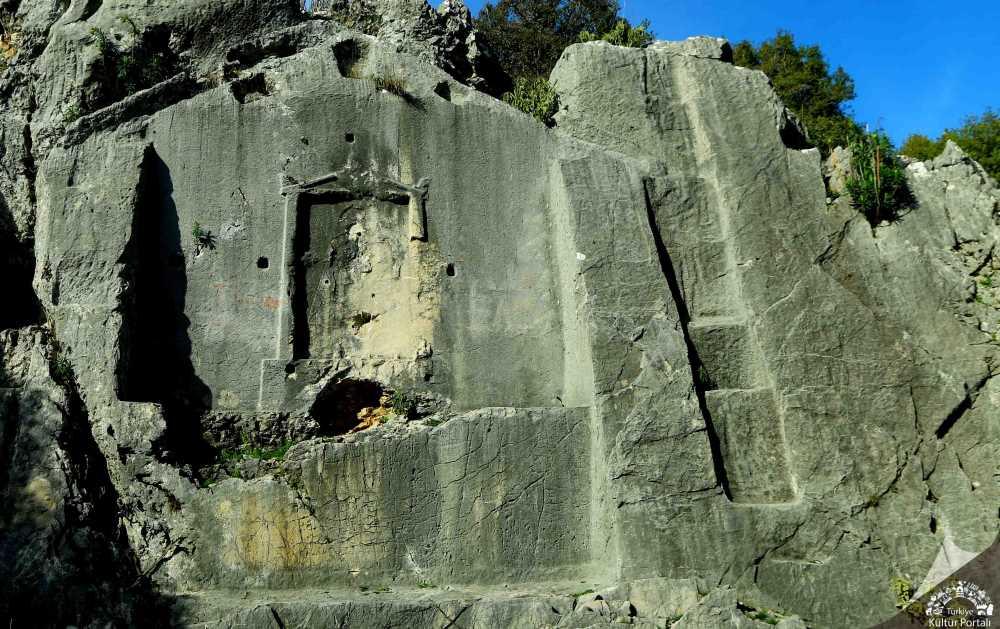
Most of the dwellings in the settlement were constructed by carving directly into the bedrock of the region. This technique provided durability and facilitated material procurement. One of the most notable structures within the city limits is a small theater built into the main rock formation. This theater played an important role in the socio-cultural life of the settlement.
The necropolis area is located outside the city walls, in the northern sector. The burial ground reflects the characteristic funerary practices and death cults of the period. Within the interior areas of the city walls, residential zones, religious structures, and public spaces are found.
Sanctuaries carved into the rocks at Milias offer important clues regarding the region’s religious structure. The arrangement and symbols of these sacred spaces exhibit characteristics associated with the Phrygian cult. Additionally, masks and sculpted heads discovered during excavations and surface surveys suggest that the city held a special status.
In addition to its natural defensive features, the city was protected by walls constructed across the gaps between the cliffs. The layout of the walls and the stonework used in their construction reflect the characteristics of Hellenistic defensive architecture.
The Milias (Milyos) Archaeological Site continues to exist today as a location known to local communities and researchers but subjected to only limited archaeological intervention. Its preservation is of vital importance for transmitting the settlement’s urban fabric, defensive systems, and religious structures to future generations.
Ministry of Culture and Tourism. "Milias Ören Yeri." Kültür Portalı. Accessed August 16, 2025. https://www.kulturportali.gov.tr/turkiye/burdur/gezilecekyer/milias
İnanır, Ali. "Kültürel Miras Turizmi Kaynakları Bakımından Bucak Milias (Milyos), Sia ve Kremna Antik Kentleri Örneği." Accessed August 16, 2025. https://www.researchgate.net/profile/Ali-Inanir/publication/338213391_KULTUREL_MIRAS_TURIZMI_KAYNAKLARI_BAKIMINDAN_BUCAK_MILIAS_MILYOS_SIA_VE_KREMNA_ANTIK_KENTLERI_ORNEGI/links/60a0d03f92851cfdf3382982/KUeLTUeREL-MIRAS-TURIZMI-KAYNAKLARI-BAKIMINDAN-BUCAK-MILIAS-MILYOS-SIA-VE-KREMNA-ANTIK-KENTLERI-OeRNEGI.pdf
Location | Kocaaliler Burdur Bucak | ||||||||
|---|---|---|---|---|---|---|---|---|---|
Period(s) | Hellenistic and Roman | ||||||||
Prominent Structures | Small theater, walls, necropolis, sacred areas | ||||||||
Cultural Connections | Phrygian cultural traces | ||||||||
No Discussion Added Yet
Start discussion for "Milias (Milyos) Ancient Site" article
Geographical Location and Environmental Characteristics
Historical Background
Architectural Structures and Urban Fabric
Defensive Systems
Current Status