This article was automatically translated from the original Turkish version.
+1 More
Banisi | Empress Irene, wife of John II Komnenos | ||||||||
|---|---|---|---|---|---|---|---|---|---|
Construction Start Date | 1122 | ||||||||
Conversion to Mosque | 1453 | ||||||||
Name Source | Molla Zeyrek Mehmed Efendi | ||||||||
Last Restoration Date | 2009-2018 | ||||||||
Location | Türkiye Istanbul Fatih | ||||||||
Molla Zeyrek Camii is located in the Zeyrek neighborhood of Istanbul’s Fatih district. Originally part of the Byzantine Pantokrator Monastery complex, its churches were converted into a madrasa after the Ottoman conquest of Istanbul and became the city’s first educational institution under Ottoman rule. During the Byzantine era, the Pantokrator Monastery was Istanbul’s second-largest Christian religious structure after Hagia Sophia. Following the conquest, at the order of Fatih Sultan Mehmed, the monastery was transformed into a madrasa, and Molla Mehmed Efendi, known by the epithet Zeyrek, was appointed as its instructor.
After the conversion of the Pantokrator Church into a mosque, both the building and the surrounding neighborhood began to be known as Zeyrek in honor of Molla Zeyrek. Today, the structure known as Molla Zeyrek Camii enriches Istanbul’s historical fabric through its layered Byzantine and Ottoman architectural, social, and cultural elements.

Molla Zeyrek Camii (Zeyrek Academy)
During the Byzantine era, it was known as the Pantokrator Monastery. The complex, attributed to the architect Nikephoros, was initiated around 1124 by Empress Irene, wife of Emperor John II Komnenos. It originally comprised a church dedicated to Christ Pantokrator (Christ the Almighty), a library, and a hospital. After Empress Irene’s death in 1134, John II commissioned a second church, dedicated to Theotokos Elaiousa (the Merciful Virgin Mary), adjacent to the north of the first church. Finally, a burial chapel dedicated to Archangel Michael was constructed between the two churches, uniting them into a single architectural ensemble. This integration created a monastic complex that combined religious worship with public and medical functions. The monastery housed a hospital, pharmacy, elderly residence, holy spring, library, and a school for medical education. It also contained a direct imperial burial ground, where numerous members of the Komnenos and Palaiologos dynasties were interred, including Emperor John II and Empress Irene (whose tomb was later moved to Hagia Sophia).
The Fourth Crusade of 1204, which resulted in the Latin conquest of Constantinople, significantly affected the Pantokrator Monastery. During Latin rule, parts of the complex were partially emptied, its regional functions diminished, and certain sections were repurposed as storage or administrative spaces. Its medical and educational services largely ceased, and the structure suffered extensive damage. After the Byzantine reconquest in 1261, monastic functions were partially restored, but some structural damage remained permanent.
The Pantokrator Monastery was the first major Byzantine structure in Istanbul to be converted from a church into a mosque. After the Ottoman conquest, at the command of Fatih Sultan Mehmed, it was transformed into a madrasa, and Molla Mehmed Efendi, known as Molla Zeyrek, was appointed as its instructor. Following its conversion into a mosque, both the building and the surrounding neighborhood came to be known as Zeyrek in his honor.
During the Ottoman period, the structure functioned over time as both a madrasa and a mosque, with certain parts of the monastery repurposed for new uses. For instance, the monks’ cells were converted into madrasa classrooms, and the former churches were adapted for use as mosques and smaller prayer halls. While the building was modified to suit its new religious function, the majority of its Byzantine structural elements were preserved.
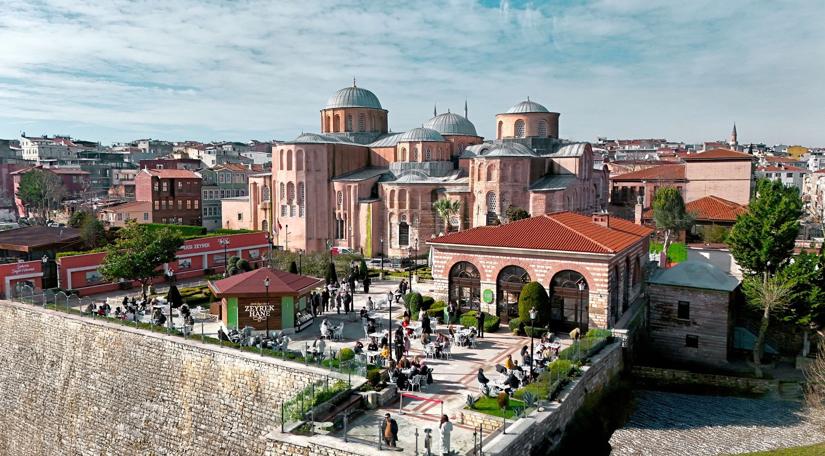
Molla Zeyrek Cami (Fatih Municipality)
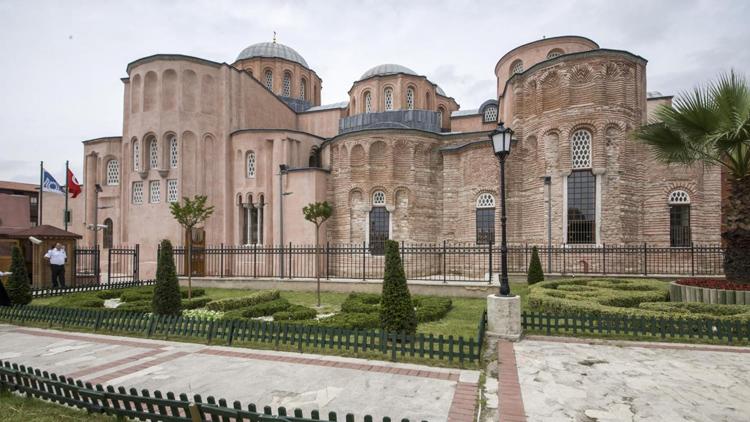
Molla Zeyrek Camii consists of the fusion of three churches: the Theotokos Church to the north, the Pantokrator Church to the south, and the central burial chapel (katholikon). All three structures were built using the characteristic Byzantine “cross-in-square” plan. The construction technique employed is “opus mixtum,” combining stone and brick in alternating layers. On the exterior façade, horizontal bands of brick are alternated with stone courses.
Inside the structure, traces of mosaic flooring executed in the opus sectile technique and fragments of frescoes remain visible. The main dome rests on four piers and is elevated by a drum. Some additions made during the Ottoman period, particularly the mihrab and minbar, were introduced to accommodate mosque functions. Repairs following the earthquake of the 18th century introduced Baroque-style ornamental woodwork and decorative elements that stand out.

Molla Zeyrek Cami (Pexels / Zeynep Şahin)
The structure underwent various repairs during both the Byzantine and Ottoman periods. It suffered its most severe damage in the 1766 earthquake and was subsequently restored during the reign of Mustafa III. Although the General Directorate of Foundations carried out some restoration efforts in 1953 and 1966, these primarily focused on the southern section, which remained open for worship, while the northern sections remained neglected for decades. In 2009, a protocol signed between the Istanbul Metropolitan Municipality and the General Directorate of Foundations initiated a nine-year restoration process. On 29 May 2019, the building was reopened to the public both as a place of worship and as a historical and cultural heritage site.
Anadolu Ajansı. “Molla Zeyrek Camisi Küllerinden Doğdu.” Accessed July 26, 2025. https://www.aa.com.tr/tr/turkiye/molla-zeyrek-camisi-kullerinden-dogdu/1491313
Fatih Municipality. “Şehrin Seyir Hanesi Zeyrekhane, Yenilenen Yüzüyle Hizmetinizde!” Accessed July 30, 2025. T.C. Fatih Belediyesi, Şehrin Seyir Hanesi Zeyrekhane, Yenilenen Yüzüyle Hizmetinizde!
Pexels. “Mihrab Niche in Zeyrek Mosque in Istanbul.” Accessed July 27, 2025. https://www.pexels.com/photo/mihrab-niche-in-zeyrek-mosque-in-istanbul-19524197/
Schweinfurth, Philipp. “İstanbul’da Komnenos’lar Devri’ne Ait Bir Mozaik.” Translated by Semavi Eyice. Belleten 17 (1953): 490–501. Accessed July 24, 2025. https://dergipark.org.tr/tr/download/article-file/3092590
T.C. Ministry of Culture and Tourism Field Directorate. "Zeyrek." Accessed July 26, 2025. http://www.alanbaskanligi.gov.tr/zeyrek.html
TRT 2 YouTube Channel. "Molla Zeyrek Camii." Accessed July 24, 2025. https://www.youtube.com/watch?v=aaBdD3fgW3s
Türkiye Diyanet Vakfı İslâm Ansiklopedisi. "Zeyrek (Kilise-Cami)." Accessed July 25, 2025. https://islamansiklopedisi.org.tr/zeyrek-kilise-camii.
Zeyrek Akademi. “Molla Zeyrek Camii.” Accessed July 24, 2025. https://zeyrekakademi.com/zeyrek/molla-zeyrek-camii.html

Banisi | Empress Irene, wife of John II Komnenos | ||||||||
|---|---|---|---|---|---|---|---|---|---|
Construction Start Date | 1122 | ||||||||
Conversion to Mosque | 1453 | ||||||||
Name Source | Molla Zeyrek Mehmed Efendi | ||||||||
Last Restoration Date | 2009-2018 | ||||||||
Location | Türkiye Istanbul Fatih | ||||||||
Historical Background
Byzantine Period
Latin Occupation Period (1204–1261)
Ottoman Period
Architectural Features
Plan and Construction Technique
Interior Space and Decorations
Restoration and Current Condition