

This article was automatically translated from the original Turkish version.
Artist | Leonardo da Vinci | ||||||||
|---|---|---|---|---|---|---|---|---|---|
Year of Production | 1503 – 1506 | ||||||||
Technique | Oil paint | ||||||||
Dimensions | 77 cm × 53 cm | ||||||||
Location | Louvre Museum, Paris, France | ||||||||
Style | Renaissance | ||||||||
Leonardo da Vinci painted the Mona Lisa (La Gioconda) between 1503 and 1507, one of the most famous works of the Renaissance period. The portrait depicts Lisa Gherardini, wife of the Florentine silk merchant Francesco del Giocondo. For this reason, the work is also known in Italian as La Gioconda and in French as La Joconde. Da Vinci created this portrait using his sfumato technique, which produces a smoky effect through soft transitions and thin layers, giving the figure a lifelike and natural appearance. The subject’s slight turn toward the viewer adds movement to the painting and distinguishes it from other portraits of its time.

Mona Lisa Painting
The painting entered the French Royal Collection in 1518, shortly before the artist’s death, after Leonardo da Vinci was invited to France by King Francis I. Following the French Revolution, when the royal collection was opened to the public, the Mona Lisa eventually found its home in the Louvre Museum, where it is displayed today.
La Gioconda is exhibited in a specially protected case in Room 711 (Salle des États) in the Denon Wing of the Louvre Museum. This room is the largest exhibition space in the Louvre and also houses important Venetian works such as Paolo Veronese’s The Wedding at Cana. Since 2005, the Mona Lisa has been displayed alone in a climate-controlled glass case. This practice serves not only security purposes but also conservation needs. The artwork was painted in oil on a panel of poplar wood rather than on canvas. Over time, warping of the panel has caused cracks on the surface, making the painting more fragile.

Mona Lisa Visitors
In a 2023 study by scientists from France and England, a tiny sample of human hair taken from the upper right corner of the painting was analyzed. X-ray analysis revealed the presence of plumbonacrite, a rare compound in the initial paint layer applied by Leonardo. This substance is a derivative of lead oxide and, when mixed into oil paint, creates a thick surface. The researcher leading the study, Victor Gonzalez, stated that this discovery confirms the hypothesis that Leonardo added lead oxide powder to his paint mixture to increase its thickness and drying speed. Gonzalez also noted that Leonardo was experimenting with different techniques while working on the Mona Lisa and enjoyed testing new methods. The later appearance of a similar compound in works by Rembrandt, who lived in the 17th century, indicates that such techniques were subsequently adopted by other painters.
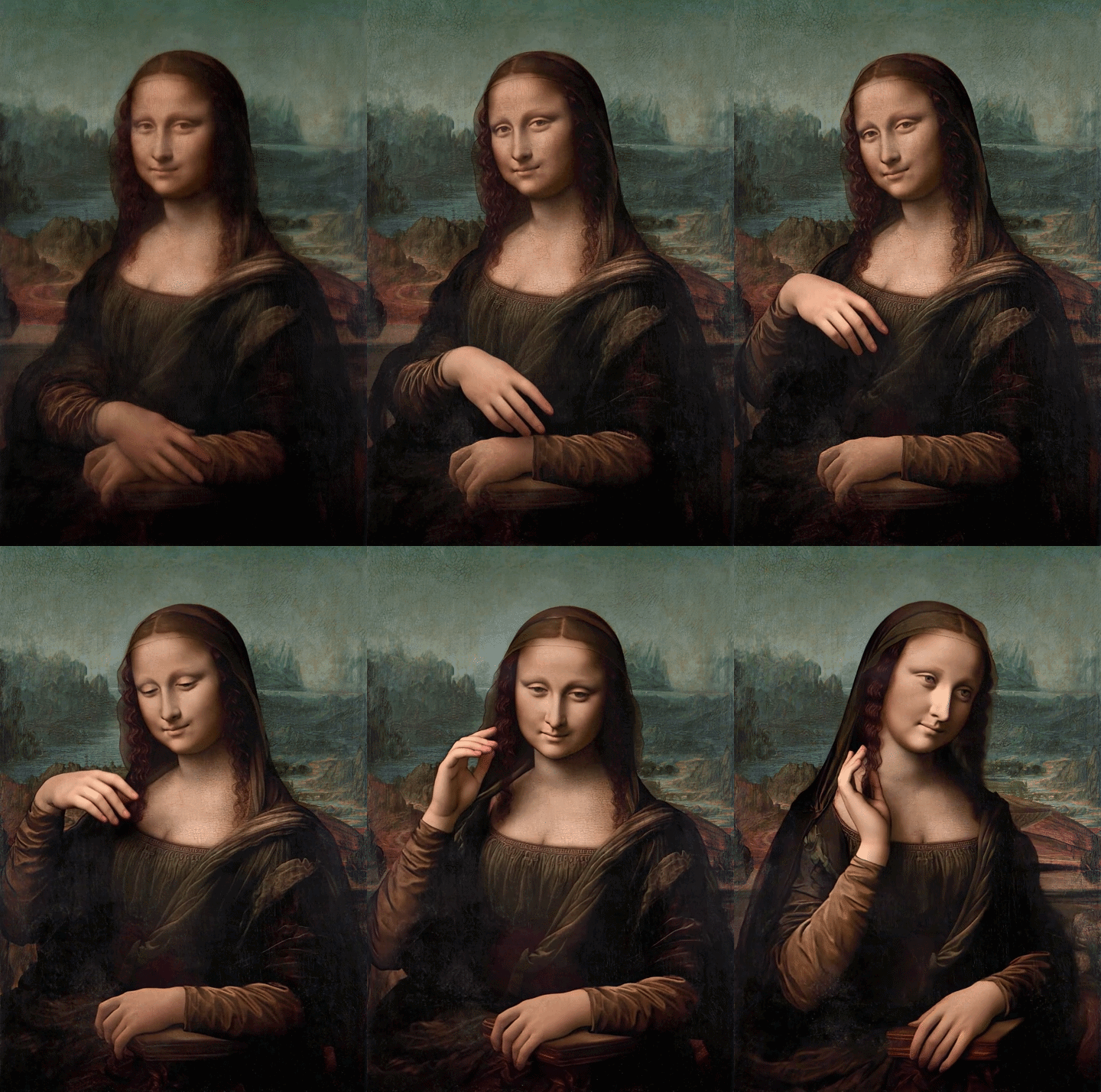
Mona Lisa was stolen from the Louvre Museum on 21 August 1911, causing a major public sensation. After remaining missing for nearly two years, the painting was recovered when Vincenzo Peruggia, a former museum employee, attempted to sell it to an art dealer in Italy. Its return further solidified the painting’s international fame.
The Salle des États, where the Mona Lisa is displayed, was designed by Hector Lefuel between 1855 and 1857 and originally served as a chamber for legislative sessions during the reign of Napoleon III. After being incorporated into the museum in 1870, the room was first dedicated to 19th-century French art and later transformed by architect Edmond Guillaume during the Third Republic. Windows were sealed to create more wall space, and the ceiling was covered with glass to reduce reflections. After World War II, masterpieces of the Venetian Renaissance began to be exhibited in this room. In 2019, the walls were repainted in a deep midnight blue, enhancing the richness of the Venetian paintings’ color palettes.
Leonardo da Vinci’s Mona Lisa has acquired a significant place within the cultural heritage not only through its artistic qualities but also through its conservation conditions, the space in which it is displayed, historical events it has experienced, and scientific findings obtained through research. The enduring interest over centuries has ensured the painting’s lasting prominence in art history and its widespread recognition.
The Theft of the Mona Lisa Reimagined by Artificial Intelligence
Anadolu Ajansı. "Leonardo da Vinci’nin Mona Lisa’yı Yaparken Kullandığı Tekniklere İlişkin Yeni Bulgular Açığa Çıktı." Accessed August 3, 2025.https://www.aa.com.tr/tr/kultur/leonardo-da-vinci-nin-mona-lisayi-yaparken-kullandigi-tekniklere-iliskin-yeni-bulgular-aciga-cikti/3016088
Depositphotos. “Mona Lisa.” Accessed August 3, 2025.https://depositphotos.com/tr/photos/mona-lisa.html?qview=663891116
Louvre Museum. "From the Mona Lisa to the Wedding Feast at Cana." *Louvre*. Accessed August 3, 2025.https://www.louvre.fr/en/explore/the-palace/from-the-mona-lisa-to-the-wedding-feast-at-cana
Pixabay. "Sanat Tablo Mona Lisa Klasik Kadın." Accessed August 3, 2025.https://pixabay.com/tr/photos/sanat-tablo-mona-lisa-klasik-kad%C4%B1n-74050/
YouTube. "Mona Lisa'nın Hırsızlık Hikayesi Yapay Zeka İle Canlanıyor!" Anadolu Ajansı. Accessed August 4, 2025.https://www.youtube.com/watch?v=LJmgh4m85wo

Artist | Leonardo da Vinci | ||||||||
|---|---|---|---|---|---|---|---|---|---|
Year of Production | 1503 – 1506 | ||||||||
Technique | Oil paint | ||||||||
Dimensions | 77 cm × 53 cm | ||||||||
Location | Louvre Museum, Paris, France | ||||||||
Style | Renaissance | ||||||||
No Discussion Added Yet
Start discussion for "Mona Lisa (Painting)" article
Display Conditions and Security Measures
Chemical Composition and New Findings
Historical Events: Theft and Recovery
Exhibition Space: Salle des États