

This article was automatically translated from the original Turkish version.
+2 More
Location | Idil district Şırnak Province Yaylabaşı Village (formerly Yarbasi) | ||||||||
|---|---|---|---|---|---|---|---|---|---|
Period(s) | Estimated to be from the 6th century dedicated to Saint Mor Dodo of the Ancient Syriac Church | ||||||||
Architectural Feature(s) | regional traditional stone architecture use of yellow limestone vaulted interior space apse on the east and entrance on the west facade east-west orientation Three-aisle basilical plan | ||||||||
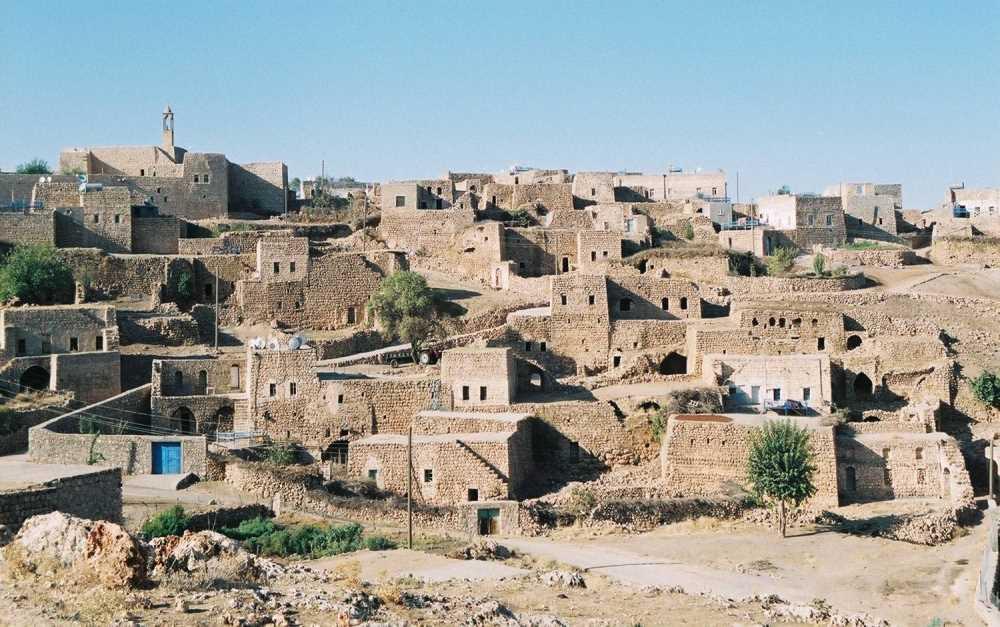
Mor Dodo Church is a registered cultural heritage site located within the boundaries of Yaylabaşı Village (formerly Yarbasi), in the İdil district of Şırnak Province, in southeastern Türkiye. This historic place of worship, associated with the ancient Syriac community, stands out as one of the distinctive examples of Christian architecture in the region.
The church is situated to the west of İdil district, within the rural fabric of Yaylabaşı Village, on a sloping terrain. The structure, built in traditional stone architecture, harmonizes with its surroundings and is located near the historical center of the village settlement.
Mor Dodo Church follows a basilical plan oriented in an east-west direction. The entrance is located on the western façade, while the apse occupies the eastern end. The façades feature no decorative elements, and simple stone masonry has been preferred throughout. The building was constructed using local limestone with yellowish tones. The interior is covered by a barrel-vault system, and original stone masonry patterns have been preserved on certain interior wall sections.
The structure is rectangular in plan and single-story. Its interior layout follows a three-nave design. The narthex provides a distinct entrance space, while the apse on the eastern façade ensures spatial balance. Window openings and arch forms are designed in accordance with traditional geometric principles. Additionally, remnants of associated ancillary structures and additions linked to the church have been observed in its surroundings.

Mor Dodo Church (Culture Portal)
The structure is built using yellow limestone, and no mortar traces have been found in the masonry. The façade surfaces are clad with precisely cut stone. The roofing system includes barrel vaults, with dome elements present in certain sections. The architectural techniques reflect practices characteristic of the building’s period.
Mor Dodo Church was registered and placed under protection by the General Directorate of Cultural Heritage and Museums in 2007. According to the 2022 updated conservation report, partial roof collapses, stone losses on the northern façade, and deterioration in the apse area have been identified. Deformations in the barrel vault and surface damage caused by moisture have also been documented. The overall integrity of the structure remains largely preserved.
The building is no longer used for worship but remains open to visitors. As a protected immovable cultural heritage site, the church continues to fulfill its role as a cultural landmark accessible to the public.
Culture Heritage Protection High Council. "Şırnak İli İdil İlçesi Yaylabaşı Köyü Mor Dodo Kilisesi Güncel Raporu (8690)." Accessed July 17, 2025. https://korumakurullari.ktb.gov.tr/Eklenti/88540,8690---sirnak-idil-yarbasi-koyu-mor-dodo-kilisesi-gunce-.pdf?0
Ministry of Culture and Tourism. "Dıl Habêrlbaşbrn Mor Dodo Klses." *Türkiye Kültür Portalı*. Accessed July 17, 2025. https://www.kulturportali.gov.tr/turkiye/sirnak/gezilecekyer/dl-haberlbasbrn-mor-dodo-klses
Ministry of Culture and Tourism. "Mor Dodo Klses." *Turkey Culture Portal Culture Inventory*. Accessed July 17, 2025. https://www.kulturportali.gov.tr/turkiye/sirnak/kulturenvanteri/mor-dodo-klses
T.C.Şırnak İl Directorate of Culture and Tourism. "Mor Dodo Kilisesi." *sirnak.ktb.gov.tr*. Accessed July 17, 2025. https://sirnak.ktb.gov.tr/TR-372628/mor-dodo-kilisesi.html

Location | Idil district Şırnak Province Yaylabaşı Village (formerly Yarbasi) | ||||||||
|---|---|---|---|---|---|---|---|---|---|
Period(s) | Estimated to be from the 6th century dedicated to Saint Mor Dodo of the Ancient Syriac Church | ||||||||
Architectural Feature(s) | regional traditional stone architecture use of yellow limestone vaulted interior space apse on the east and entrance on the west facade east-west orientation Three-aisle basilical plan | ||||||||
Location and Settlement Characteristics
Architectural Features
Material and Technical Characteristics
Conservation Status
Current Status and Accessibility