


This article was automatically translated from the original Turkish version.
+2 More
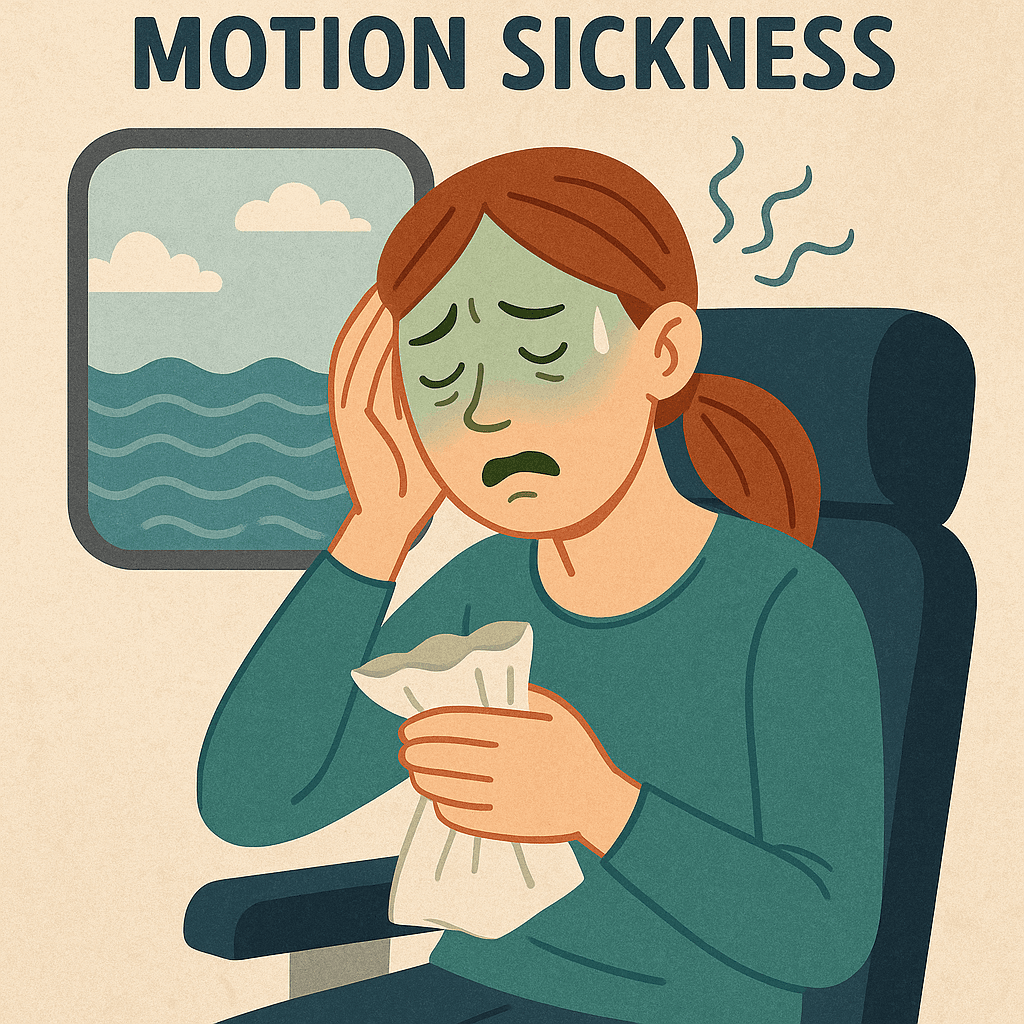
Motion Sickness
Defining | Reason & Brand (1975) | ||||||||
|---|---|---|---|---|---|---|---|---|---|
Field of First Definition | Neurophysiology, Transportation medicine | ||||||||
Affected Systems | Autonomic nervous system Visual system Vestibular system | ||||||||
Symptoms | Difficulty concentrating Pallor Fatigue and weakness Dizziness Cold sweating Nausea and vomiting | ||||||||
Prevention Methods | Sensory compensation, Pharmacological support, Environmental modification | ||||||||
Motion sickness is a neurophysiological condition characterized by physiological and psychological symptoms arising from discordance among multiple sensory systems. This condition is observed in transportation environments such as road, sea, and air travel, as well as in virtual reality systems, and is triggered by conflict between the vestibular system, proprioceptive feedback, and visual perception. Motion sickness is not only regarded as a travel-related discomfort but also recognized as an important area of study in human-computer interaction and neuropsychological research.
The primary theoretical explanation for motion sickness is the Sensory Conflict Theory. According to this theory, when sensory inputs from the visual system, vestibular system (inner ear), and musculoskeletal system are inconsistent, the brain perceives a conflict and interprets it as a toxic condition, thereby activating the vomiting reflex. This approach was systematically formalized by Reason and Brand (1975) and has since formed the basis of current clinical explanations.
During motion sickness, increased neural activity is observed particularly in the brainstem, vestibular nuclei, nucleus solitarius, and the vestibulocerebellar lobe of the cerebellum. fMRI studies have also demonstrated that emotional responses are accompanied by activation in the anterior insula and medial prefrontal cortex.
Key Neurophysiological Processes:

(Generated with the assistance of artificial intelligence).
This image symbolically represents the core sensory conflict model of motion sickness. On the left, an individual experiencing dizziness or nausea is depicted, while surrounding linear circular motion elements such as a rotating head figure, directional arrows, and wavy patterns emphasize the vestibular system’s perception of movement. In contrast, the individual’s stationary posture creates a contradiction with the visual system’s lack of motion detection. This sensory conflict—where the vestibular system signals “movement” while the visual system signals “no movement”—generates a discrepancy in the brain. The resulting imbalance, nausea, and vomiting symptoms are also reflected in the facial expression of the person in the next image.
Symptoms:
These symptoms may intensify as motion continues and typically diminish once the individual reaches a stationary position.
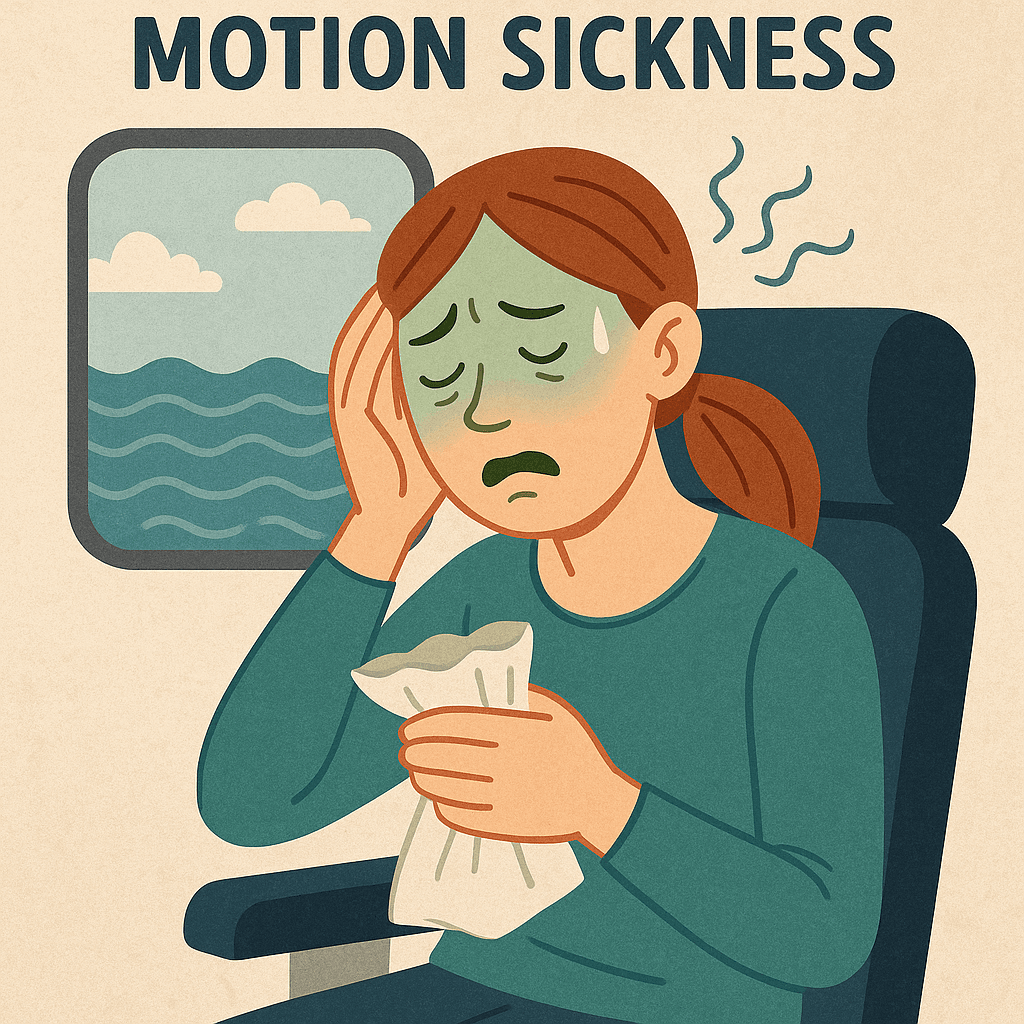
(Generated with the assistance of artificial intelligence).
With the proliferation of virtual reality technologies, cybersickness has emerged as a condition characterized by the presence of visual motion without corresponding vestibular motion. This phenomenon, increasingly common in games, simulations, and educational applications, is regarded as the digital counterpart of motion sickness.
Motion sickness can cause not only physical but also cognitive impairments. During prominent symptoms, transient disruptions in attention, memory, and decision-making processes may occur. These effects pose significant safety risks for pilots, drivers, and heavy machinery operators.
Dennison, Michael S., and Michael D’Zmura. “Cybersickness without the Wobble: Experimental Results Speak Against Postural Instability Theory.” *Applied Ergonomics* 58 (2017): 215–223. Accessed May 4, 2025. https://scholar.google.com/citations?view_op=view_citation&hl=en&user=eci4MtQAAAAJ&citation_for_view=eci4MtQAAAAJ:blknAaTinKkC.
Golding, John F. “Predicting Individual Differences in Motion Sickness Susceptibility by Questionnaire.” *Personality and Individual Differences* 41, no. 2 (2006): 237–248. Accessed May 4, 2025. https://doi.org/10.1016/j.paid.2006.01.012.
Napadow, Vitaly, J. D. Sheehan, J. Kim, et al. “The Brain Circuitry Underlying the Temporal Evolution of Nausea in Humans.” *Cerebral Cortex* 23, no. 4 (2013): 806–813. Accessed May 4, 2025. https://pubmed.ncbi.nlm.nih.gov/22473843/.
Reason, J. T., and J. J. Brand. *Motion Sickness*. London: Academic Press, 1975. https://psycnet.apa.org/record/1976-12574-000.
Riccio, Gary E., and Thomas A. Stoffregen. “An Ecological Theory of Motion Sickness and Postural Instability.” *Ecological Psychology* 3, no. 3 (1991): 195–240. Accessed May 4, 2025. https://doi.org/10.1207/s15326969eco0303_2.


Motion Sickness
Defining | Reason & Brand (1975) | ||||||||
|---|---|---|---|---|---|---|---|---|---|
Field of First Definition | Neurophysiology, Transportation medicine | ||||||||
Affected Systems | Autonomic nervous system Visual system Vestibular system | ||||||||
Symptoms | Difficulty concentrating Pallor Fatigue and weakness Dizziness Cold sweating Nausea and vomiting | ||||||||
Prevention Methods | Sensory compensation, Pharmacological support, Environmental modification | ||||||||
Theoretical Foundations and Historical Development
Alternative Theories
Neurobiological Mechanism
Triggers of Motion Sickness
Subtypes of Motion Sickness
Risk Factors Increasing Susceptibility
Behavioral and Environmental Strategies
Cybersickness: Motion Sickness of the Digital Age
Neuropsychological and Cognitive Effects
Research Agenda and Proposed Solutions