


This article was automatically translated from the original Turkish version.
Visual illusion can be defined as a mismatch between the objective properties of the external world and their subjective representation. In other words, it is the phenomenon in which the visual sense perceives images under certain conditions in ways that differ from their physical reality. This occurs when a stimulus received through the sensory organs is interpreted differently in the mind due to erroneous assumptions or inferences. Illusions are a pervasive reality that manifests in all areas of life through the visual process.
Visual illusions are not a perceptual disorder like hallucination, in which a stimulus object is absent yet perception occurs. For an illusion to arise, there must necessarily be the presence of a physical object or group of objects. This phenomenon fundamentally arises from the brain’s misinterpretation or misprocessing of images projected onto the retina.
The concept of illusion stimulates the visual sense in both physical and cognitive ways. Fundamentally, illusions can be divided into two main categories: those related to cognitive processes, known as visual illusions, and those arising from direct physiological stimulation of the eye’s physical structure, known as optical illusions. Visual illusions largely result from the brain’s processes of interpretation, meaning-making, and inference based on experience, while optical illusions emerge from the physiological responses of the eye’s optical system and retina to specific physical properties such as high contrast or rhythmic repetition.
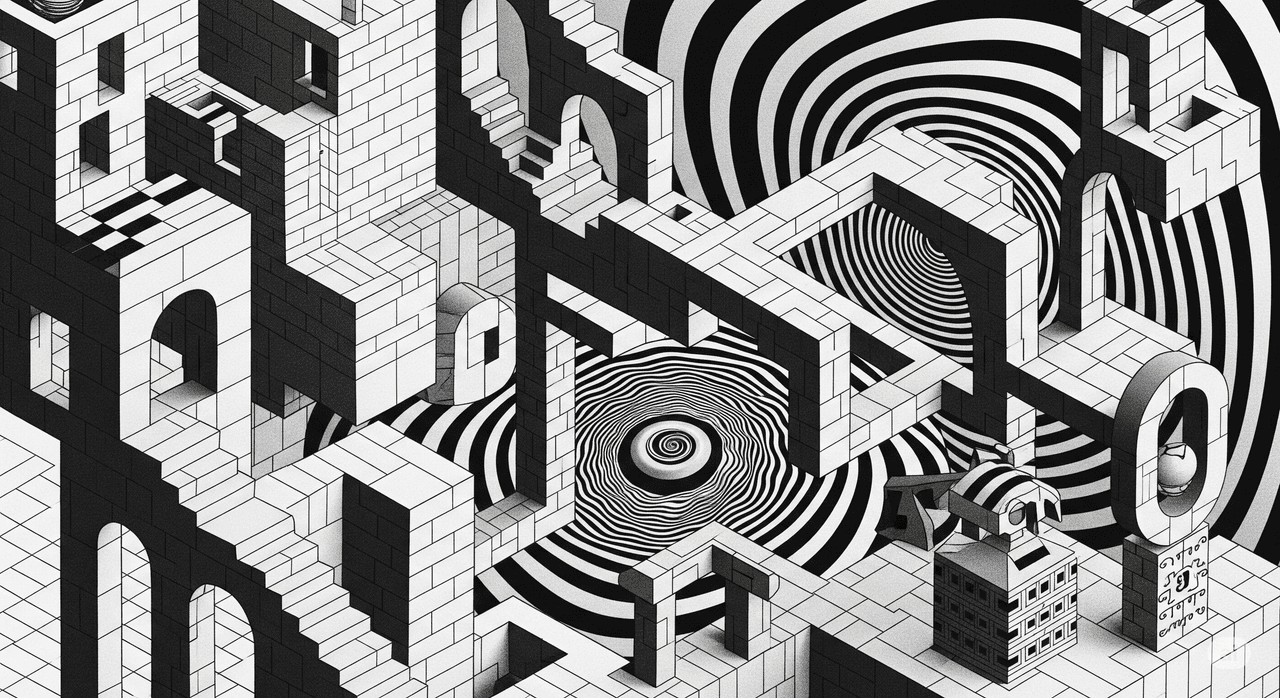
Figure-Ground Reversal (Generated by Artificial Intelligence)
The emergence of visual illusions is explained by both the physiological structure and operational principles of the visual system and the cognitive and interpretive processes of the brain. These processes are typically interrelated.
The visual system has limited structural and metabolic resources. These constraints have led the system to develop optimization strategies that enhance efficiency, and illusions can be viewed as a consequence of these strategies.
The visual system encodes information based on context rather than absolute values. Lateral inhibition is a mechanism in which an activated nerve cell reduces the activity of neighboring cells, thereby enhancing contrast between boundaries. While this facilitates edge detection, it can also produce illusions such as Mach bands. This effect is also observed in other visual properties such as orientation, as in the Zöllner illusion.
Assimilation is the opposite mechanism to lateral inhibition, in which a signal from one area conforms to or resembles signals from surrounding areas. In the phenomenon known as the “watercolor effect,” a colorless area enclosed by a colored contour is perceived as taking on a pale tone of the contour’s color.
This refers to the visual system’s adjustment of its responsiveness based on previous sensory signals. For example, after viewing a high-contrast pattern for some time, the visibility of a low-contrast version of the same pattern decreases (contrast adaptation). This mechanism helps the system detect novel or rare stimuli. Motion aftereffects (the waterfall illusion) and color aftereffects are also results of adaptation.
Visual information is encoded in opposing pairs. In color perception, there are red-green and yellow-blue axes; therefore, perceptions such as “greenish-red” are impossible. This principle also explains the simultaneous color contrast effect, in which a color is perceived differently depending on its background color.
The blind spot, discovered by French thinker Edme Mariotte in 1668, is the area on the retina where the optic nerve exits and photoreceptors are absent. The brain “fills in” the missing information in this region using surrounding tissue, which is why we normally do not perceive this gap.
The brain does not passively record sensory data but actively interprets and makes it meaningful. Illusions can arise from erroneous assumptions made during this interpretive process.
According to this view proposed by Hermann von Helmholtz in the 19th century, perception is largely the result of unconscious inferences based on past experience and knowledge. When confronted with ambiguous or incomplete sensory signals, the brain makes the most probable interpretation to fill gaps and construct a coherent whole. A contemporary example is the “dress illusion”; different unconscious assumptions about the lighting conditions of the photograph led viewers to perceive the dress as different colors.
This school of perceptual psychology argues that the brain tends to group visual elements into meaningful wholes. Principles such as figure-ground, proximity, closure, and continuity enable fragmented parts to be perceived as unified objects. For instance, the illusory contours of the Kanizsa triangle are a product of the brain’s tendency to complete incomplete shapes.
According to this modern theory, the brain is not a passive processor of sensory input but an organ that continuously predicts future sensory inputs based on internal models. Perception arises from the process of minimizing the discrepancy between these predictions (prior expectations) and actual sensory data (prediction error). Illusions can emerge as a result of this predictive mechanism; for example, the tendency to predict the future position of a moving object explains the “flash-lag” illusion. This framework is also used to explain perceptual differences observed in certain psychopathological conditions such as schizophrenia and autism.
Illusions can be classified as cognitive (visual) or physiological (optical) based on their underlying mechanisms.
These illusions relate to how the brain interprets two- or three-dimensional space and are typically static images that are logically contradictory or open to multiple interpretations.
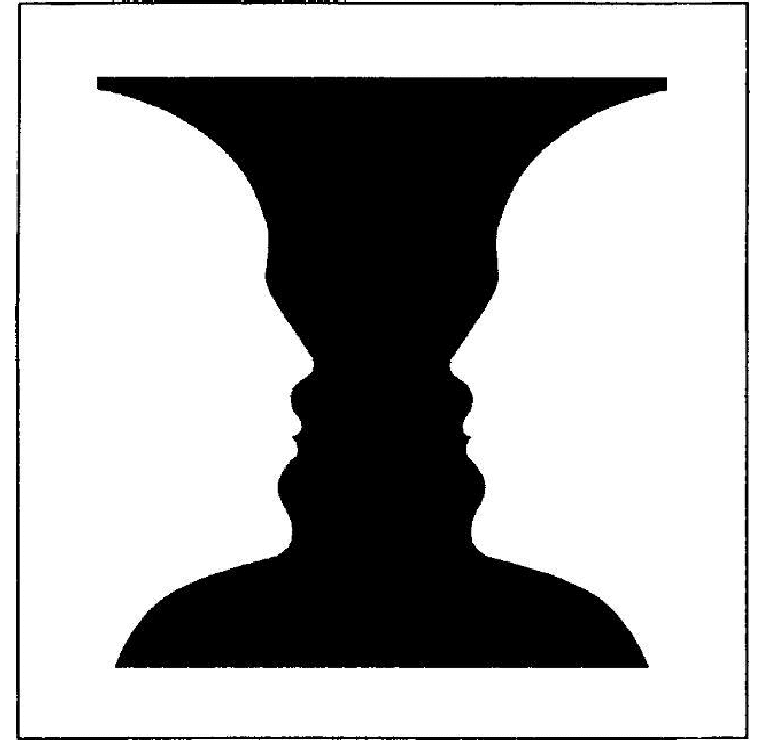
Vase-Face (ResearchGate)
Trompe-l'oeil (deception of the eye) has been used in painting since the Renaissance and Baroque periods to create a sense of three-dimensional reality. Michelangelo’s ceiling frescoes in the Sistine Chapel create an architectural illusion of depth.
These illusions arise from the physiological responses of the eye and early visual pathways to repetitive patterns, brightness, color, and contrast. They typically produce illusory effects such as movement, shimmering, or flickering in images that are in fact static.
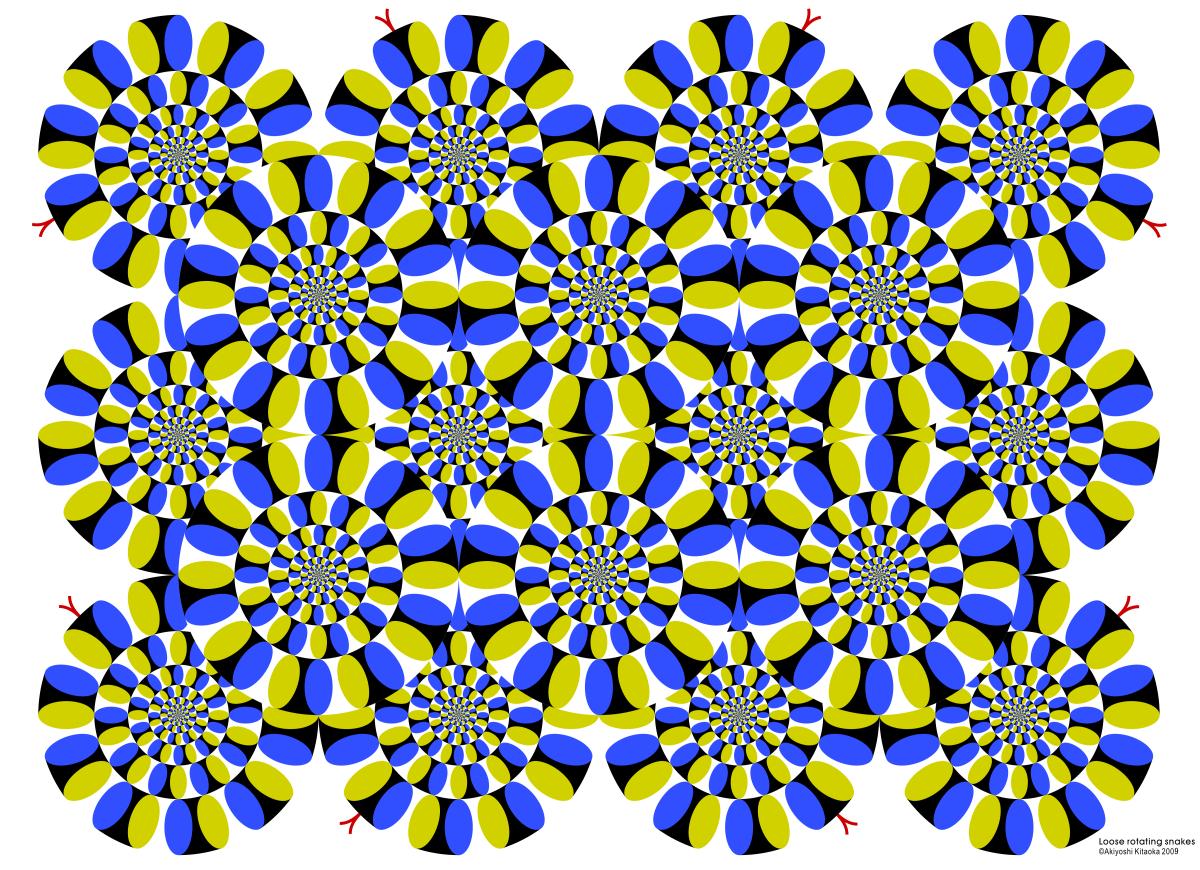
Rotating Snakes (Akiyoshi’s Illusion Pages)
Artists and designers have historically used visual illusions to manipulate perception, create extraordinary experiences, and reinforce specific messages.
In ancient Greek architecture, curved lines were deliberately used to make structures appear more regular. Renaissance artists, particularly Michelangelo and Andrea Pozzo, employed the trompe-l'oeil technique in frescoes and ceiling paintings to impart a sense of architectural depth and volume to flat surfaces. Giuseppe Arcimboldo created portraits composed of fruits, vegetables, and flowers, generating metaphorical and ambiguous imagery.
Surrealist artists such as Salvador Dalí used visual illusions to explore the unconscious and dreams. In works like Dalí’s “Face Made of Women,” hidden images within a single image create scenes open to multiple interpretations.
This art movement, emerging in the 1960s, is entirely based on creating optical illusions. Its aim is to induce sensations of movement, vibration, or flickering in the viewer through the systematic use of geometric forms, lines, and contrasting colors.
M.C. Escher designed mathematically based impossible spaces and transformations. Japanese designer Shigeo Fukuda created entirely new objects by using the shadows of object piles and playing with figure-ground relationships. Argentine artist Leandro Erlich incorporates mirrors and architecture in large-scale installations that immerse viewers in deceptive spatial experiences.
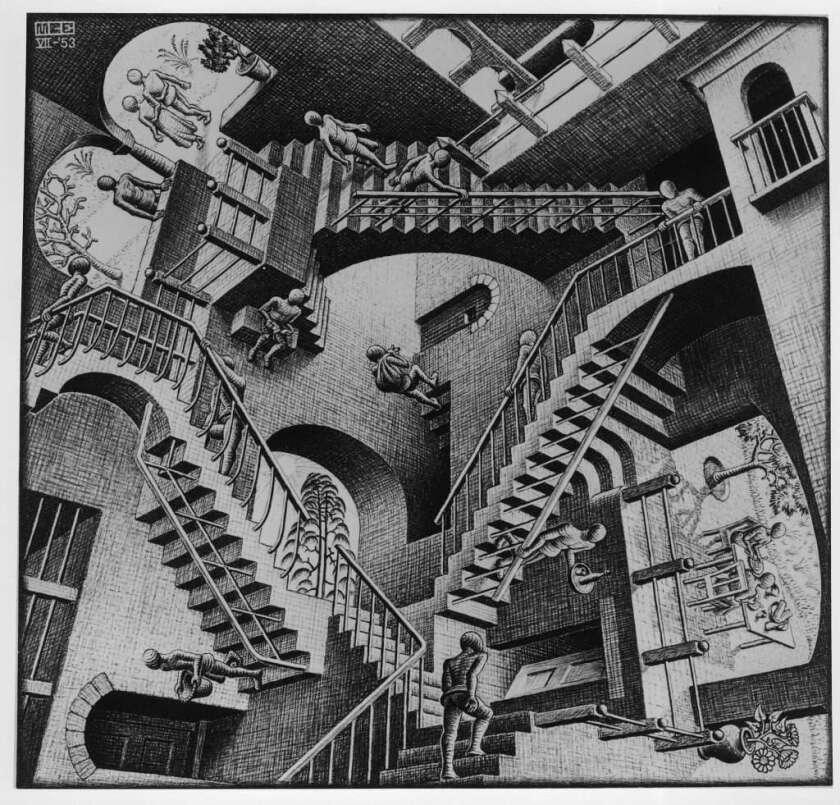
M.C. Escher's "Relativity" (BYU)
Akiyoshi’s Illusion Pages. “Rotating Snakes.” Accessed June 26, 2025. https://www.psy.ritsumei.ac.jp/akitaoka/rotsnakes12e.html.
Ayhan, İnci, and Güneş Ünal. “Görsel Yanılsamalar Bağlamında Görsel Algının Esasları.” *Nesne Psikolojik Dergisi* 8, no. 18 (2020). Accessed June 26, 2025. https://www.nesnedergisi.com/makale/pdf/1583834974.pdf.
Beyoğlu, Aylin. “Sanat Eğitiminde Algı, Görsel Algı ve Yanılsama: Victor Vasarely’nin Çalışmaları Üzerine Bir İnceleme.” *Trakya Üniversitesi Sosyal Bilimler Dergisi* 17, no. 1 (June 2015): 333–348. Accessed June 26, 2025. https://dergipark.org.tr/en/pub/trakyasobed/issue/30210/326103.
Brigham Young University Museum of Art. “MC Escher’s Relativity.” Accessed June 26, 2025. https://moa.byu.edu/m-c-eschers-relativity/.
Lehimler, Zafer. “Görsel ve Optik Yanılsama Arasındaki Fark.” *Asos Journal Uluslararası Sosyal Bilimler Dergisi*, no. 123 (2021): 1–19. Accessed June 26, 2025. https://avesis.atauni.edu.tr/yayin/b7a1ad38-3596-4f42-b28e-81370af3dac1/gorsel-ve-optik-yanilsama-arasindaki-fark.
ResearchGate. “Rubin's Vase (Two-Face-One-Vase Illusion).” Accessed June 26, 2025. https://www.researchgate.net/figure/Rubins-vase-sometimes-referred-to-as-The-Two-Face-One-Vase-Illusion-depicts-the_fig3_271842692.
Yüksel, İsmet. *Seramik Yüzeylerde Görsel Yanılsamalar.* Art Competence Thesis, Dokuz Eylül University Institute of Fine Arts, Ceramic and Glass Design Major, 2014. Accessed June 26, 2025. https://www.proquest.com/openview/e79e6b60469163d8b587218fd6e95c80/1?pq-origsite=gscholar&cbl=2026366&diss=y.

Theoretical Approaches and Causes
Physiological Mechanisms
Lateral Inhibition and Contrast
Assimilation
Adaptation
Opponency
Blind Spot
Cognitive Mechanisms
Unconscious Inference and Top-Down Processing
Gestalt Principles
Predictive Coding and Bayesian Inference
Types and Examples of Illusions
Visual Illusions (Cognitive/Mental)
Optical Illusions (Physiological)
Applications in Art and Design
Early Period and Renaissance
Surrealism
Op Art (Optical Art)
Contemporary Art and Design