


This article was automatically translated from the original Turkish version.
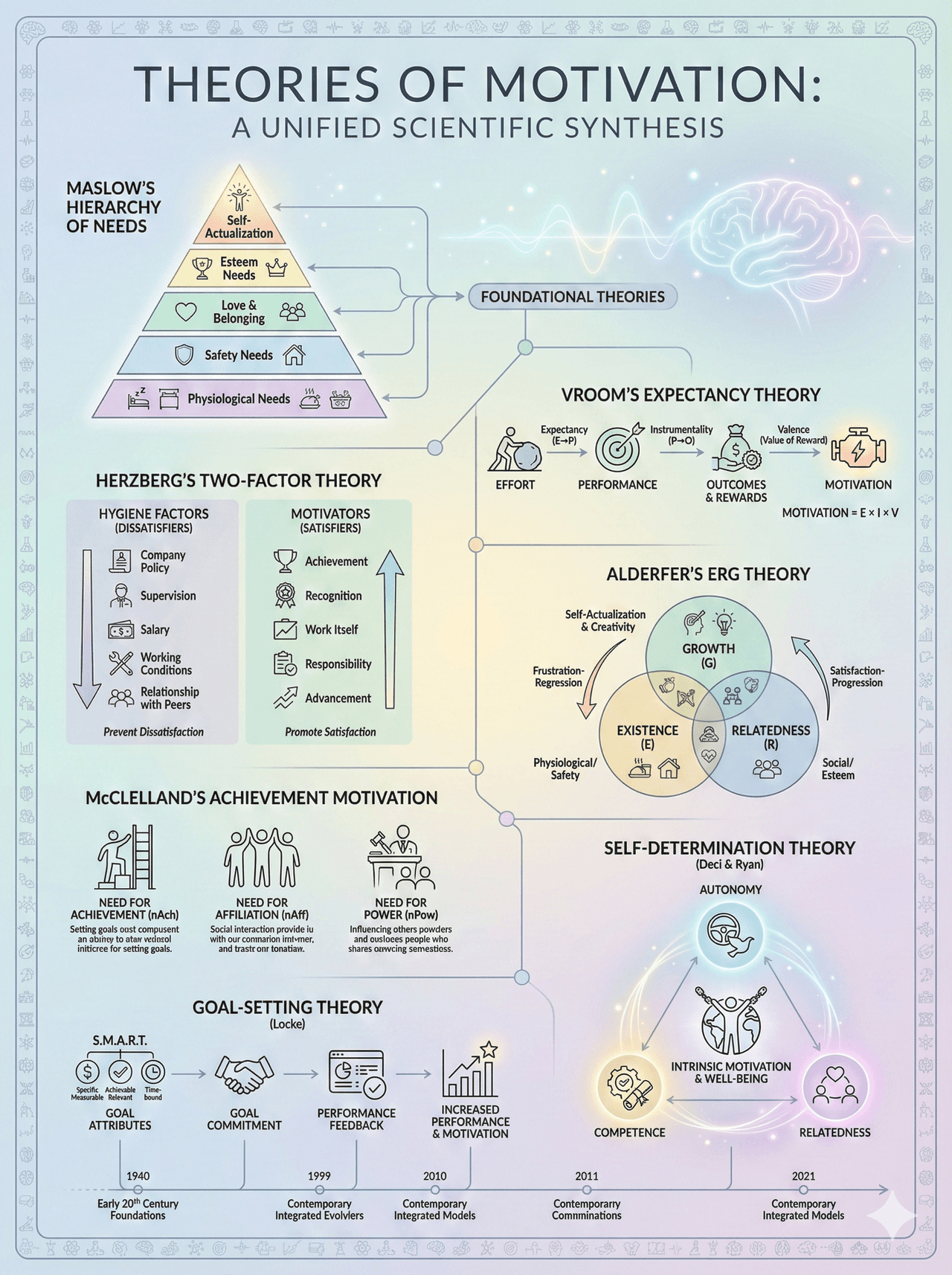
Motivation Theories (Generated with Artificial Intelligence.)
Definition(s) | Psychological processes that initiate and sustain human behavior. | ||||||||
|---|---|---|---|---|---|---|---|---|---|
Basic Components | Perceived competence Value assigned to the task Goal orientation Internal and external factors Social environmental influence | ||||||||
Intrinsic Motivation | The activity itself generating interest and curiosity. | ||||||||
Extrinsic Motivation | Orientation dependent on external factors such as rewards, obligations, and social expectations. | ||||||||
Self-Determination Theory | Autonomy Competence Relatedness | ||||||||
Expectancy-Value Theory | Expectation of success Perceived importance and benefit of the task | ||||||||
Goal Orientation Theory | Mastery orientation Performance orientation Avoidance orientation | ||||||||
Attribution Processes (Cause-Effect Evaluation) | The impact of attributions for success and failure on motivation. | ||||||||
Neurocognitive Approach | The shaping of motivation through reward, decision-making, and learning cycles. | ||||||||
Digital Learning Context | Attractiveness Support for autonomy Sense of competence Social connectedness | ||||||||
Holistic Models | A multilayered structure of needs in the domains of self, social, material, and spiritual. | ||||||||
Motivation is a psychological mechanism that determines an individual’s tendency to initiate and sustain an activity. The field examines a wide range of interacting factors spanning from biological drives to cognitive evaluations and social contexts. Modern motivation research acknowledges the existence of a complex system in which intrinsic and extrinsic factors operate together. In this context, contemporary literature encompasses both classical theories and current explanatory frameworks such as self-determination, expectancy-value, goal orientation, and holistic models.

Motivation Theories (Generated by Artificial Intelligence)
Motivation theories have generally been developed to define the processes that initiate and sustain behavior. These theories examine how individuals evaluate activities, their expectations regarding goals, the influence of environmental stimuli, and their sense of self-efficacy. Research shows that motivation is a multidimensional construct shaped by the interplay of competence beliefs, value attributions, emotional responses, and social conditions. Contemporary studies demonstrate that motivation cannot be explained by a single variable but arises from the interactive dynamics of multiple theoretical components.
Early theories focused on explaining behavior through instinctual tendencies, physiological arousal levels, or reward-punishment mechanisms. Instinct theories assume that certain behaviors are innate, while arousal theory posits that individuals seek an optimal level of activation for engagement. Reward-based approaches accept that reward and punishment systems guide behavior. Although these theories explain fundamental components of motivation, subsequent research revealed the critical role of cognitive evaluation processes.
In contemporary literature, the distinction between intrinsic and extrinsic motivation holds a central position. Intrinsic motivation is associated with activities that generate interest, curiosity, or enjoyment in themselves. Extrinsic motivation, by contrast, relies on external factors such as rewards, social approval, or obligations. Research shows that intrinsic motivation is strengthened when the needs for autonomy, competence, and relatedness are satisfied. Extrinsic regulations, meanwhile, are positioned along a continuum moving from external rewards toward internally endorsed values. This distinction is a core component of frameworks such as self-determination theory and cognitive evaluation theory.
Self-determination theory is a holistic approach that explains individual behavior in terms of the degree to which the needs for autonomy, competence, and relatedness are fulfilled. The theory classifies motivation along a continuum from self-determined to controlled processes and emphasizes that the form of regulation determines the quality of behavior. Research demonstrates that satisfying these three needs enhances intrinsic motivation, while their frustration is linked to motivation loss and negative affect. Systematic reviews in the context of exercise have shown that when social factors support these fundamental psychological needs, motivational outcomes are positively affected.
The expectancy-value theory argues that an individual’s motivation to perform a task depends on their expectation of success and the value they attribute to the task. Expectancies reflect the individual’s belief in their ability to accomplish the task, while the value component represents the perceived importance, benefit, and interest of the activity. Research indicates that expectancy beliefs predict engagement in the learning process, while value attributions determine orientation toward the task. This approach is particularly applied in educational contexts to shape motivational processes.
Goal orientation theory asserts that individuals engaging in activities primarily pursue either mastery-oriented or performance-oriented goals. Mastery orientation focuses on improving competence, while performance orientation focuses on appearing better than others. Mastery goals are associated with deep learning, persistence, and positive emotional outcomes. Performance-avoidance orientation, by contrast, reflects a tendency to avoid failure and can negatively impact motivation. This theory holds a significant place in understanding learning strategies in educational and professional contexts.
Recent studies have focused on the neurobiological foundations of motivation. Cortico-striatal-limbic circuits in the brain, which govern reward, expectation, and decision-making processes, activate differently in intrinsic and extrinsic motivation. Behaviors linked to intrinsic motivation are associated with cognitive processes such as exploration, curiosity, and learning orientation, even in the absence of reward expectations. Extrinsic motivation, by contrast, follows more reward-based mechanisms. Neuroscientific findings indicate that motivation involves distinct yet interactive systems.
New theoretical frameworks attempt to explain the multidimensional nature of motivation within a single model. Integrated motivation models argue that individuals possess diverse needs across personal, material, social, and spiritual domains, and that these needs shape behavioral orientation. These models emphasize that motivation emerges as a multilayered system operating at both individual and contextual levels. Empirical studies show that motivation consists of structurally distinct yet interrelated subcomponents.
Online learning environments present unique challenges for sustaining motivation. Research demonstrates that motivational elements such as capturing interest, supporting autonomy, enhancing perceived competence, and fostering social connection are critical. Analyses reveal that strategies focused on generating interest and curiosity are prioritized, while support based on competence, autonomy, and relatedness is less frequently addressed. This highlights the need to diversify motivational strategies in digital learning.
Computational modeling of motivation has enabled formal explanations of the competence need. Within frameworks of machine learning, models have been developed based on intrinsically motivated exploration, learning progress, and skill utilization. These models show that the formation of perceived competence is determined by environmental influences, feedback, and the individual’s ability to discern action-outcome relationships. Computational approaches contribute to expressing motivation theories with more precise conditions and mechanisms.
Motivation theories offer different but complementary perspectives for explaining human behavior. This theoretical diversity, extending from classical drive- and reward-based approaches to cognitive and social frameworks, demonstrates that motivation is a multidimensional construct. Contemporary research reveals that motivation depends not only on individual inclinations but also on the interaction of social environment, cognitive evaluation, and neurobiological systems.
Bandhu, M. Murali Mohan, Noel Anurag Prashanth Nittala, Pravin Jadhav, Alok Bhadauria, and Kuldeep K. Saxena. “Theories of Motivation: A Comprehensive Analysis of Human Behavior Drivers.” Acta Psychologica 244 (2024): 104177. Accessed December 1, 2025. https://doi.org/10.1016/j.actpsy.2024.104177
Bernardo, Jacinto Miguel Viveiros, Raúl Antunes, Rui Matos, Nuno Amaro, Luís Cid, Nuno Couto, and Diogo Monteiro. “Application of the Hierarchical Model of Intrinsic and Extrinsic Motivation in the Context of Exercise: A Systematic Review.” Frontiers in Psychology 16 (2025). Accessed December 1, 2025. https://doi.org/10.3389/fpsyg.2025.1512270
Cook, David A., and Anthony R. Artino Jr. “Motivation to Learn: An Overview of Contemporary Theories.” Medical Education 50, no. 10 (2016): 997–1014. Accessed December 1, 2025. https://doi.org/10.1111/medu.13074
Gavarkovs, Alexander, Elizabeth Miller, John Coleman, Tharshan Gunasegaran, Rashmi A. Kusurkar, Kulasegaram K. Kulasegaram, Meghan Anderson, and Ryan Brydges. “Motivation Theories and Constructs in Experimental Studies of Online Instruction: Systematic Review and Directed Content Analysis.” JMIR Medical Education 11 (2025). Accessed December 1, 2025. https://doi.org/10.2196/64179
Lintunen, Erik M., Nadia M. Ady, Sebastian Deterding, and Christian Guckelsberger. “Towards a Formal Theory of the Need for Competence via Computational Intrinsic Motivation.” arXiv (2025). Accessed December 1, 2025. https://arxiv.org/abs/2502.07423
Morris, Lindsey S., Mirko M. Grehl, Sophie B. Rutter, Manish Mehta, and Matthew L. Westwater. “On What Motivates Us: A Detailed Review of Intrinsic v. Extrinsic Motivation.” Psychological Medicine 52, no. 10 (2022): 1801–1816. Accessed December 1, 2025. https://doi.org/10.1017/S0033291722001611
Murayama, Kou, and Laura von Keyserlingk. “A Critical Analysis of the Current Motivation Theories in Educational Psychology: Why the Same Theories Continue to Dominate.” Educational Psychologist (2025): 1–16. Accessed December 1, 2025. https://doi.org/10.1080/00461520.2025.2473894
Pincus, Joshua D. “The Structure of Human Motivation.” BMC Psychology 11, no. 308 (2023). Accessed December 1, 2025. https://doi.org/10.1186/s40359-023-01346-5
Ryan, Richard M., and Edward L. Deci. “Intrinsic and Extrinsic Motivations: Classic Definitions and New Directions.” Contemporary Educational Psychology 25, no. 1 (2000): 54–67. Accessed December 1, 2025. https://doi.org/10.1006/ceps.1999.1020
Sasakura, Kazuyuki. “A Macroeconomic Theory of Price Determination.” 2021. Accessed December 1, 2025. https://www.sciencedirect.com/science/article/pii/S0954349X21001028
Zhang, Zhi, L. L. F. van Lieshout, Olivia Colizoli, et al. “A Cross-Cultural Comparison of Intrinsic and Extrinsic Motivational Drives for Learning.” Cognitive Affective and Behavioral Neuroscience 25 (2025): 25–44. Accessed December 1, 2025. https://doi.org/10.3758/s13415-024-01228-2

Motivation Theories (Generated with Artificial Intelligence.)
Definition(s) | Psychological processes that initiate and sustain human behavior. | ||||||||
|---|---|---|---|---|---|---|---|---|---|
Basic Components | Perceived competence Value assigned to the task Goal orientation Internal and external factors Social environmental influence | ||||||||
Intrinsic Motivation | The activity itself generating interest and curiosity. | ||||||||
Extrinsic Motivation | Orientation dependent on external factors such as rewards, obligations, and social expectations. | ||||||||
Self-Determination Theory | Autonomy Competence Relatedness | ||||||||
Expectancy-Value Theory | Expectation of success Perceived importance and benefit of the task | ||||||||
Goal Orientation Theory | Mastery orientation Performance orientation Avoidance orientation | ||||||||
Attribution Processes (Cause-Effect Evaluation) | The impact of attributions for success and failure on motivation. | ||||||||
Neurocognitive Approach | The shaping of motivation through reward, decision-making, and learning cycles. | ||||||||
Digital Learning Context | Attractiveness Support for autonomy Sense of competence Social connectedness | ||||||||
Holistic Models | A multilayered structure of needs in the domains of self, social, material, and spiritual. | ||||||||
No Discussion Added Yet
Start discussion for "Motivation Theories" article
Conceptual Foundations
Classical Approaches
Distinction Between Intrinsic and Extrinsic Motivation
Self-Determination Theory
Expectancy-Value Approach
Goal Orientation Theory
Neurocognitive Approaches
Holistic Models and Contemporary Approaches
Motivation in Digital Learning Contexts
Computational Approaches