


This article was automatically translated from the original Turkish version.
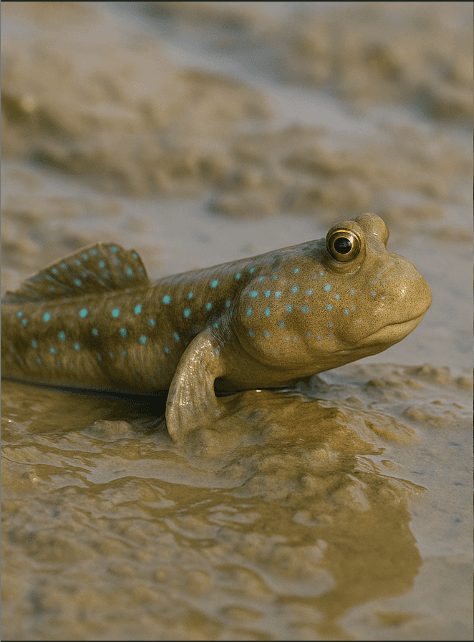
Mudskippers are semi-aquatic fish species belonging to the subfamily Oxudercinae, capable of living both underwater and on land. These species have evolved to thrive particularly in coastal and tidal zones, and exhibit numerous biological adaptations that support life in both aquatic and terrestrial environments.
Mudskippers (Oxudercinae) display specialized anatomical features adapted for life in both aquatic and terrestrial habitats. Their bodies are elongated with broadened and flattened heads. This morphology enables unique modes of movement such as crawling or jumping across muddy substrates. Their body surfaces are typically dark brown in color, with some species exhibiting lighter blotches. This pigmentation can serve as camouflage, blending with the substrate of their habitat.
One of the most striking features of these fish is the prominent, large eyes located on the upper part of the head. Unlike the eyes of purely aquatic fish, these eyes are functional both underwater and above the water surface. Additionally, the eyes are supported by muscular structures that allow them to move independently. This enables simultaneous monitoring of environmental threats and prey opportunities. Mudskippers are among the first fish species to effectively observe terrestrial environments using their vision.
Mudskippers typically inhabit tidal zones in tropical and subtropical regions, especially in mangrove forests, salt marshes, and muddy coastal strips. These habitats provide simultaneous access to both aquatic and terrestrial environments, supporting the dual lifestyle of mudskippers. The wet mud flats exposed during tidal retreats create ideal conditions for these fish to be active on the surface.
Their natural distribution is particularly widespread across the Indo-Pacific region. High population densities are commonly found in the coastal ecosystems of Bangladesh, Thailand, Indonesia, Malaysia, and the Philippines. Various species have also been observed in mangrove systems along the Atlantic coast, particularly on the western African shoreline. Habitat selection is closely linked to environmental factors such as the mud composition, salinity levels, and tidal rhythm of coastal areas.
Mudskippers use burrows they excavate individually for both shelter and spawning. These burrows are typically tunnel-shaped and dug into the mud, with interior chambers offering cooler and more oxygen-balanced conditions. The structure of the burrow varies by species and is shaped by local environmental conditions. During high tide, these burrows become microhabitats where individuals can safely retreat.
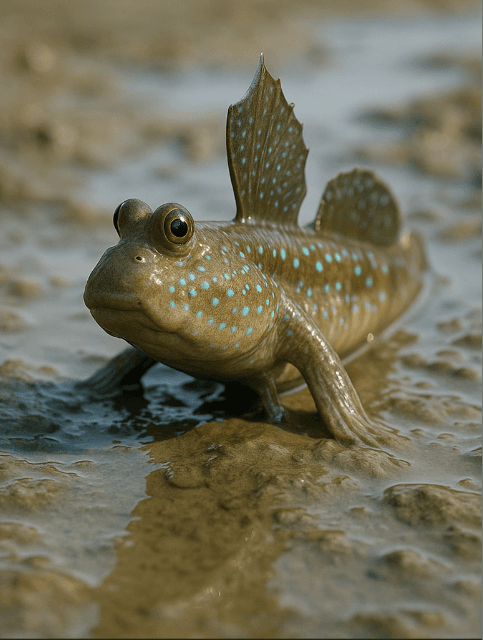
Mudskipper (generated by artificial intelligence.)
These fish exhibit territorial behavior and frequently use various visual signals to defend their territories. Raising their pectoral fins, jumping, and inflating their bodies are among these signaling behaviors. Males commonly display these behaviors, especially during the breeding season.
Mudskippers have an omnivorous diet consisting of small invertebrates, insects, and algae. Their feeding behavior outside water is characterized by sudden lunging movements. They consume prey captured on land by moistening it with water held in their mouths before swallowing.
While reproductive processes vary among species, in most mudskipper species the male attracts the female to a burrow he has dug to initiate mating. These burrows are tunnel-like structures excavated into the mud, with interiors designed to safely house eggs. The female typically deposits her eggs on the ceiling of the tunnel, after which the male fertilizes them. Spawning is often synchronized with environmental conditions and is influenced by water temperature and day length.
After fertilization, the male assumes responsibility for guarding the eggs in the burrow. In low-oxygen environments, the male actively brings air into the burrow through mouthfuls of air to maintain suitable oxygen levels for embryonic development. This behavior prevents egg decay and ensures healthy embryonic growth. This protective behavior demonstrates that mudskippers actively defend their offspring against environmental threats.
After hatching, the young remain in the burrow for a period while continuing their development. During this stage, their mobility is limited, making the protected space of the burrow critically important for early life survival. Once they reach a certain developmental threshold, the juveniles leave the burrow and begin moving independently on the surface or within the mud. This sequence of behaviors is fundamental to the species’ generational continuity, and the preservation of their habitat is essential for sustaining this cycle.
Wild Africa Zone – Meet the Mudskippers (National Geographic Türkiye)
Major threats to mudskippers include destruction of mangrove forests, habitat loss, pollution, and overuse of coastal areas. Environmental pollution, particularly from agricultural runoff and industrial waste, degrades water quality and endangers the species. Due to their high sensitivity to environmental changes, mudskippers are regarded as biological indicator species.
In some regions, mudskippers are directly consumed as a food source by local communities. Particularly in Southeast Asian countries, these fish are sold in local markets and prepared for consumption. However, commercial harvesting of the species is generally small-scale and limited to local levels. As a result, the pressure on natural populations is lower compared to industrial fishing; yet when combined with habitat loss, it can threaten sustainability.
In certain cultural practices, mudskippers are used in traditional medicine or associated with spiritual properties. These practices indicate that the species is assigned symbolic meanings. Additionally, mudskippers appear in various folktales and local mythologies. In this context, the fish holds cultural value alongside its ecological role.
In modern times, mudskippers have also gained interest among aquarium hobbyists. Due to their intriguing appearance and ability to move on land, some species are commercially traded and kept in specialized aquarium systems. Controlled trade and avoidance of excessive extraction from the wild are crucial for the species’ conservation. Furthermore, under international exotic species trade regulations, such sales are expected to follow sustainability principles.

Physical Characteristics
Habitat and Distribution
Behavior and Social Structure
Feeding Habits
Reproduction and Offspring
Threats and Conservation Efforts
Relationships with Humans