


This article was automatically translated from the original Turkish version.
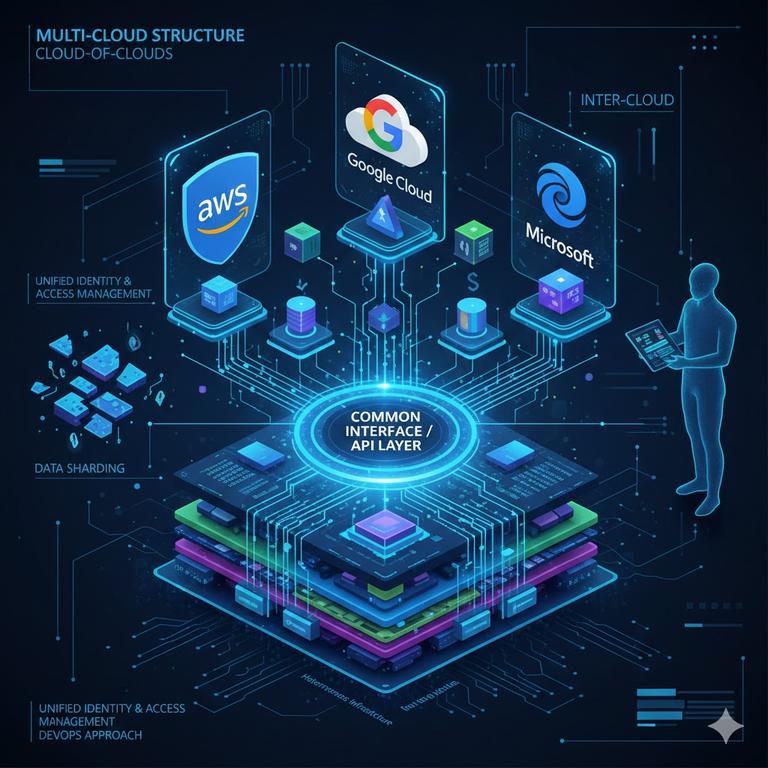
Çoklu Bulut (Multi-Cloud) (Yapay Zeka ile Oluşturulmuştur.)
Multi-cloud is a distributed cloud computing approach in which data and application components are stored and executed across multiple independent cloud providers rather than being confined to a single cloud provider. In this architecture, application components can be deployed simultaneously or sequentially across different cloud environments, and services from various providers can be used in an integrated manner.
Multi-cloud is also referred to in the literature as “cloud-of-clouds” and “inter-cloud,” describing architectures that involve the combined use of multiple cloud providers.【1】 In this structure, data and operations are distributed across different clouds, preventing the consolidation of all content at a single point.
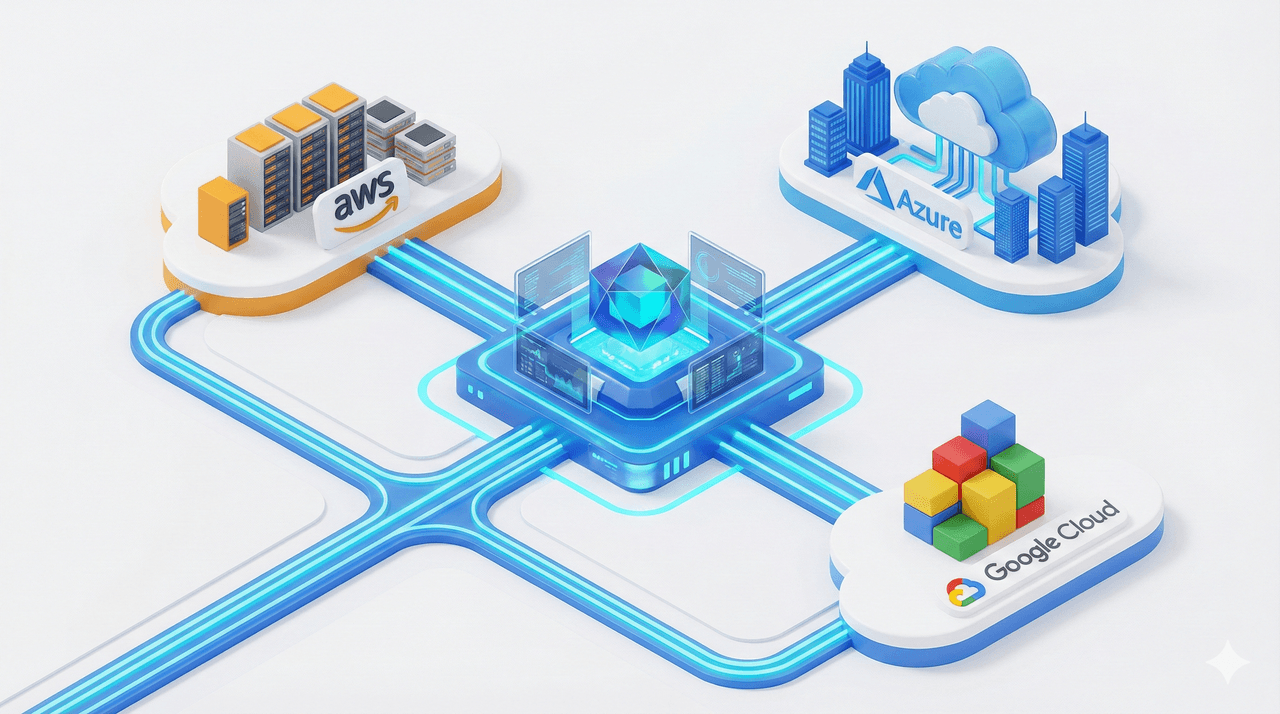
Multi-cloud architecture integrating cloud providers (AWS, Azure, Google Cloud) within a single management plane. (Generated by Artificial Intelligence.)
In some definitions, multi-cloud is associated with hybrid architectures that combine on-premises private resources with public cloud resources.【2】 Additionally, federated architectures, in which services from different providers are made interoperable through an intermediary layer, are also considered within the scope of multi-cloud.
Systems relying on a single cloud provider face capacity constraints when confronted with increasing workloads and data volumes. Since no data center has unlimited resources, meeting rising demand requires the combined use of resources from multiple providers.
The volume of data generated and the number of processes processed within organizations increase over time. This growth makes it difficult to rely on a single provider for all resources and leads to usage models based on distributing data across multiple clouds.
When dependent on a single provider, control over data is centralized, making migration to other environments difficult. In a multi-cloud structure, data can be divided and stored across multiple clouds, with allocation adjusted according to capacity needs. This creates a flexible structure capable of adapting to variable demand conditions.
Initial usage patterns, which involved replicating the same application across different clouds, have evolved with the widespread adoption of microservices, containerization, and serverless architectures. These approaches enable different components of an application to run simultaneously across multiple providers, allowing integration of functionalities not offered by any single provider.
Multi-cloud environments consist of heterogeneous infrastructures that combine virtual machines, storage services, databases, and other services from different providers. This heterogeneity complicates the classification, selection, and allocation of resources.
Users can initiate compute nodes across different data centers independently of physical servers. Data can be distributed and stored across multiple clouds. Communication between components is facilitated through virtual network layers that are independent of physical connections.
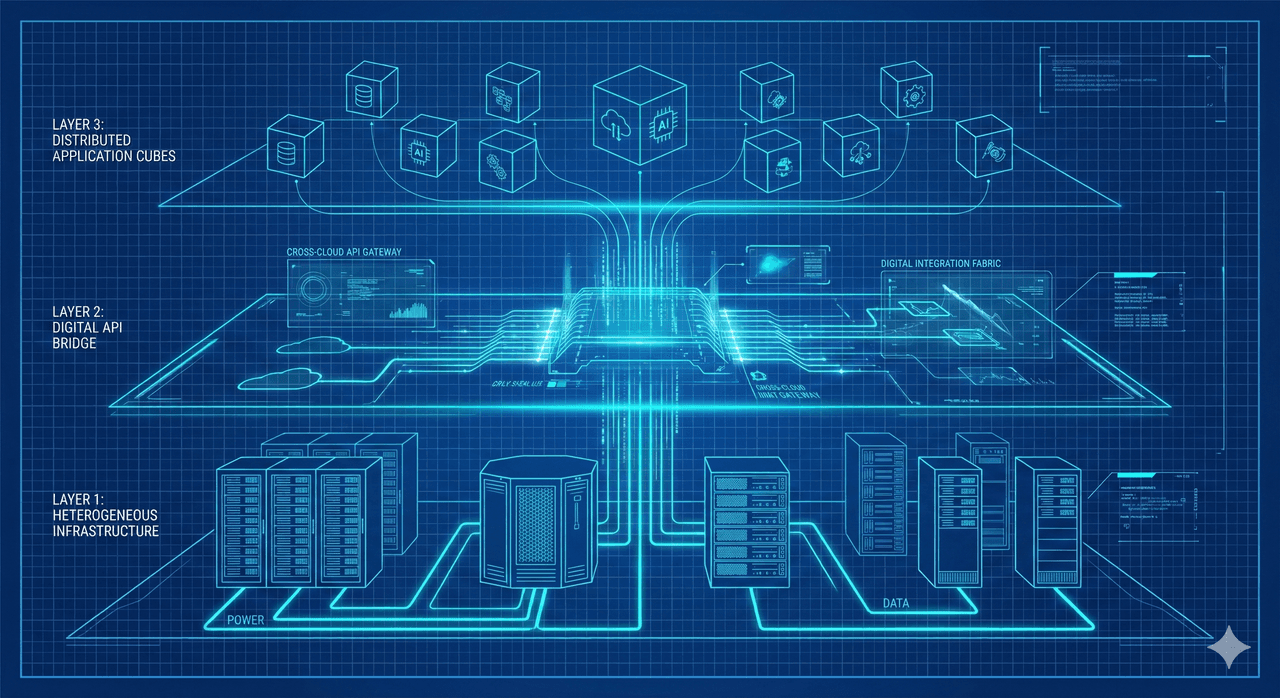
Layered technical schematic of a multi-cloud architecture comprising heterogeneous infrastructure, digital API bridges, and distributed application components. (Generated by Artificial Intelligence.)
In a multi-cloud structure, access to different providers is achieved through a single unified interface or API. This allows users to manage all providers through a centralized control point rather than performing separate operations for each.
User execution environments can be run on provider infrastructure using additional virtualization layers. Additionally, lightweight and portable container units that provide application-level isolation enable applications to be migrated across different clouds.
The application is executed sequentially across different clouds rather than simultaneously. Provider switching occurs due to cost, contract expiration, backup needs, or emergency situations. The focus is on provider transition and data portability.
Application subcomponents run simultaneously across different providers and collectively form a single application. Users receive services concurrently from multiple providers, enabling access to functionalities not offered by any single provider.
Structures combining replicated and distributed approaches allow some components to run simultaneously while others run sequentially across different providers.
Data is divided and stored across multiple clouds, with each cloud containing only a portion of the data. Unstructured files can be fragmented using cryptographic methods; structured data can be distributed across clouds at the column and row level.
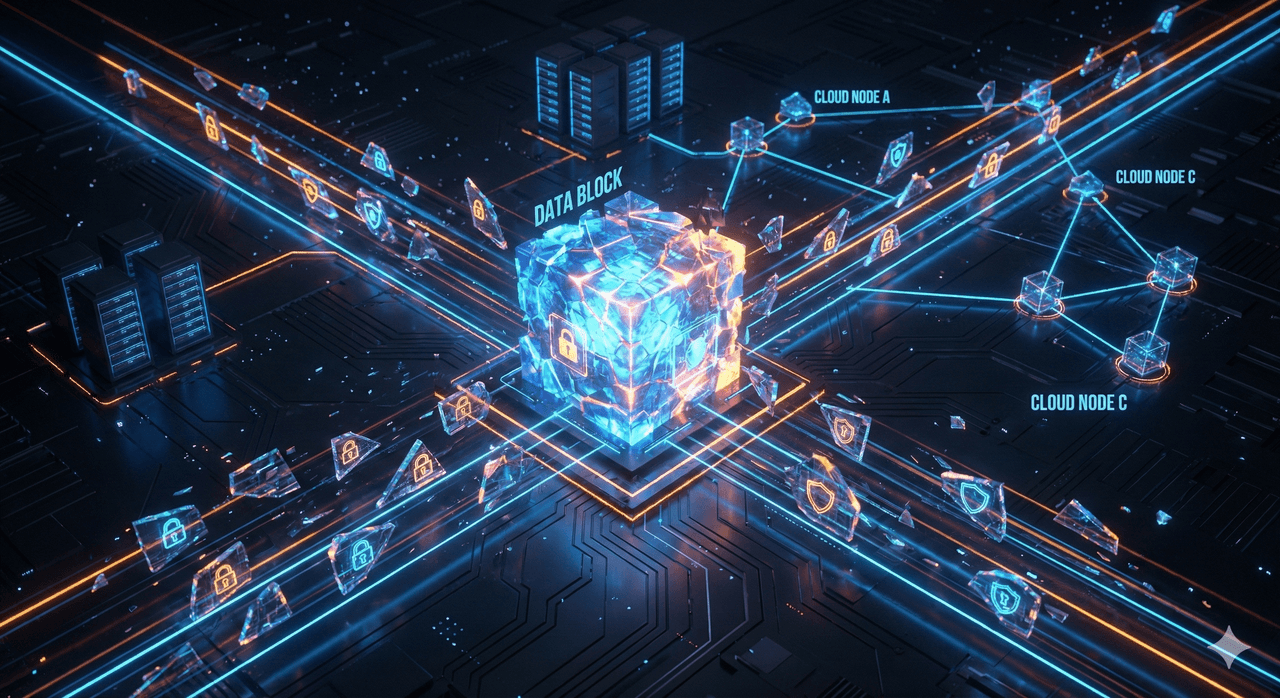
Secure distribution of data fragmented using cryptographic methods across multiple cloud providers. (Generated by Artificial Intelligence.)
Synchronizing distributed data fragments and maintaining their consistency is identified as a key challenge in multi-cloud environments. Current approaches focus primarily on infrastructure-level migration, while impacts at the application and data levels are addressed only marginally.
The ability to migrate stateful components and data during runtime is defined as a research topic. This process is linked to application self-healing and automatic component migration.
Distributed data fragments are replicated with additional copies. If one provider becomes unavailable, data can be recovered from other copies, ensuring service continuity. In Byzantine fault tolerance approaches, data is stored across multiple clouds, allowing live data retrieval from other providers even if one is offline.
In federated structures, users can access multiple centers using a single identity. In multi-tenant environments, logical isolation is applied to ensure separation between users.
Separate keys are generated for each data fragment stored in a cloud, and access is granted using these keys. Keys are encrypted and associated with files, and used during data retrieval. Security policy conflicts and new cryptographic requirements are among the shared security concerns in multi-cloud environments.
In multi-cloud applications, the design, deployment, and operation phases of the lifecycle are addressed together. Developers and operators design and run applications while considering multiple cloud options. Detailed classification of resources and alignment with requirements necessitate the reorganization of DevOps processes within the multi-cloud context.
Key challenges include modeling heterogeneous infrastructures through high-level abstraction, linking application models with infrastructure models based on non-functional requirements, and distinguishing between stateful and stateless components. Established design patterns for vendor-independent software have not yet matured. Differences in APIs, data formats, network topologies, and virtualization structures used by providers complicate interoperability. Additionally, data centers in different geographic regions being subject to different legal regulations creates technical and managerial inconsistencies.
Research focuses on integrating new infrastructure elements into the model under cloud continuity, developing architectural design patterns for multi-cloud native applications, and advancing runtime data and component migration, lightweight comparison, and multi-criteria optimization methods.【3】 Standard security models and approaches for quantitatively evaluating security are also included in this scope.
[1]
Kathuria, Sakshi. "A Survey on Security Provided by Multi-Clouds in Cloud Computing." International Journal of Scientific Research in Network Security and Communication 6, no. 1 (February 2018): 23-27. Access Date: January 31, 2026. https://ijsrnsc.org/index.php/j/article/view/120.
[2]
Alonso, Juncal, Leire Orue-Echevarria, Valentina Casola, Ana Isabel Torre, Maider Huarte, Eneko Osaba ve Jesus L. Lobo. "Understanding the challenges and novel architectural models of multi-cloud native applications - a systematic literature review." Journal of Cloud Computing 12, no. 1 (2023): 6. Access Date: January 31, 2026. https://link.springer.com/article/10.1186/s13677-022-00367-6.
[3]
Alonso, Juncal, Leire Orue-Echevarria, Valentina Casola, Ana Isabel Torre, Maider Huarte, Eneko Osaba ve Jesus L. Lobo. "Understanding the challenges and novel architectural models of multi-cloud native applications - a systematic literature review." Journal of Cloud Computing 12, no. 1 (2023): 6. Access Date: January 31, 2026. https://link.springer.com/article/10.1186/s13677-022-00367-6.

Çoklu Bulut (Multi-Cloud) (Yapay Zeka ile Oluşturulmuştur.)
Conceptual Framework and Terminology
Naming of Multi-cloud (Cloud-of-Clouds, Inter-Cloud)
Relationship with Hybrid and Federated Architectures
Reasons for Emergence
Capacity and Scalability Limitations
Growing Data and Workload Volumes
Flexibility and Reduced Vendor Lock-in
Impact of Microservices, Containerization, and Serverless Approaches
Core Architecture and Components
Heterogeneous Infrastructure Structure
Compute, Storage, and Network Layers
Common Interface and API Layer
Virtualization and Container Technologies
Deployment and Placement Models
Replicated Model
Distributed Model
Hybrid Models
Data Management and Portability
Data Distribution and Sharding
Data Synchronization and Consistency
Runtime Data and Component Migration
Security and Access Control
Redundancy and Fault Tolerance
Unified Identity and Access Management
Security Policies and Cryptographic Requirements
Management and DevOps Approach
Technical Challenges
Development Trends and Research Areas