


This article was automatically translated from the original Turkish version.
+1 More
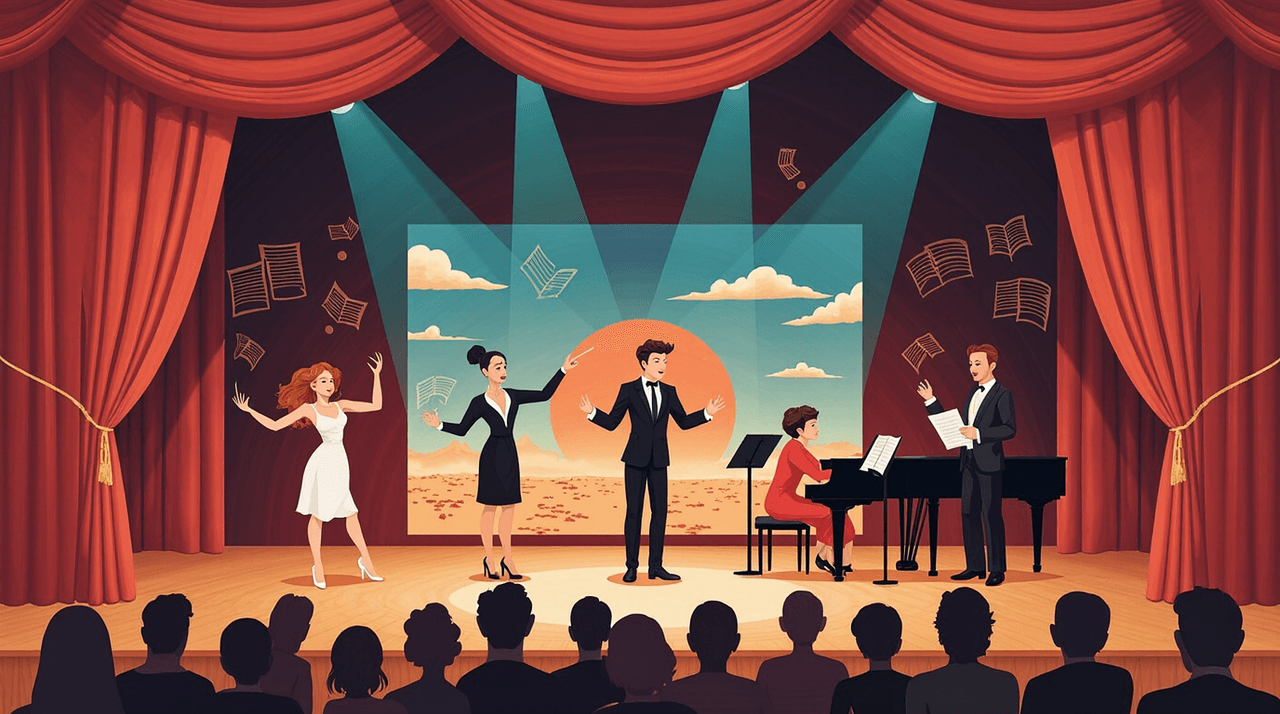
Musical Theatre (Generated with Artificial Intelligence)
Definition(s) | A performing art in which music and dialogue are integrated into a narrative structure. dance | ||||||||
|---|---|---|---|---|---|---|---|---|---|
Basic Elements | Song, Dance, Acting | ||||||||
Origin(s) | Early 19th century (Modern Western Musical) | ||||||||
Important Examples | The Phantom of the Opera, Cats, Hamilton, Les Misérables | ||||||||
Education | Acting - specialized programs (BFA) that combine singing and dance disciplines | ||||||||
Musical theatre is a dramatic and entertaining stage art form characterized by a unique plot structure in which music, dance, and dialogue are presented as an integrated whole. In this form, commonly abbreviated as “musical,” narrative and emotional content are conveyed through words, music, bodily movement, and dramatic structure, often expressing emotions such as humor, tragedy, love, and anger. Although musical theatre shares certain structural similarities with opera, operetta, ballet, and other stage arts, its defining feature is the equal importance accorded to acting, singing, and dancing within the storytelling process. The seamless integration of these three core elements is the primary characteristic that distinguishes musical theatre from other traditional theatrical genres. Contemporary Western musicals, in their modern sense, emerged historically in the early 19th century and gained global prominence in the 20th century through institutionalization on Broadway (New York) and West End (London) stages.
Musical theatre is composed of the convergence of three primary artistic disciplines: acting, music (singing), and dance. Each discipline supports the integrity of the narrative and enhances its dramatic impact. Artists performing in this genre are typically described as “triple threats,” as they must be capable of acting, singing at a professional level, and dancing choreographically on stage.
In musical theatre, music is not merely a functional background element but an integral part of the narrative itself. Songs express characters’ emotional states, motivations, inner conflicts, and developmental arcs while simultaneously advancing the plot. The musical styles used in musicals are highly diverse, spanning from the classical operetta tradition to jazz, blues, and rock, and extending in contemporary works to hip-hop, R&B, and rap. For instance, Lin-Manuel Miranda’s Hamilton: An American Musical redefined narrative possibilities in musical theatre by presenting the life story of founding father Alexander Hamilton through hip-hop, rap, and jazz.
Dance in musical theatre serves not only as aesthetic visual appeal but also plays a functional role in conveying relationships between characters, emotional transitions, and dramatic conflicts. Choreography enriches the narrative, particularly in scenes requiring non-verbal storytelling, through visual metaphors and physical expression techniques. Consequently, training in musical theatre involves intensive instruction in various dance disciplines, including classical ballet, jazz, tap, modern dance, and theatrical dance. Productions such as West Side Story, A Chorus Line, and Fosse are key examples demonstrating the central role of choreography in storytelling.
The written text of a musical theatre work, encompassing both lyrics and spoken dialogue, is called the libretto. The libretto facilitates transitions between spoken passages and songs, maintains narrative continuity, and deepens character relationships. In some musicals, spoken dialogue between songs supports the progression of the story, while in others, dramatic storytelling is carried almost entirely through song (sung-through). Works such as Les Misérables and The Phantom of the Opera belong to the latter category, whereas The Sound of Music and My Fair Lady balance dialogue and song equally.

Musical Theatre (Generated by Artificial Intelligence)
Musical theatre requires an interdisciplinary educational process aimed at cultivating artists with multifaceted technical skills. Universities, conservatories, and specialized arts institutions worldwide offer academic programs at the Bachelor of Fine Arts (BFA) or Bachelor of Arts (BA) level for those pursuing careers in this field. The primary objective of these programs is to enable students to develop simultaneously in acting, singing, and dance.
During their education, students gain practical experience through active participation in academic productions and stage applications. Prestigious institutions such as Syracuse University, Carnegie Mellon, and NYU Tisch School of the Arts provide opportunities for students to collaborate directly with industry professionals, work with professional theatre companies, and earn credits toward Actors’ Equity Association membership.
The use of stage technology in musical theatre has significantly expanded since the late 20th century, offering new possibilities to enrich the visual and auditory dimensions of storytelling. Contemporary musical productions are now equipped with technological components such as lighting design, sound engineering, stage mechanics, projection systems, and digital effects.
In large-scale productions, computer-controlled moving stage platforms, automated curtain systems, and LED screen-backed scenic environments allow flexible representation of spatial and temporal dimensions. Advances in sound technology have improved audience experience by enabling effective microphone amplification for performers and optimized orchestral sound reinforcement.
Projection mapping and augmented reality (AR) applications have gained prominence in recent years, particularly in experimental productions. These technologies partially replace physical set pieces with virtual imagery, enabling more abstract or dynamic staging. Contemporary works such as Dear Evan Hansen and Harry Potter and the Cursed Child exemplify how technology can serve narrative purposes.
Musical theatre is an art form that connects with audiences not only locally but also on an international scale. Various global festivals and award programs promote and evaluate musical theatre works and artists.
These awards and festivals enhance the artistic credibility of musical theatre by highlighting not only its performance qualities but also its components such as composition, writing, acting, and scenic design.
The historical evolution of musical theatre has been shaped by numerous transformative works that expanded the boundaries of musical storytelling, pioneered advancements in staging and musical technology, and catalyzed the emergence of new subgenres. Notable classical and contemporary musicals include:
Musical theatre in Türkiye began to develop from the mid-20th century and reached a broad audience through both state-supported institutions and private theatres. Public institutions such as Istanbul City Theatres, Ankara State Theatre, and İzmir State Theatre have led the staging of both local and foreign musicals.
The Turkish musical tradition has developed its own distinctive identity not only through the adaptation of Western musical forms but also through original local productions. Works such as İstanbul Efendisi, Lüküs Hayat, and Hisseli Harikalar Kumpanyası exemplify the fusion of Turkish cultural elements with musical theatre storytelling.
Today, regular musical productions are staged at venues such as Zorlu Performing Arts Centre (Zorlu PSM), DasDas, Trump Sahne, and Süreyya Opera House. Additionally, private institutions like the Gülsin Gümüş Musical Theatre Academy contribute to the professionalization of Türkiye’s musical theatre scene by providing training for young talent.
Finney, Madison. “Putting It Together: Musical Theatre as an Academic Discipline.” *Honors College Theses*, no. 311 (2020). Accessed August 7, 2025. https://digitalcommons.pace.edu/honorscollege_theses/311.
Karaca, Sevgi. “Sinema ve Tiyatroda Müzikal.” Master's thesis, 2016. Accessed August 7, 2025. https://www.academia.edu/103559925/Sinema_ve_Tiyatroda_M%C3%BCzikal.
Kenrick, John. Musical Theatre: A History. London: Bloomsbury Publishing, 2017.
McMillin, Scott. *The Musical as Drama*. Princeton: Princeton University Press, 2014. Accessed August 7, 2025. https://doi.org/10.1515/9781400865406.
Miller, Scott. Strike Up the Band: A New History of Musical Theatre. Portsmouth, NH: Heinemann Drama, 2007.
Tüzün, Z. “Müzikal Tiyatroya Giriş.” *Sanat ve Tasarım Dergisi* 6, no. 1 (2016): 116–133. Accessed August 7, 2025. https://doi.org/10.20488/www-std-anadolu-edu-tr.291257.
Çelik Kasapoğlu, İ. *Yirminci Yüzyıldan Günümüze Opera ve Müzikal Tiyatro Arasındaki Etkileşimler*. Master's thesis, İstanbul Üniversitesi Sosyal Bilimler Enstitüsü, 2007. Accessed August 7, 2025. https://nek.istanbul.edu.tr/ekos/TEZ/53887.pdf.

Musical Theatre (Generated with Artificial Intelligence)
Definition(s) | A performing art in which music and dialogue are integrated into a narrative structure. dance | ||||||||
|---|---|---|---|---|---|---|---|---|---|
Basic Elements | Song, Dance, Acting | ||||||||
Origin(s) | Early 19th century (Modern Western Musical) | ||||||||
Important Examples | The Phantom of the Opera, Cats, Hamilton, Les Misérables | ||||||||
Education | Acting - specialized programs (BFA) that combine singing and dance disciplines | ||||||||
Core Elements of Musical Theatre
Music and Song
Dance and Choreography
Dialogue and Libretto
Education and Professional Development
Core Educational Components
Use of Technology in Musical Theatre
Global Festivals and Awards
International Festivals
Award Programs
Significant Works and Genre Development
Musical Theatre in Türkiye