


+1 More

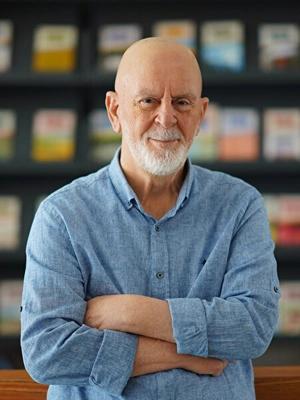
Mustafa Kutlu
Born | 06 March 1947 | ||||||||
|---|---|---|---|---|---|---|---|---|---|
Job | Writer | ||||||||
Education | Ataturk University - Turkish Language and Literature Department | ||||||||
Mustafa Kutlu was born on March 6, 1947, in Kuruçay, a township in the Ilıç district of Erzincan. He was the third child of Nahiye Director Nurettin Bey and Sulhiye Hanım. Known in Turkish literature as a storyteller, novelist, publisher, essayist, screenwriter, travel writer, sports columnist, journalist, painter, and teacher, Kutlu became a prominent figure in the New Literature movement within the Anatolia-Ottoman-Turkey framework from the last quarter of the 20th century onward. His works often depict the struggles of Anatolian people, social transformation processes, and the conflict between tradition and modernity, distinguished by his simple and fluent style.
Kutlu's childhood was spent in various cities due to his father’s profession. In 1953, upon Nurettin Bey’s retirement, the family settled in Erzincan. He completed his primary, secondary, and high school education there, graduating from Erzincan High School in 1964. The loss of his father during his middle school years left a deep mark on his life. After high school, he initially planned to study at the Fine Arts Academy in Istanbul to become a painter but later enrolled in Atatürk University’s Department of Turkish Language and Literature in Erzurum. He graduated in 1968, having been immersed in an environment rich in art and literature. Professor Ioanna Kuçuradi and two friends encouraged him to organize an art exhibition at Erzurum Public Education Hall. He developed his literary knowledge under the mentorship of scholars such as Orhan Okay, Kaya Bilgegil, Selahattin Olcay, Niyazi Akı, Haluk İpekten, Hüseyin Ayan, Bilge Seyidoğlu, and Muhan Bali. A pivotal moment in his literary career was meeting Ezel Erverdi, the editor-in-chief of the Hareket magazine, in Orhan Okay’s office.
Kutlu entered the literary world in 1968 when his drawing appeared on the cover of the 28th issue of Fikir ve Sanatta Hareket magazine. The following issue, in May 1968, published his first short story, "O." His university graduation thesis, "Plastic Elements in Sait Faik," was published by Hareket Publishing in 1968 under the title The Story World of Sait Faik. At Orhan Okay’s suggestion, he wrote a study on Sabahattin Ali, published in 1972 by the same publisher. In 1969, he married Sevgi Hanım, with whom he had two children. That same year, he was appointed as a literature teacher at Tunceli High School (1969-1972) and later taught at Istanbul Vefa Poyraz High School (1972-1974). In 1974, he left teaching to work at Dergâh Publishing, marking a crucial shift in his literary career.
Writing for Fikir ve Sanatta Hareket magazine, Kutlu became its editorial director from 1979 to 1982. His work also appeared in Adımlar, Hisar, Türk Edebiyatı, Düşünce, and Yönelişler magazines. From 1976, he contributed to the Turkish Language and Literature Encyclopedia and eventually took over as its editor-in-chief. From 1990 until January 2016, he served as the general editor of Dergâh magazine.
Mustafa Kutlu's works focus on the daily lives of Anatolian people, social change, and the struggles of modernization. His first story collections, Ortadaki Adam (1970) and Gönül İşi (1974), reflect a romanticized view of Anatolia, influenced by Nurettin Topçu. In Yokuşa Akan Sular (1979), he developed a "river story" style inspired by classical Eastern narratives. This work presents a unique structure addressing industrialization and migration. Yoksulluk İçimizde (1981) explores the effects of capitalism through a Sufi-Islamic perspective and won the Turkish Writers' Union Storybook Award. Ya Tahammül Ya Sefer (1983), Bu Böyledir (1987), and Sır (1990) continued his "river story" approach, deepening his use of symbolism and Sufi themes.
In the 2000s, Kutlu transitioned to writing longer stories with Uzun Hikâye, which won the Turkish Writers' Union Language Award and was adapted into a film by Osman Sınav. His long-form narratives explore social change through the individual-society relationship, employing a simple, fluid style rooted in everyday language. His stories often revolve around villages, towns, childhood, love, and migration, successfully bridging modern and traditional elements.
Beyond storytelling, Kutlu has written screenplays, adapting Sleep by Orhan Kemal and Huzur by Ahmet Hamdi Tanpınar, as well as his works such as Gönül İşi, Kapıları Açmak, Uzun Hikâye, and Mavi Kuş. He began writing columns for Yeni Şafak in 1995, covering essays and sports articles. He also produced television programs such as Monday Stories on TRT2, Istanbul Dervish Lodges on Kanal 7, and The Story of a Book: Poetry in the Museum on TRT-1. His Istanbul-themed essays were published as A Bunch of Istanbul (1992) and City Letters (1993), focusing on topics like Istanbul, poverty, and Sufism.
Currently residing in Istanbul, Kutlu continues to write for Yeni Şafak and Dergâh. He has played a significant role in shaping Turkish storytelling, influencing younger writers like Nazan Bekiroğlu and Cihan Aktaş.
Kutlu received the Turkish Writers' Union Storybook Award in 1981 and 1983 and the Language Award in 2000.
Kitaphaber. Mustafa Kutlu ile Mekânları Gezmek. Erişim tarihi 22 Mart 2025. https://www.kitaphaber.com.tr/mustafa-kutlu-ile-mekanlari-gezmek-k6061.html.
Türkiye Yazarlar Birliği. TYB Erzincan Şubesi’nde Konuşan Mustafa Kutlu: "Yazdıklarım Yerli ve Milli". Erişim tarihi 22 Mart 2025. https://www.tyb.org.tr/tyb-erzincan-subesinde-konusan-mustafa-kutlu-yazdiklarim-yerli-ve-milli-56617h.htm.
Anadolu Mektebi. Mustafa Kutlu. Erişim tarihi 22 Mart 2025. https://www.anadolumektebi.org/tr/icerik/mustafa-kutlu/1591361309165.
Dergâh Yayınları. Mustafa Kutlu. Erişim tarihi 22 Mart 2025. https://www.dergah.com.tr/yazarlar/mustafa-kutlu.
Türkiye Edebiyat İsimleri Sözlüğü. Kutlu, Mustafa. Erişim tarihi 22 Mart 2025. https://teis.yesevi.edu.tr/madde-detay/kutlu-mustafa.

Mustafa Kutlu
Born | 06 March 1947 | ||||||||
|---|---|---|---|---|---|---|---|---|---|
Job | Writer | ||||||||
Education | Ataturk University - Turkish Language and Literature Department | ||||||||
Early Life and Education
Beginning of Literary and Publishing Career
Literary Career and Style
Other Works and Contributions
Awards
Books
This article was created with the support of artificial intelligence.