


This article was automatically translated from the original Turkish version.
+1 More
Mutaflık is a traditional textile craft whose primary raw material is goat hair. The term “muytab,” derived from Persian words “mu” (hair) and “tab” (weaver), evolved over time into “mutaf” and came to denote both the artisan and the product. This term settled in meaning “something woven from goat hair” or “a man who weaves and sells goods from hair.” This craftsperson group, known locally as “mutaf” or “mutafçı,” was recorded in Ottoman archives as “muytap esnafı.” Products such as belleme, payvant, kebe, kolan, and gebre fall under the scope of mutaflık hairwork. 【1】
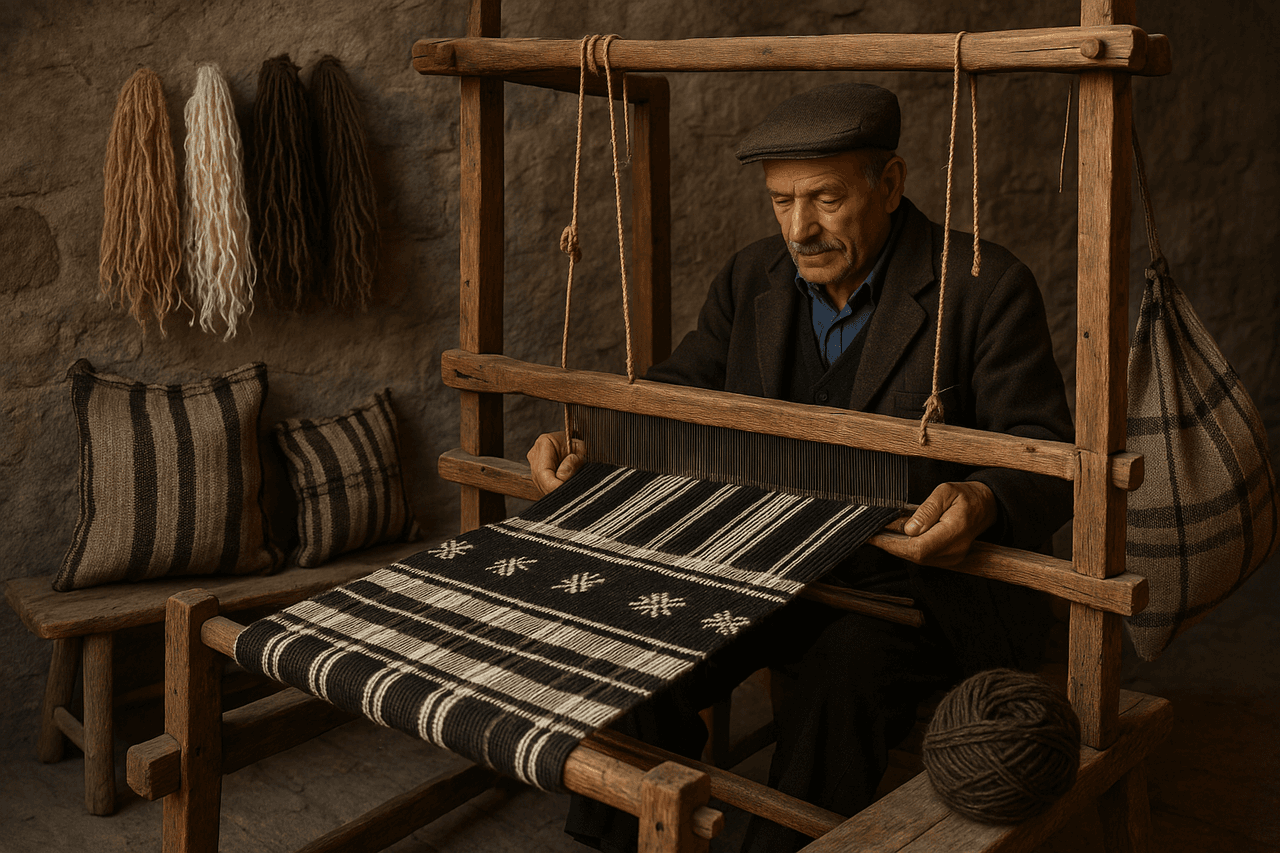
Representative Mutaf Image (Generated by Artificial Intelligence)
The primary raw material in mutaflık is goat hair. In particular, the hair of goats that have reached one year of age, known as çebiç hair, is preferred for weft yarn (argaç) due to its soft texture. Male goat hairs, which are long and stiff, are generally used for warp yarn (eriş); female goat hairs are shorter in structure.
Hair shearing is carried out once a year, during May to July. After shearing using the traditional tool called kırklık, the hairs are combed on a hair comb to remove impurities such as dirt and debris. They are then stretched on a frame to achieve a uniform consistency. Once prepared for weaving, the hairs are twisted using a “çark” or locally called “çıkrık,” and subsequently undergo a tensioning process to enhance their strength.
The main tools and equipment used in mutaflık are as follows:
Traditional motifs such as goose foot, bird’s eye, and mouse tooth were commonly used in the textiles. These motifs reflected both the aesthetic values and the local identity of the region.
Due to their high durability, mutaflık products were primarily valued for transportation purposes. The range of products includes:
These products are constructed to be long-lasting and robust, suited to rural living conditions.
With the widespread adoption of plastic sacks and industrial materials, interest in textiles made from natural goat hair has declined. Changes in lifestyle and technological advancement have caused mutaflık to cease being an economically viable occupation.
Genç, Mustafa, Noman Öztürk, and Deniz Çeliker. “Isparta’da Mutaflık ve Son Mutaf Nuri Akkulak.” *Art-e Sanat Dergisi* 10, no. 20 (December 31, 2017): 354–371. Accessed July 12, 2025. https://dergipark.org.tr/tr/pub/sduarte/issue/33202/358725#article_cite.
Ministry of Culture and Tourism of the Republic of Türkiye. "Mutaflık." *Culture Portal.* Accessed July 12, 2025. https://www.kulturportali.gov.tr/turkiye/afyonkarahisar/kulturatlasi/mutaflik.
[1]
Mustafa Genç, Noman Öztürk ve Deniz Çeliker, “Isparta’da Mutaflık ve Son Mutaf Nuri Akkulak,” Art-e Sanat Dergisi 10, no. 20 (31 Aralık 2017): 355, https://dergipark.org.tr/tr/pub/sduarte/issue/33202/358725#article_cite.

Raw Materials and Preparation Process
Tools and Equipment Used
Weaving Technique and Motifs
Products and Uses
Decline of the Craft