


This article was automatically translated from the original Turkish version.
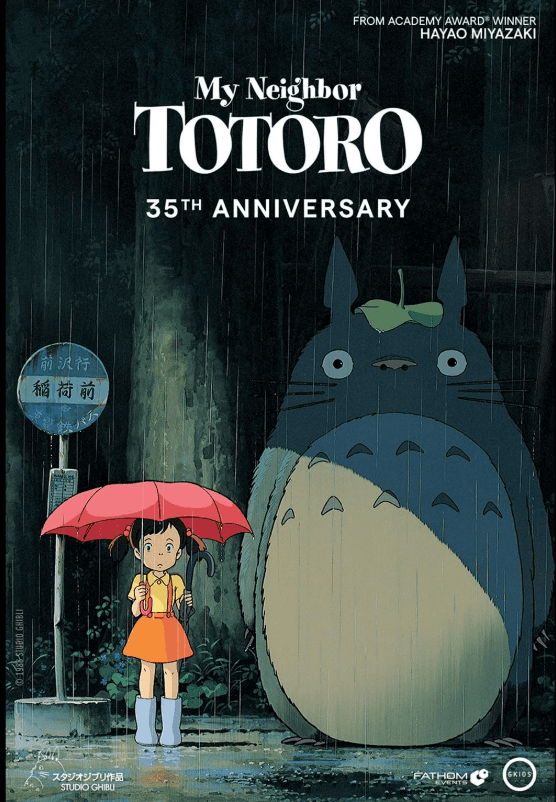
My Neighbor Totoro Movie Poster
Original Name(s) | Tonari no Totoro | ||||||||
|---|---|---|---|---|---|---|---|---|---|
Production Year | 1988 | ||||||||
Duration | 86 Minutes | ||||||||
Type(s) | Anime Animation | ||||||||
Author(s) | Hayao Miyazaki | ||||||||
Language(s) | Japanese | ||||||||
Production Country | Japan | ||||||||
My Neighbor Totoro (original title: Tonari no Totoro) is a 1988 animated feature film written and directed by Hayao Miyazaki, one of the leading figures of Japanese animation cinema. Produced by Studio Ghibli, it presents a fantastical narrative centered on rural life in Japan and the relationship between humans and nature. The production encapsulates both Japanese cultural codes and universal emotions associated with childhood.
The film begins with two young sisters, Satsuki and Mei, whose mother has been ill for a long time and is receiving hospital treatment, moving with their father to a rural area. Their father is a university professor. Their new home is a settlement deeply integrated with nature, surrounded by fields and farmland. While exploring the garden, Mei encounters Totoro, a mystical creature. Totoro is a creature of enormous size, combining features of an owl, a rabbit and a panda. The story unfolds around the bond the girls form with nature and its supernatural beings. Spatial transitions in the film are anchored in natural elements place.
The film meticulously reflects the natural landscape of the rural Japan. Agricultural fields, rice paddies, forests and vegetation are not merely background elements but active components of the narrative. Alongside rural landscape motifs, specific plant species are clearly identified in the film: Althaea officinalis (marshmallow), Hydrangea macrophylla (bigleaf hydrangea), Nymphaea sp. (water lily), Pittosporum tobira ‘Nana’ (dwarf mock orange), and Chamaerops excelsa (palm tree) like.
House gardens are enclosed by fences and surrounded by vegetation to create privacy. Agricultural activities of villagers are prominently featured. Crops such as sunflowers, tomatoes, cucumbers and corn form part of the agricultural landscape. Notably, Cinnamomum camphora (camphor tree) serves both a physical and symbolic function in the film; the hollow within this tree is the site where the children first encounter Totoro.
The spaces and natural elements in the film are linked to Japanese belief systems. According to Shintoism, spirits known as “kami” inhabit nature. Totoro is widely interpreted as a manifestation of these nature spirits. The camphor tree in which Totoro resides becomes a symbolic landmark. The passage within the tree is presented to the viewer as a portal to another dimension of reality door.
The story is told from the perspective of child characters. The boundary between reality and fantasy blurs through the children’s perception of nature. The film emphasizes how children establish connections with nature through wonder, imagination and exploration game curiosity.
Frequent use of bird’s-eye views in the film highlights the dramatic and pastoral qualities of the rural landscape. These scenes are regarded as expressions of Japanese nostalgia and the aesthetic values of rural life. As the narrative progresses, nature and environment are directly associated with the emotional states of the characters.
The animation technique is hand-drawn and relies on traditional methods rather than digital digital effects. This approach allows environmental elements to be conveyed with greater organic authenticity.
My Neighbor Totoro offers a narrative centered on the human-nature relationship, viewed through the lens of childhood. The film is not merely a children’s fable; it is a layered narrative that references environmental awareness, cultural values continuity and the integration of architectural and natural landscapes. The detailed, species-specific representation of the Japanese rural landscape positions the work as a significant example for evaluating landscape architecture.
Beyazperde. "Komşum Totoro." Accessed April 21, 2025. https://www.beyazperde.com/filmler/film-14790/
IMDb. "Tonari no Totoro" (1988). Accessed April 21, 2025. https://www.imdb.com/title/tt0096283/
Sağlık, Alper, Merve Temiz, Gizem Kasniç, and Abdullah Kelkit. “Hayao Miyazaki’nin ‘Rüzgârlı Vadi, Komşum Totoro, Rüzgâr Yükseliyor’ Animelerindeki Peyzaj Unsurlarının İncelenmesi ve Değerlendirilmesi.” Sanat Dergisi, no. 37 (2021): 359–374. https://dergipark.org.tr/tr/pub/ataunigsfd/issue/60935/764769

My Neighbor Totoro Movie Poster
Original Name(s) | Tonari no Totoro | ||||||||
|---|---|---|---|---|---|---|---|---|---|
Production Year | 1988 | ||||||||
Duration | 86 Minutes | ||||||||
Type(s) | Anime Animation | ||||||||
Author(s) | Hayao Miyazaki | ||||||||
Language(s) | Japanese | ||||||||
Production Country | Japan | ||||||||
No Discussion Added Yet
Start discussion for "My Neighbor Totoro (Film)" article
Themes and Content
Nature and Landscape Elements
Cultural and Symbolic Meanings
Childhood and Fairytale Narrative
Aesthetic and Narrative Features
Main Characters