


This article was automatically translated from the original Turkish version.
MySQL is an open-source relational database management system (RDBMS). It operates using the SQL language and ensures secure, fast, and consistent processing of data. It is widely used across a broad spectrum of applications, from web applications to large enterprise systems. Developed and maintained by Oracle, MySQL is one of the foundational infrastructures for data-driven applications worldwide. MySQL is an open-source database system designed to manage data in a relational model. The name "My" derives from the daughter of its developer Michael Widenius, while "SQL" stands for Structured Query Language. MySQL was originally developed by MySQL AB in 1995, acquired by Sun Microsystems in 2008, and subsequently by Oracle in 2010.
Connection between the MySQL client and server is established via the TCP protocol. After the connection is made, the client sends authentication credentials for verification. If this process succeeds, SQL queries are transmitted to the server and results are returned to the client.
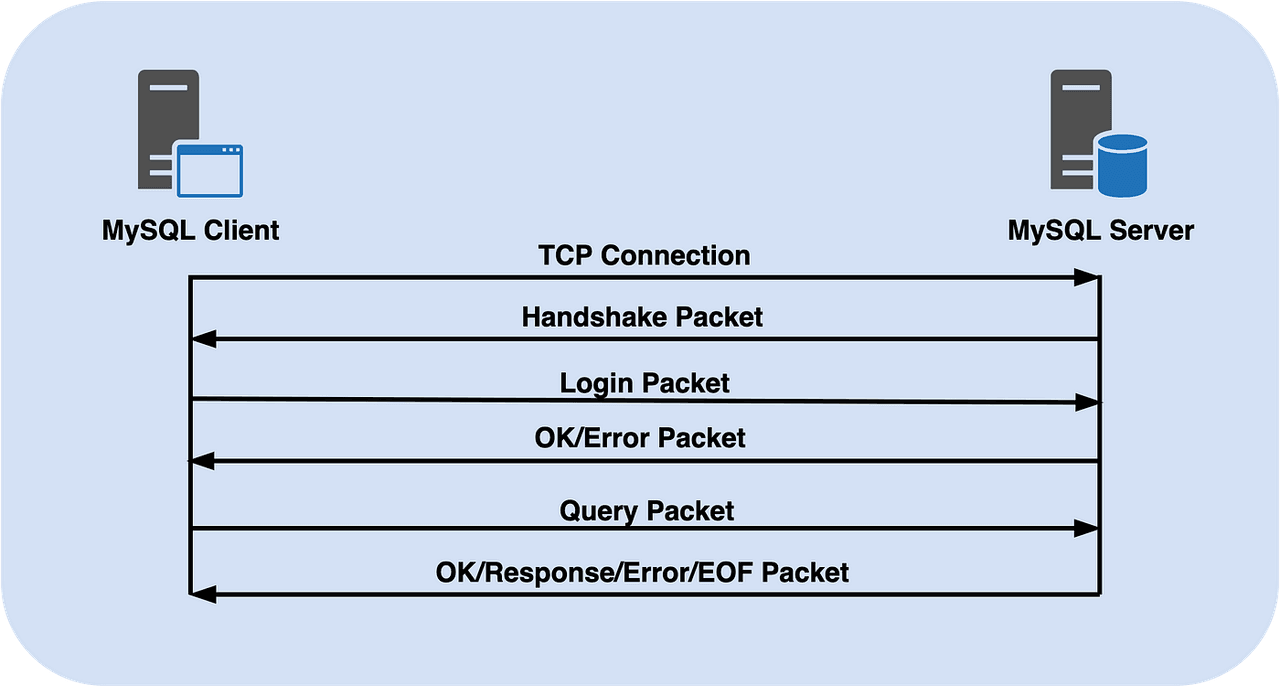
The diagram above illustrates communication between a MySQL client and server. The process proceeds as follows:
This structure is important for illustrating the client-server relationship, error handling, and the sequence of operations.
MySQL is a preferred database management system in many domains due to its scalability, flexibility, and reliability. Its open-source nature makes it accessible to both beginner developers and large enterprise organizations. In modern applications, API-based services, microservices architectures, and multi-tier systems, it has become an indispensable component.
Alex Ravikovich. “Writing MySQL Proxy in Go for Learning Purposes – Part 2.” Medium, 2021. https://alexravikovich.medium.com/writing-mysql-proxy-in-go-for-learning-purposes-part-2-decoding-connection-phase-server-response-7091d87e877e. Accessed May 2025.
Bulutistan. "MySQL Nedir?" Bulutistan Blog. Accessed May 2025.
Coderspace. "MySQL." *Coderspace Sözlük*. https://coderspace.io/sozluk/mysql/. Accessed May 2025.
MySQL Documentation. "What is MySQL?" *MySQL Reference Manual, Version 8.4*. Oracle Corporation. https://dev.mysql.com/doc/refman/8.4/en/what-is-mysql.html. Accessed May 2025.
Oracle. "What Is MySQL?" *Oracle*. Accessed May 2025.
W3Schools. “MySQL Introduction.” W3Schools. Accessed May 2025.

Technical Architecture and Operation
Visual Illustration
Key Features
Use Cases
Advantages and Limitations
Advantages
Limitations