

This article was automatically translated from the original Turkish version.
+1 More
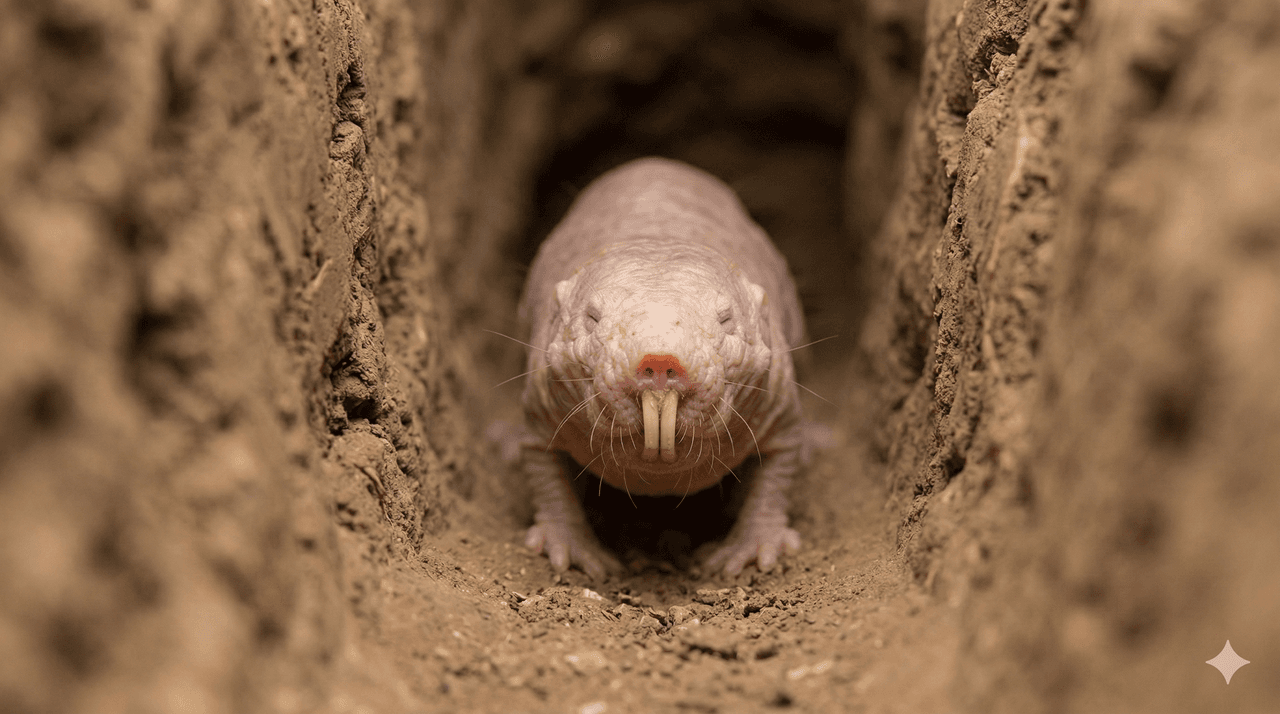
Naked Blind Mouse
(Generated with Artificial Intelligence)
Naked Mole-Rat (Heterocephalus glaber)
Distribution(s) | East Africa Somalia Ethiopia Kenya | ||||||||
|---|---|---|---|---|---|---|---|---|---|
Nutrition | coprophagous Strictly herbivorous | ||||||||
Social Organization | Eusocial | ||||||||
Taxonomy | Order: Rodentia (Rodents), Family: Bathyergidae, Genus: Monotypic | ||||||||
Naked Mole-Rat (Heterocephalus glaber) is a mammalian species belonging to the family Bathyergidae within the order Rodentia. It lives in underground tunnel systems in the arid regions of East Africa and forms eusocial colonies.

Naked Mole-Rat (Heterocephalus glaber)
(Generated by Artificial Intelligence)
The species constitutes a monotypic genus with no morphological variation or genetic diversity within the family Bathyergidae. Its body is cylindrical, adapted for subterranean movement, with short limbs and pinkish-brown skin that is loose and wrinkled. It lacks a standard layer of fur for thermal insulation. Instead, it has thick sensory hairs arranged in regular intervals along its body surface and around the face, functioning like vibrissae for orientation and tactile perception. Its eyes are extremely small, ear flaps are absent, and auditory canals are very narrow.
One of the most distinctive anatomical features of the species is the procumbent incisors, which protrude outside the oral cavity. This structural adaptation prevents the animal from ingesting soil while digging tunnels. Additionally, thanks to a flexible mandibular symphysis, the lower incisors can be moved independently of each other.
There is no pronounced sexual dimorphism within the species; the external genitalia and overall body structures of breeding and non-breeding individuals are very similar. Adult body weights typically range between 25 and 50 grams depending on social status, though individuals reaching up to 110 grams have been recorded.
Naked mole-rats inhabit semi-arid regions encompassing Kenya, Ethiopia, and Somalia. They live in complex, multi-layered, and sealed tunnel systems extending up to 2 meters deep and 1.6 kilometers long. Internal tunnel temperatures exhibit high thermal stability, with annual fluctuations of less than 1°C. However, due to limited ventilation and the respiratory activity of dense colonies, the atmosphere is hypoxic (10–15% oxygen) and hypercapnic (5% carbon dioxide).
Strictly herbivorous, naked mole-rats feed on underground plant roots, bulbs, and tubers. They consume only the inner portions of tubers weighing up to 50 kilograms, then seal the excavated outer areas with soil to allow the plant to regenerate—a form of sustainable foraging. Their digestive systems feature specialized microbial fermentation processes, and they regularly consume their own feces (coprophagy) to obtain essential nutrients, giving them one of the highest digestive efficiencies among mammals.
It is one of only two mammalian species known to exhibit eusociality (living in colonies with rigid division of labor). Colonies, averaging 70 individuals, are organized around a single breeding female (the queen) and one to four breeding males. The remainder of the colony consists of non-reproductive workers and defenders whose reproductive capabilities are suppressed. Smaller individuals perform maintenance tasks such as tunnel digging and food gathering, while larger individuals defend the colony against intruding colonies and predators such as snakes.
Reproductive suppression in non-breeding females is not primarily hormonal but behaviorally controlled through the queen’s pushing and physical aggression. The queen can breed continuously throughout the year, giving birth to up to four litters annually and averaging 12 pups per litter; some litters may contain as many as 29 pups.
This species uniquely exhibits poikilothermic (cold-blooded) traits among mammals and cannot maintain a constant body temperature via endothermic mechanisms within the typical mammalian range of 12°C to 37°C. Its basal metabolic rate is approximately 70% lower than that of other rodents of similar size. Although visual and auditory systems are vestigial, the somatosensory (touch) system is highly developed, occupying one-third of the sensory cortex.
They have evolved a unique insensitivity to chemical and inflammatory pain, unlike all other mammals. They show no behavioral pain response to substances such as acid or capsaicin, which normally cause severe pain, because their nerve fibers lack the neurotransmitters Substance P and calcitonin gene-related peptide (CGRP), which transmit pain signals. This absence is an obligatory evolutionary adaptation to the persistently acidic subterranean environment, characterized by high levels of carbon dioxide and ammonia. Their underdeveloped lung alveoli and hemoglobin molecules with significantly higher oxygen affinity than those of other mammals also enable survival in hypoxic underground conditions.
Liver cells (hepatocytes) of the naked mole-rat differ strikingly from those of standard mammalian models. In laboratory mice, the rough endoplasmic reticulum (RER) occupies approximately 17% of the cell volume, while the smooth endoplasmic reticulum (SER) accounts for only 2.5%, and this structural ratio remains constant throughout life. In contrast, even in one-week-old naked mole-rats, the SER occupies 35.15% of the cell area. This area continues to grow without plateauing with age, reaching 62.89% of hepatocyte volume in 11-year-old individuals. During this period, the RER proportion declines from 12.84% to around 6.52%.
The spatial organization of mitochondria within hepatocytes also differs from that of mice: in mice, mitochondria are homogeneously distributed, whereas in naked mole-rats, they cluster around the nucleus and in peripheral regions of the cell. This unprecedented SER hypertrophy and mitochondrial organization directly support the animal’s highly efficient protein degradation (ubiquitin-proteasome) systems, lifelong detoxification mechanisms against endogenous and exogenous toxins (hormetic response), and the management of glycogen stores that are ten times denser than those in mice.
Naked mole-rats exceed the expected mammalian lifespan for their body size by 5.3 times, surviving over 30 years under laboratory conditions and holding the title of the longest-lived rodent known. They exhibit negligible senescence: for at least 85% of their maximum lifespan, they maintain cardiovascular systems, reproductive potential, bone structure, and lean muscle mass at youthful levels and show no age-related increase in mortality risk.
Despite accumulating high levels of oxidative damage from early life, their cells possess an exceptional capacity to tolerate this damage and maintain protein stability. Furthermore, no clinical evidence of spontaneous neoplasia (cancer) has ever been detected in this species.
The naked mole-rat is a subterranean mammal native to the arid and semi-arid regions of East Africa, particularly Kenya, Ethiopia, and Somalia. The species has a wide geographic distribution, and its populations are generally considered stable across many areas. Consequently, the International Union for Conservation of Nature (IUCN) classifies it as being of low risk.
Nevertheless, the species is not entirely free from threats. Expansion of agricultural activities, degradation of soil structure, and human-induced changes in land use can impact subterranean habitats. As a species entirely dependent on underground tunnel systems, it is vulnerable to habitat loss caused by intensive soil cultivation and infrastructure development. Additionally, climate change altering vegetation patterns in arid regions may indirectly affect the distribution of its food resources.
The most important conservation approach is the protection of its natural habitats and the sustainable management of semi-arid ecosystems. Research into the biological significance of subterranean ecosystems is enhancing understanding of this species’ ecological role. Naked mole-rat colonies play a vital role in their habitat by contributing to soil aeration and influencing nutrient cycling within underground ecosystems. Therefore, habitat conservation is not only critical for this species but also for other organisms sharing the same ecosystem.
Buffenstein, Rochelle, Thomas Park, Martha Hanes, and James E. Artwohl. "Naked Mole Rat." In *The Laboratory Rabbit, Guinea Pig, Hamster, and Other Rodents*, 1055-1074. Elsevier, 2012. Accessed March 6, 2026. https://pmc.ncbi.nlm.nih.gov/articles/PMC7149588/pdf/main.pdf
Hess, Jon, Stan Braude, Colleen Ingram, and Alan Templeton. "Population genetics of the naked mole-rat Heterocephalus glaber: The role of rivers in shaping genetic structure." *Frontiers in Ecology and Evolution* 10 (2022): 857660. Accessed March 6, 2026. https://www.researchgate.net/publication/362766530_Population_genetics_of_the_naked_mole-rat_Heterocephalus_glaber_The_role_of_rivers_in_shaping_genetic_structure
Vays, Valeriya, Irina Vangeli, Chupalav Eldarov, Vasily Popkov, Susanne Holtze, Thomas Hildebrandt, Olga Averina, Dmitry Zorov, and Lora Bakeeva. "Unique Features of the Tissue Structure in the Naked Mole Rat (Heterocephalus glaber): Hypertrophy of the Endoplasmic Reticulum and Spatial Mitochondrial Rearrangements in Hepatocytes." *International Journal of Molecular Sciences* 23, no. 16 (2022): 9067. Accessed March 6, 2026. https://pdfs.semanticscholar.org/dc93/d4636321801910f2bd96b3feceed6a08a880.pdf

Naked Blind Mouse
(Generated with Artificial Intelligence)
Naked Mole-Rat (Heterocephalus glaber)
Distribution(s) | East Africa Somalia Ethiopia Kenya | ||||||||
|---|---|---|---|---|---|---|---|---|---|
Nutrition | coprophagous Strictly herbivorous | ||||||||
Social Organization | Eusocial | ||||||||
Taxonomy | Order: Rodentia (Rodents), Family: Bathyergidae, Genus: Monotypic | ||||||||
No Discussion Added Yet
Start discussion for "Naked Mole-Rat (Heterocephalus glaber)" article
Taxonomy and Physical Characteristics
Natural Habitat and Ecology
Eusocial Colony Structure and Reproductive Behavior
Physiology, Sensory Systems, and Pain Insensitivity
Cellular Structure and Endoplasmic Reticulum Hypertrophy
Aging and Disease Resistance
Conservation Status and Threats