


This article was automatically translated from the original Turkish version.
+1 More
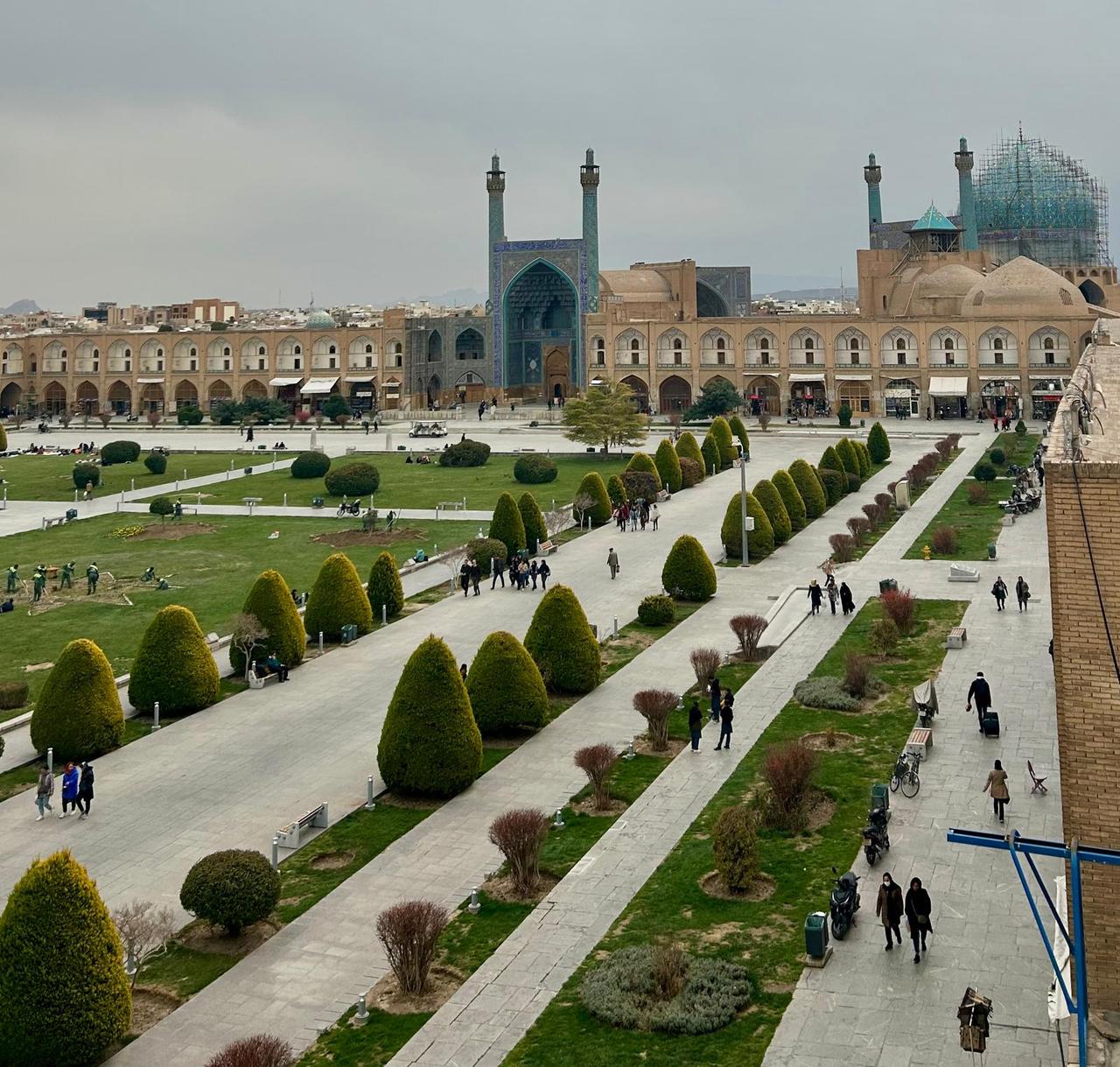
(Photo: Duygu Şahinler)
Nakş-ı Cihan Square
Designations | Nakş-ı Cihan, Meydân-ı Şah, İmam Meydanı | ||||||||
|---|---|---|---|---|---|---|---|---|---|
Size(s) | 524 × 159 m | ||||||||
Surrounding Monuments | Kayseriye Pazarı, Şah (İmam) Mescidi, Şeyh Lütfullah Mescidi, Ali Kapu Sarayı | ||||||||
Nakş-ı Cihan Meydanı is a large rectangular public space, designed under the patronage of Safavid Shah Abbas I as the primary commercial, religious, and ceremonial center of the new capital, Isfahan, surrounded on all sides by a covered bazaar composed of two-story rows of shops.
To the north lies the Qaysariyye Bazaar, to the west the Ali Qapu Palace, to the east the Sheikh Lotfollah Mosque, and to the south the Shah (Imam) Mosque. The square and its monumental surroundings were completed in two phases over approximately forty years.
The square measures 524 by 159 meters. Its sides were constructed during the Safavid period and are enclosed by mosques, palaces, and commercial buildings. Today, access is provided through three main pedestrian entrances: two on the west and one on the east.
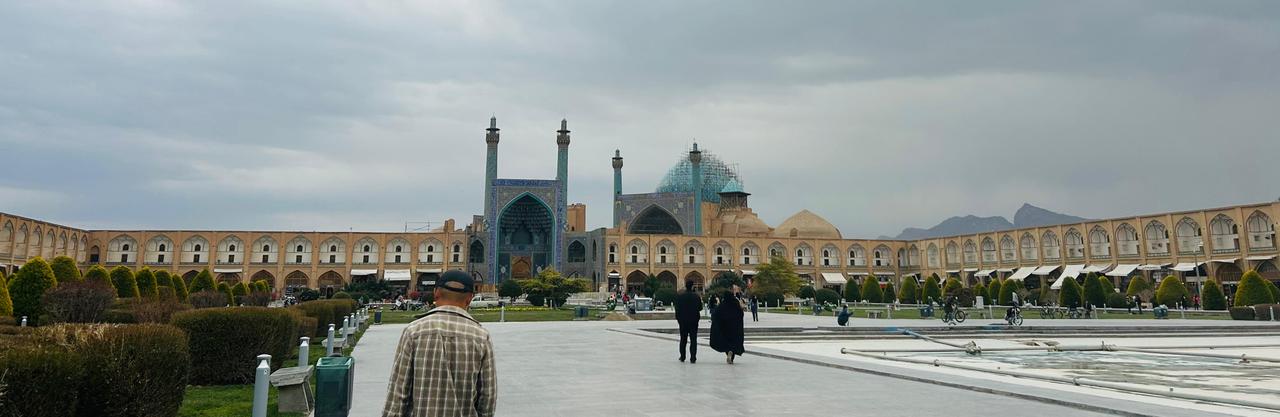
Nakş-ı Cihan Meydanı (Photograph: Duygu Şahinler)
The square is a rectangular central space measuring 524 by 159 meters, bounded on all sides by monumental structures from the Safavid period—mosques, palaces, and commercial buildings—and today features three main pedestrian entrances: two on the west and one on the east.
The spatial layout is defined by the placement of four monumental buildings: the Qaysariyye on the north, the Shah/Imam Mosque on the south, the Sheikh Lotfollah Mosque on the east, and the Ali Qapu Palace on the west. The Qaysariyye and the Shah Mosque face each other along the central axis, while the Sheikh Lotfollah Mosque and the Ali Qapu Palace are not positioned at the exact center of their respective facades but slightly southward, along a “one-third” axis. This arrangement, combined with the pointed-arch rhythm of the surrounding arcades, enhances the visual harmony and symmetrical impact of the space. The spatial schema follows the “open courtyard with four iwan” plan.
All four sides are enclosed by a covered rectangular bazaar (çehâr bāzār) consisting of two rows of shops, totaling approximately 200 units. Each shop in the first row has two doors: one opening onto the square and the other onto the enclosed corridor between the two rows. The upper floors of the first-row shops are defined by white-painted balconies facing the square. The second-row shops open only onto the corridor. The wide corridor between the two rows is covered by small domes and has a high ceiling.
On the northern side, the rows of shops and their roofs are designed twice as wide as those on the other sides; this extended canopy served as a “temâşâgâh” (viewing terrace) for the monarch to observe activities in the square.
Nakş-ı Cihan Meydanı is defined by four main monuments:
The Qaysariyye and the Shah Mosque are aligned on the central axis, while the Ali Qapu Palace and the Sheikh Lotfollah Mosque are positioned slightly south of the center of their respective facades, creating a deliberate asymmetry that contributes to the overall compositional balance. The pointed-arch rhythm of the facades and the placement of the four monumental portals reinforce the square’s visual coherence.
Centered on the northern facade, the Qaysariyye Bazaar stands out with its two-story arcaded entrance courtyard, a semicircular grand portal, and a small square pool at its center. Flanking the entrance iwan are arcades, while the entrance walls feature paintings depicting hunting, warfare, and musical gatherings, and paired wings display square Kufic script panels. This iconographic program is linked to the square’s concept of “nakş” (design or image).
Located on the eastern facade, slightly south of center, the mosque has been referred to in historical sources under various names; since the late 17th century, it has commonly been known as the Sheikh Lotfollah Mosque. According to accounts, Shah Abbas I brought Sheikh Lotfollah to Isfahan in 1594 and ordered the construction of a mosque under his supervision.
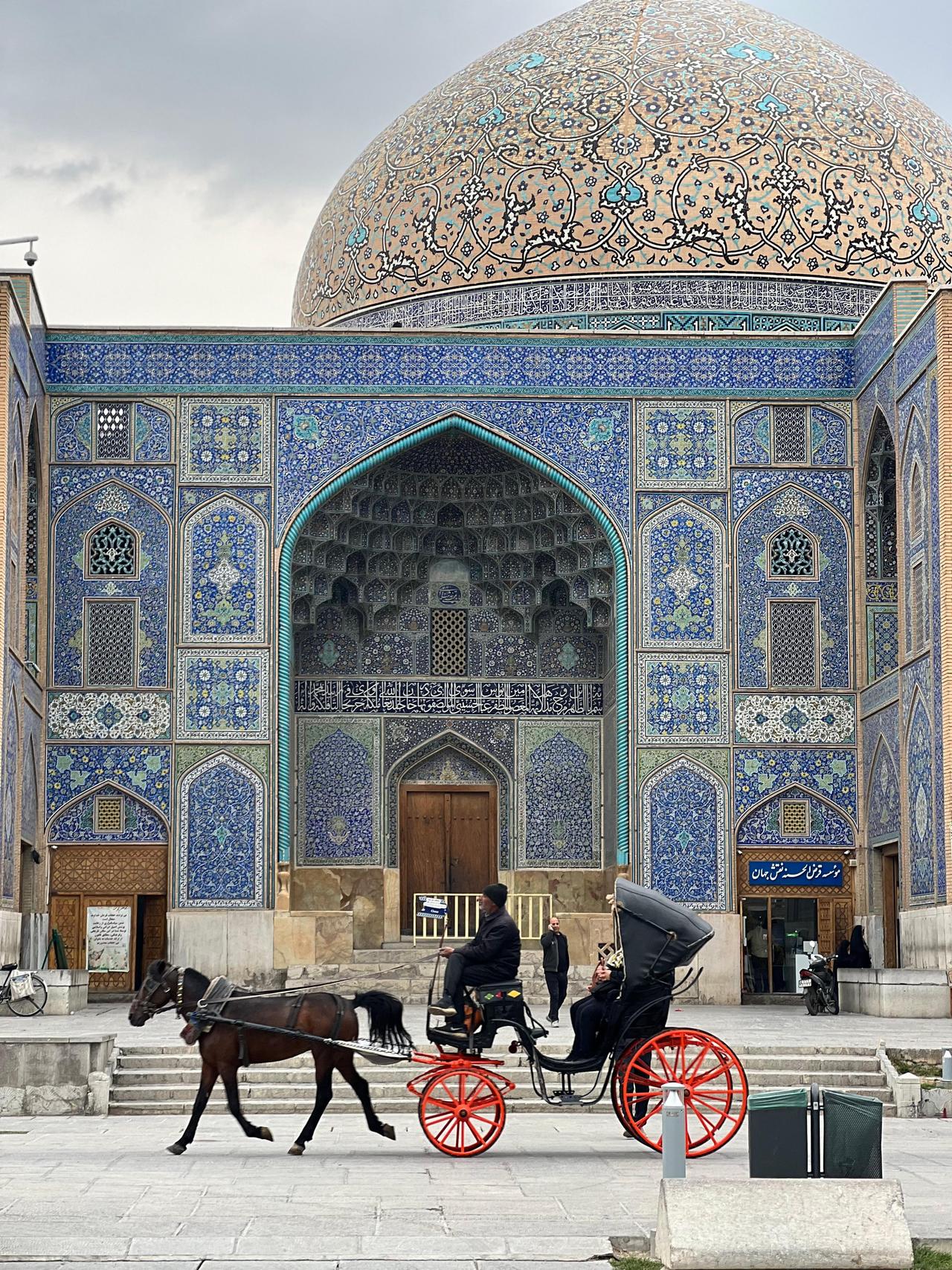
View of the Sheikh Lotfollah Mosque from the Nakş-ı Cihan Meydanı facade (Photograph: Duygu Şahinler)
Located precisely at the center of the southern side, the Shah Mosque is positioned directly opposite the Qaysariyye Bazaar along the central axis; this axial alignment defines the square’s primary perspective and ceremonial orientation.
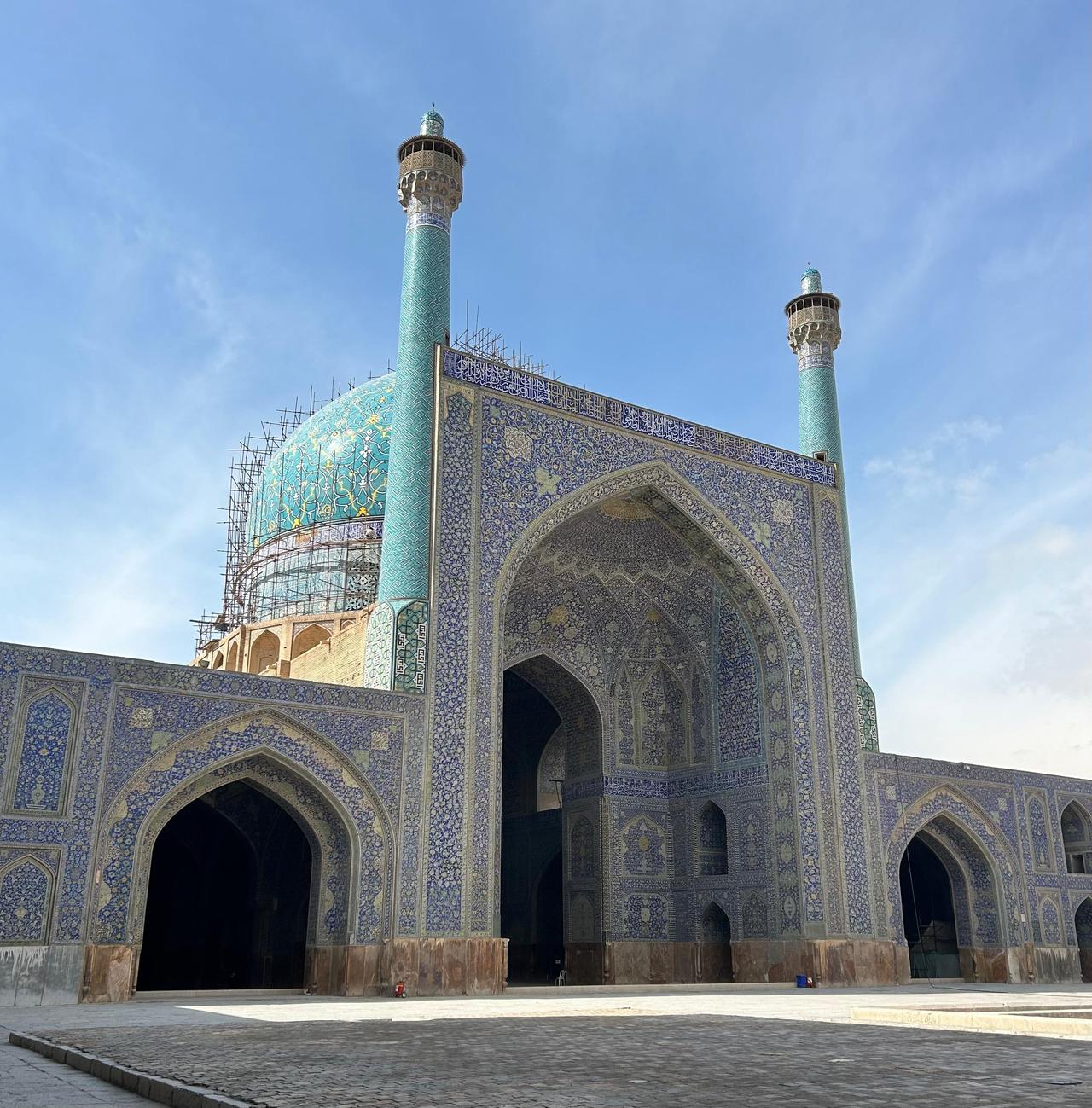
Shah Mosque (Photograph: Duygu Şahinler)
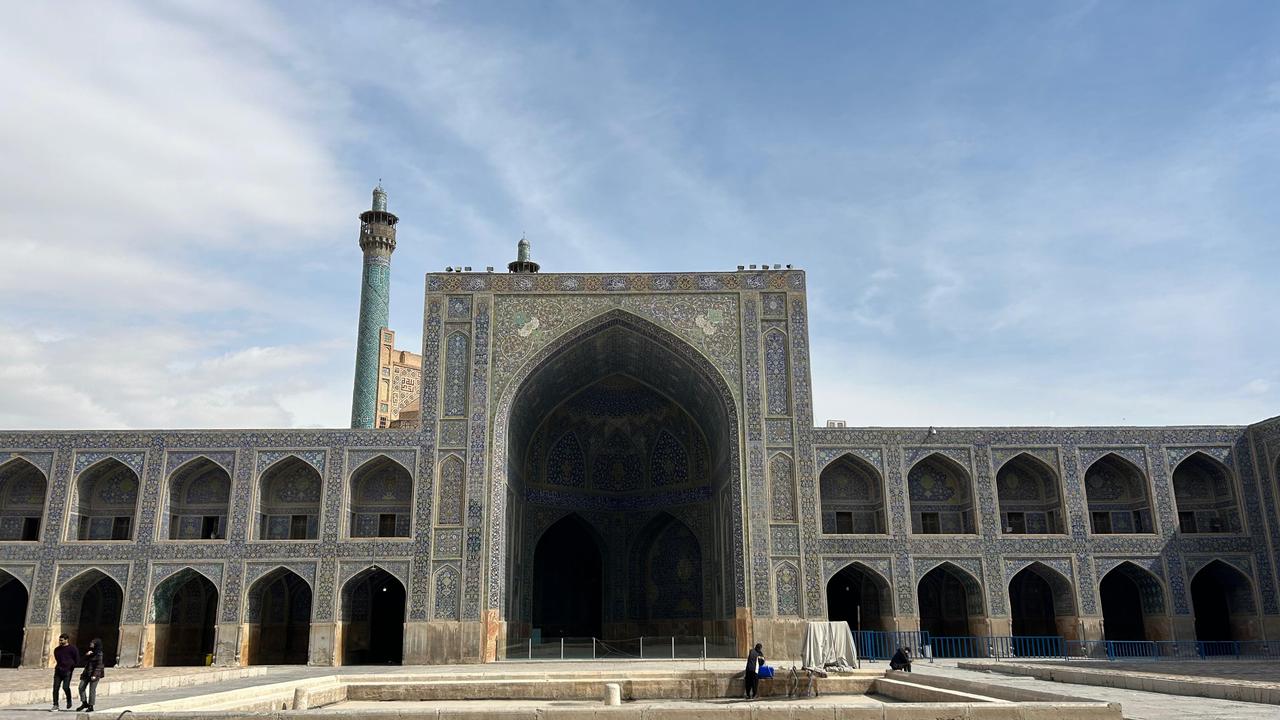
Shah Mosque (Photograph: Duygu Şahinler)
Located on the western facade, slightly south of center, Ali Qapu Palace is considered one of the finest examples of the Safavid palace-square model. Construction began during the reign of Shah Abbas I and was completed in its current five-story form during the reign of Shah Abbas II; the lower two stories were designated for administrative functions, while the upper floors were reserved for receptions, banquets, and entertainment. The wooden-columned semi-open talār section facing the square was used for viewing ceremonies and festivities; the palace’s gate opening onto the square was regarded as a “sacred threshold.”
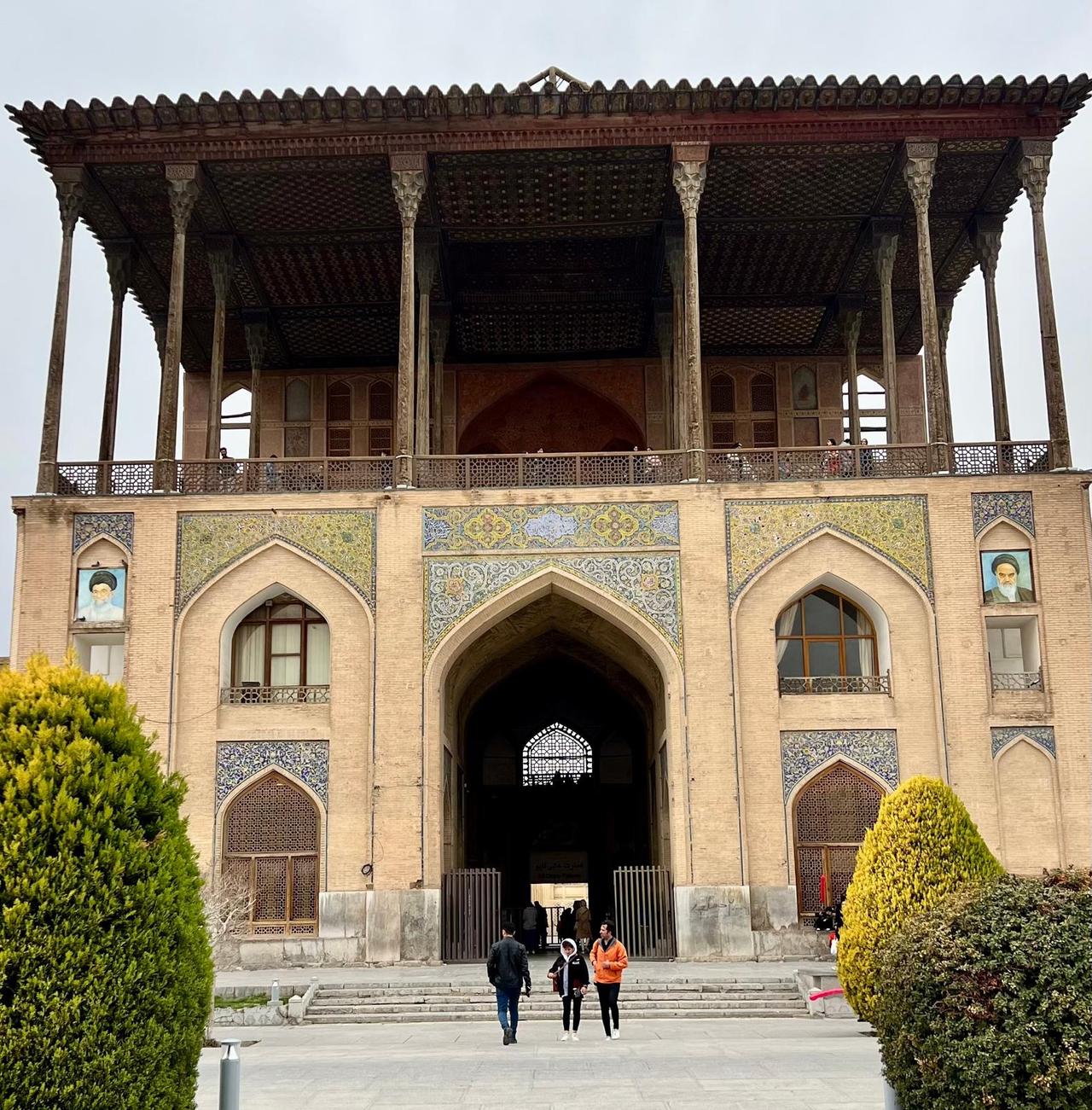
Ali Qapu (Photograph: Duygu Şahinler)
The four sides of the square are enclosed by a covered rectangular bazaar (çehâr bāzār) consisting of two rows of shops, totaling approximately 200 units. Each shop in the first row has two doors: one opening onto the square and the other onto the enclosed corridor between the two rows. The upper floors of the first-row shops are marked by white-painted balconies facing the square. The second-row shops open only onto the inner corridor. The wide corridor between the two rows is covered by evenly spaced small domes; according to accounts, its width is sufficient for two camels to walk side by side comfortably.
The northern side of the bazaar differs: the two rows of shops and their roofs are designed twice as wide as those on the other sides. This extended canopy served as a temâşâgâh (viewing terrace) for Safavid shahs to observe activities in the square; today, this section functions as a museum and café, offering views of the square.
The entrance to the Qaysariyye, centered on the northern facade, features a courtyard surrounded by two-story arcades, a central square pool, and a grand semicircular portal. The entrance walls are adorned with paintings depicting musical gatherings, hunting, and warfare, while paired wings display square Kufic script panels.
This bazaar ring, together with the pointed-arch arcade rhythm and the placement of the four monumental portals, functions as a unified urban “perimeter wall,” sustaining the square’s commercial and circulation functions while supporting its ceremonial and viewing programs.
The shops lining the bazaar surrounding Nakş-ı Cihan Meydanı and the commercial units within the Qaysariyye were not merely leased for commercial activity but were rented out to generate steady income for waqf institutions, as was customary in classical Islamic cities. In 1604–1605 (H. 1013), Shah Abbas I established a waqf document before the entire complex was fully completed, stipulating that half of the rental income from the Qaysariyye and surrounding shops be allocated as salaries to the Husayni sayyids and sayyidahs in Medina, and the other half to those in Najaf, to secure their livelihoods.
The primary source of the waqf’s income came from the two-tiered shop rows surrounding the square and the artisanal and merchant workshops located at the entrance and vicinity of the Qaysariyye (e.g., jewelers and textile merchants); coffeehouses were also present in this same zone. The nakkāra-khāna and the dār al-sikka-yi humāyūn, integrated into the Qaysariyye complex, served as complementary units reinforcing the square’s economic and ceremonial functions; it is known that the mint produced gold coins one day, silver the next, and copper the following day.
The shops adjacent to the portal of the Shah Mosque were also directly tied to the waqf system. The mosque’s waqf document mentions “two bookbinders and two apothecaries” located at the entrance; such storefronts ensured a steady flow of income to the religious structure.
The exact identity of the designer(s) of the square and its surrounding monumental structures remains uncertain. Only one contemporary account (by Yazdī, the court astrologer of Shah Abbas) claims that the Shah himself conceived the square as a layout with a water channel and plane trees lining its long and short sides. However, the reliability of this claim is debated. There is no evidence that Shah Abbas had formal training in architecture or engineering; it is more likely that he outlined general concepts, which were then detailed by experts in architecture and engineering.
Among local popular narratives, Sheikh Bahāʾ al-Dīn Āmulī (d. 1621), who held the position of Shaykh al-Islām of Isfahan and enjoyed court patronage, emerges as a likely key figure in the design or execution of the square due to his advanced knowledge of mathematics and engineering. His authorship of a summary of the Shah Mosque’s waqf document further strengthens this possibility.
On the practical architectural front, Ali Akbar Isfahani, mentioned as the “mimar” (architect) in inscriptions on the portal of the Shah Mosque and identified as the chief architect of the period, is the most concretely documented figure associated with the implementation of the square’s project. Although direct evidence is lacking, it is highly probable that, in his capacity as chief architect, he also oversaw the construction of the other surrounding structures.
The square and its surrounding monumental structures were built in two major phases, with the entire composition taking approximately forty years to complete. The first phase began in the 1590s and extended to 1602–1603; the second phase lasted from 1602–1603 into the 1630s.
Initial planning and designs: The plan for the Qaysariyye Bazaar was drawn up in 1590/91; similar decisions for the Ali Qapu Palace and the Sheikh Lotfollah Mosque were made in the same years.
Construction commencement: Following the demolition of the old Qaysariyye, construction of the new Qaysariyye and the surrounding bazaar began in 1592–1593; by 1593–1594, the construction was “excavated.”
1595 testimony: During the first phase, the square was enclosed by a built perimeter with plastered and painted facades.
Key completion: The main body of the Qaysariyye (excluding its entrance) was completed in 1602–1603.
Opening of the phase and early works: The portal of the Sheikh Lotfollah Mosque was completed in 1603–1604.
1610s “contemporaneous portals”: The monumental entrance of the Qaysariyye and that of the Shah Mosque were completed in 1616–1617; the dome of the Sheikh Lotfollah Mosque dates from the same period.
Completion markers for Sheikh Lotfollah: The mihrab bears the date 1618–1619; the main sections of the building were thus in place by these years.
Extended completion of the Shah Mosque: The iwan, madrasa cells, and congregational areas of the mosque, begun in 1611, were completed at different dates between 1625–1626 and 1635–1636.
Layered development of Ali Qapu: The structure began as a two-story building under Shah Abbas I; three additional stories were added under Shah Abbas II, who also added the semi-open talār section facing the square.
Urban landscape additions: The water channel and tree planting surrounding the square were implemented during this second phase.
Nakş-ı Cihan lies south of Harun-ı Velayet Square, which had served as Isfahan’s commercial, religious, and ceremonial center before and during the early Safavid period. By the 17th century, the city’s central functions had effectively shifted to this new square.
According to chronicles, the process began with Shah Abbas I’s order in the early 1590s to renovate the shops and bazaars around Harun-ı Velayet, while simultaneously commissioning plans for a new Qaysariyye and a new square. This simultaneity reveals the monarch’s intention to maintain two distinct squares in the new capital. This situation is interpreted as a continuation of the model implemented by Shah Abbas I’s grandfather, Shah Tahmasb, in Qazvin.
In the comprehensive re-planning of Isfahan as the Safavid capital, Nakş-ı Cihan was positioned as the city’s primary ceremonial and social center within a broader wave of monumental construction under royal patronage. This extensive urban transformation reshaped the city with new monuments and neighborhoods.
The axial pathways and rectangular grassy islands in the center of the square evoke the widespread Safavid garden scheme known as “chahār bāgh.” Together with the green belt along the perimeter and surrounding pathways, this landscape creates a “garden-square” effect at the urban scale. This arrangement has changed in the modern era; the large central pool and expansive green areas did not exist during the Safavid period.
The shift of the urban center from Harun-ı Velayet to Nakş-ı Cihan was shaped within Shah Abbas I’s “two-square” concept; the new square became the principal urban stage, integrating commerce, ceremony, and religious representation on a capital-city scale.
Gürkan Anar, Damla. “Nakş-ı Cihan Meydanı: Mekân, Mimari ve Kronoloji.” *Belleten* 88, no. 313 (December 2024): 771–810. Accessed October 1, 2025. https://belleten.gov.tr/tam-metin/3773/tur

(Photo: Duygu Şahinler)
Nakş-ı Cihan Square
Designations | Nakş-ı Cihan, Meydân-ı Şah, İmam Meydanı | ||||||||
|---|---|---|---|---|---|---|---|---|---|
Size(s) | 524 × 159 m | ||||||||
Surrounding Monuments | Kayseriye Pazarı, Şah (İmam) Mescidi, Şeyh Lütfullah Mescidi, Ali Kapu Sarayı | ||||||||
No Discussion Added Yet
Start discussion for "Nakş-ı Cihan Square" article
Dimensions, Plan, and Spatial Composition
Monumental Structures Surrounding the Square
Qaysariyye (Qaysariyye) Bazaar and Entrance
Sheikh Lotfollah Mosque
Shah Mosque (Imam Mosque)
Ali Qapu Palace
Bazaar Ring and Shop Organization
Endowment, Economy, and Patronage
Endowment System and Allocations
Revenue Sources and Commercial Ecosystem
Design and Patronage
Construction Phases and Chronology
First Phase (1590s – 1602/03)
Second Phase (1602/03 – 1630s)
Relationship with Previous Centers