

 Recently Added:
This article was automatically translated from the original Turkish version.
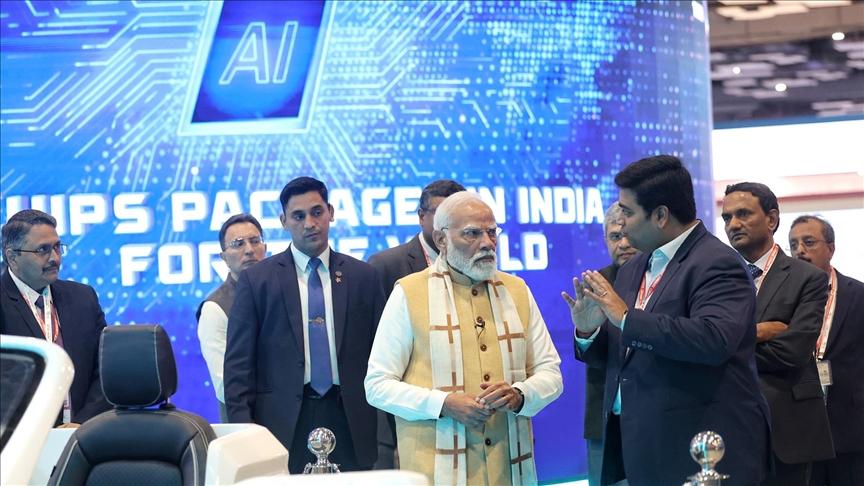
The New Delhi AI Summit was held in February 2026 at the Bharat Mandapam convention center in New Delhi the capital of India. The summit was hosted by the Government of India and brought together numerous heads of state government representatives technology company executives and representatives of international organizations. The opening session was delivered by Indian Prime Minister Narendra Modi who emphasized that artificial intelligence must be developed with a human centered ethical and inclusive approach. It was stressed that AI technologies must be governed through a global framework of shared responsibility.
During the early days of the summit high level addresses and thematic panels were held. United Nations Secretary General António Guterres noted that artificial intelligence must not exacerbate global inequalities and highlighted the importance of ensuring that developing countries have guaranteed access to these technologies. Sessions held under the summit agenda addressed AI’s impact on economic transformation digital infrastructure ethical norms and security dimensions.
In subsequent sessions international cooperation and regulation came to the forefront. French President Emmanuel Macron participated in the summit and stated that India and France must work together to shape global AI rules. During the same period some planned high level speeches at the summit underwent program changes.
The summit served as a platform for intensive multilateral diplomatic engagement. Narendra Modi stated that democratic values and the principle of transparency must underpin global governance of artificial intelligence. It was emphasized that stronger international coordination is required to ensure AI is used for the benefit of humanity.
Emmanuel Macron declared that France and India must act jointly on AI regulation. It was noted that regulatory approaches from Europe must be taken into account in establishing global norms. In this context the importance of multilateral cooperation was underscored.
United Nations Secretary General Guterres warned of the risks of AI systems remaining under the control of only a few large technology corporations. He stressed the need for a more inclusive governance model to prevent deepening the global digital divide. Statements made at the summit demonstrated that artificial intelligence has firmly taken center stage in the international political agenda.
Technical infrastructure and AI investments were key topics at the summit. India presented its initiatives to enhance national AI capacity. Large scale data centers infrastructure requiring high computational power and cloud systems were highlighted on the agenda.
Global technology companies announced plans for billions of dollars in investments in AI within India. These investments are aimed at increasing data processing capacity advancing the local innovation ecosystem and accelerating digital transformation. These developments are linked to India’s strategy to establish a central position in the global AI ecosystem.
Technical presentations were also delivered on AI applications in healthcare agriculture public services and education. Topics such as big data analytics machine learning models and algorithmic decision systems were examined in detail. The energy consumption and sustainability dimensions of AI infrastructure were also discussed.
It was noted that AI investments have grown rapidly on a global scale reaching trillions of dollars by 2026. It was stated that artificial intelligence is transforming economic systems through increased productivity automation and data driven decision making.
India’s strategy to attract global investment in its AI sector has become central to its economic agenda. Infrastructure investments and research and development expenditures by major tech firms are linked to the country’s plans to expand its digital economy. These investments are expected to impact employment technology transfer and innovation capacity.
It was emphasized that developing countries must not be economically excluded from AI. Mechanisms for financing and capacity building to ensure access to AI infrastructure for Global South nations were called for.
A key focus of the summit was AI regulation and ethical frameworks. It was stated that global AI rules must be established. The necessity of developing international norms and defining common standards was underscored.
Narendra Modi stated that artificial intelligence must be human centered. It was emphasized that AI systems must be designed to be transparent accountable and secure. Attention was drawn to balancing technological advancement with ethical responsibility.
United Nations Secretary General Guterres stated that preventive regulations must be developed to counter AI’s potential to increase global inequalities. A call was made to strengthen global digital governance mechanisms.
The security dimension of AI was also addressed at the summit. Risks of misuse disinformation and cybersecurity were brought to the agenda. It was stated that the military and strategic implications of AI are critical to global stability.
Digital security and the protection of children online were discussed. The risks of AI systems generating harmful content and enabling manipulation were examined. It was stated that regulatory mechanisms must be strengthened in this context.
It was stated that AI capacity plays a decisive role in shaping states economic and security policies. It was noted that AI has become a strategic element within the context of global power balances.
Al Jazeera. "World Leaders Discuss AI Future at India’s Global Summit in New Delhi." February 19, 2026. Accessed February 19, 2026. https://www.aljazeera.com/news/2026/2/19/world-leaders-discuss-ai-future-at-indias-global-summit-in-new-delhi.
Anadolu Ajansı. "France, India Must Shape AI Rules Together, Says Macron." Accessed February 19, 2026. https://www.aa.com.tr/en/europe/france-india-must-shape-ai-rules-together-says-macron/3834322.
BBC News. "Bill Gates Pulls Out of India's AI Summit Over Epstein Files Controversy." Accessed February 19, 2026. https://www.bbc.com/news/articles/c309qv9zglno.
NDTV. "AI Summit 2026 LIVE Updates, Day 4: PM Modi Addresses AI Impact Summit." Accessed February 19, 2026. https://www.ndtv.com/india-news/india-ai-impact-summit-2026-live-updates-bharat-mandapam-new-delhi-global-tech-leaders-pm-modi-to-inaugurate-ai-impact-summit-day-4-emmanuel-macron-11056518.
Reuters. "Bill Gates Pulls Out of India AI Summit; Anger Mounts Over Organisational Lapses." February 19, 2026. Accessed February 19, 2026. https://www.reuters.com/world/india/bill-gates-cancels-keynote-address-india-ai-summit-2026-02-19/.
TRT World. "Bill Gates Pulls Out of India AI Summit Amid Epstein Fallout." Accessed February 19, 2026. https://www.trtworld.com/article/921a5f6f8364/amp.

At the AI Summit held in New Delhi, world leaders discussed the future of artificial intelligence. Indian Prime Minister Narendra Modi and French President Emmanuel Macron called for the joint establishment of global AI regulations, while technology companies committed to billions of dollars in investment.
No Discussion Added Yet
Start discussion for "New Delhi Artificial Intelligence Summit (16–19 February 2026)" article
February 19, 2026
Political and Diplomatic Dimension
February 19, 2026
Technical and Industrial Dimension
February 19, 2026
Economic Dimension
February 19, 2026
Conceptual and Regulatory Dimension
February 19, 2026
Security and Strategic Dimension