


This article was automatically translated from the original Turkish version.
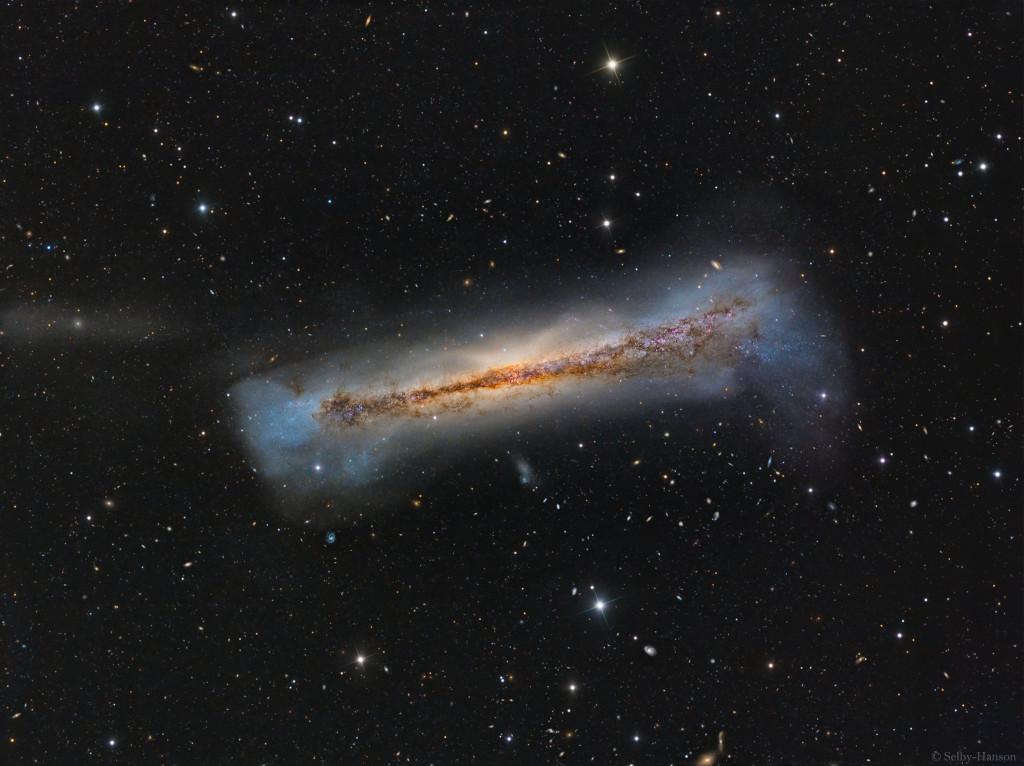
NGC 3628 Galaxy
Galaxy Type | SBa–Sc | ||||||||
|---|---|---|---|---|---|---|---|---|---|
Constellation | Leo (Aslan) | ||||||||
Approximate Distance | 35 million light years | ||||||||
Actual Diameter | Approximately 100,000 light years | ||||||||
NGC 3628 Galaxy is a barless spiral galaxy located in the constellation Leo, viewed edge-on. Although it is commonly referred to in astronomical sources as the "Hamburger Galaxy," such informal names are not used in academic contexts. NGC 3628 is a member of the "Leo Triplet," a group of galaxies that also includes Messier 65 (M65) and Messier 66 (M66). This structure constitutes an important area of study, particularly for observing interactive galaxy dynamics and external gravitational influences.

NGC 3628 Galaxy (NASA)
NGC 3628 was discovered on 8 April 1784 by the German-British astronomer William Herschel. It was later included in the New General Catalogue (NGC) published in the late 19th century with the designation 3628. Early observations were limited to visual telescopes, but from the 20th century onward, more comprehensive analyses were conducted using advancing spectroscopic and radio astronomical techniques.
NGC 3628 has a morphological type intermediate between SBb and Sc according to the Hubble classification system. However, this classification may contain some uncertainty due to the galaxy's edge-on orientation. The galaxy has a diameter of approximately 100,000 light years and is characterized by a prominent dark dust lane. This dust lane extends along the plane of the galaxy in its optical image and provides information on the distribution of interstellar matter.
NGC 3628 is rich in hydrogen (H I) and molecular gas, particularly carbon monoxide (CO). This indicates the presence of active star-forming regions within the galaxy. Infrared and radio wavelength observations have revealed intense star formation and the existence of supernova remnants in its central region. Studies also show that the galaxy's planar velocity structure is disturbed, likely due to interactive galaxy dynamics.
NGC 3628 is gravitationally interacting with the other galaxies in the Leo Triplet, namely Messier 65 and Messier 66. Particularly notable is a tidal tail extending outward from NGC 3628, approximately 300,000 light years in length, which serves as a clear indicator of such interactions. The structure of this tail provides an important example for studying dynamic processes such as intergalactic matter transfer, triggered star formation, and structural distortions.
NGC 3628 has been observed across multiple wavelengths, including optical, infrared, ultraviolet, X-ray, and radio bands. Observations made with the Chandra X-ray Observatory have revealed intense X-ray emission from the galaxy's center, associated with active star-forming regions and probable supernova remnants. Infrared data obtained by the Spitzer Space Telescope have been used to map dust density distributions.
Rotation curves of NGC 3628 show velocities higher than expected, especially in its outer regions. This observational evidence indicates the presence of a significant dark matter halo. Modeling the distribution of dark matter is used in analyzing both internal galactic dynamics and intergalactic interactions. In this context, NGC 3628 is regarded as a key case study in dark matter research.
NGC 3628 serves as an important example for numerous areas of astrophysical research, including galaxy evolution, galaxy interactions, and star formation processes. The study of its tidal tail and dense star-forming regions provides insight into how galaxy mergers and collisions occur on cosmological timescales. Additionally, the galaxy's dark matter structure is valuable for modeling the distribution of dark matter in the local universe.
In summary, NGC 3628 is a barless spiral galaxy located in the constellation Leo and observed edge-on. Its structural features, star-forming regions, gas density, and interactive galactic dynamics make it a favorable subject for astrophysical studies. Due to its interactions within the Leo Triplet and its extended tidal tail, NGC 3628 has been the focus of numerous observational and theoretical studies on galaxy evolution and dark matter.
Coles, Eric., and Helm, Mel. “NGC 3628: The Hamburger Galaxy.” *Astronomy Picture of the Day (APOD)*, May 3, 2017. https://apod.nasa.gov/apod/ap170503.html.
Hanson, Mark, and Selby, Mike. “Portrait of NGC 3628” *Astronomy Picture of the Day (APOD)*, April 14, 2023. https://apod.nasa.gov/apod/ap230414.html.
Lodge, Jonathan. “Hamburger Galaxy – NGC 3628.” *Telescope Live*. Accessed May 31, 2025. https://telescope.live/gallery/hamburger-galaxy-ngc-3628.
Telescope Live. "NGC 3628." *Telescope Live*. Accessed May 31, 2025. https://telescope.live/gallery/ngc-36287#:~:text=NGC%203628%2C%20named%20the%20Hamburger,Triplet%2C%20a%20small%20galaxy%20group.

NGC 3628 Galaxy
Galaxy Type | SBa–Sc | ||||||||
|---|---|---|---|---|---|---|---|---|---|
Constellation | Leo (Aslan) | ||||||||
Approximate Distance | 35 million light years | ||||||||
Actual Diameter | Approximately 100,000 light years | ||||||||
Discovery and Initial Observations
Structural Properties
Interaction with the Leo Triplet and Multi-wavelength Observations
Halo Structure and Scientific Significance