


This article was automatically translated from the original Turkish version.
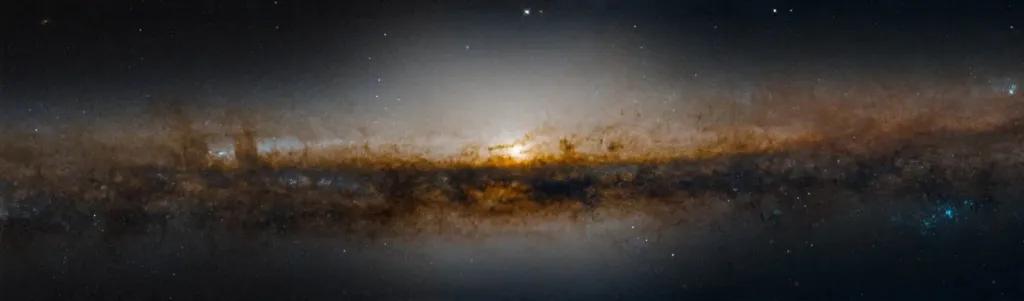
NGC 4565 Galaxy
Alternative Names | Needle Galaxy PGC 42038 UGC 7772 Caldwell 38 | ||||||||
|---|---|---|---|---|---|---|---|---|---|
Constellation | Coma Berenices (Berenis'in Saçı) | ||||||||
Galaxy Type | SA(s)b | ||||||||
Discovery(ies) | William Herschel 6 April 1785 | ||||||||
NGC 4565 Galaxy is a spiral galaxy located in the direction of the Coma Berenices constellation and viewed nearly edge-on from Earth. It was discovered by William Herschel on 6 April 1785. Due to its thin appearance when seen edge-on, the galaxy is popularly known as the "Needle Galaxy," a nickname that, while not official, is widely used.
NGC 4565 is listed in the New General Catalogue (NGC) under number 4565. It is frequently referenced in observational astrophysical studies due to its visual characteristics and structural symmetry.

NGC 4565 Galaxy (NASA)
NGC 4565 lies at a distance of approximately 30 to 50 million light years. This distance has been determined using indirect methods such as Cepheid variable stars and the Tully-Fisher relation. The galaxy’s position in the sky is easily observable with telescopes by both amateur and professional astronomers. Its coordinates are approximately right ascension 12h 36m and declination +25° 59′.

Position of NGC 4565 Galaxy (NASA)
Morphologically, NGC 4565 is classified as an SA(s)b spiral galaxy. This classification indicates a galaxy without a bar (SA), with prominent spiral arms (s), and moderately tightly wound arms (b). Although the nearly edge-on viewing angle makes direct observation of its structural details challenging, the dense dust disk and outer disk structure are clearly visible from this perspective.
NGC 4565 possesses a prominent central bulge and a dark dust lane. The dust lane extends symmetrically along the galaxy’s central plane, partially absorbing starlight and affecting observations. This structure is important for understanding the density and composition of the interstellar medium. Infrared observations reveal that this dust consists largely of carbon-based compounds and silicate grains.
Radio and optical observations have played a key role in analyzing the rotation curve of NGC 4565. The galaxy’s edge-on orientation allows for direct measurement of rotational velocities. Measurements show that the rotation speeds of stars and gas in the outer regions remain constant, supporting the presence of dark matter in this galaxy. H I line observations indicate that the majority of the galaxy’s mass consists of unseen components.
The stellar population of NGC 4565 comprises various age groups. Older, metal-rich stars dominate the central region, while younger star-forming regions are found in the disk. However, the star formation rate appears lower than in face-on spiral galaxies of similar size; this is thought to be largely an observational bias caused by the viewing angle.
Several low-mass satellite galaxies have been detected in the vicinity of NGC 4565. The most prominent of these is the small spiral galaxy NGC 4562. NGC 4565 is a member of the Coma I Group, a local galaxy group. However, this group exhibits relatively weak gravitational interactions, and NGC 4565 is believed to have undergone largely isolated evolution.
NGC 4565 has been observed across different regions of the electromagnetic spectrum using various telescopes. In visible light, the dust lanes and central bulge are particularly prominent. Infrared observations provide information on star-forming regions and dust distribution. H I radio observations reveal the extent and dynamics of neutral hydrogen. X-ray observations have detected sources that may indicate low-level active galactic nucleus activity in the central region.
NGC 4565 serves as an important example for comparative galactic studies due to its structural similarity to the Milky Way. In particular, the analysis of edge-on galaxies like NGC 4565 enables insights into disk thickness, bulge morphology, and dust distribution. This galaxy is also frequently referenced in studies of dark matter distribution, the geography of star formation, and evolutionary scenarios.
NGC 4565 is a typical spiral galaxy in the nearby universe that has been extensively studied in terms of its morphological, kinematic, and star formation properties. As a key model for structural analysis of edge-on galaxies, NGC 4565 provides meaningful contributions to our understanding of galaxy evolution and dynamics, supported by multi-wavelength observational data.
ESA/Hubble. “A galactic disc, edge-on and up close.” *ESA/Hubble Picture of the Week*, July 9, 2012. Accessed May 31, 2025. https://esahubble.org/images/potw1228a/.
Fenyes, Lorand. “NGC 4565: Galaxy on Edge.” *APOD*, June 6, 2024. https://apod.nasa.gov/apod/ap240606.html.
NASA. “Caldwell 38.” *NASA Science: Hubble Space Telescope*. Accessed May 31, 2025. https://science.nasa.gov/mission/hubble/science/explore-the-night-sky/hubble-caldwell-catalog/caldwell-38/.
NASA. “Hubble Sees the Needle Galaxy Edge-On and up Close.” *NASA Science: Hubble Space Telescope*. Accessed May 31, 2025. https://science.nasa.gov/missions/hubble/hubble-sees-the-needle-galaxy-edge-on-and-up-close/.

NGC 4565 Galaxy
Alternative Names | Needle Galaxy PGC 42038 UGC 7772 Caldwell 38 | ||||||||
|---|---|---|---|---|---|---|---|---|---|
Constellation | Coma Berenices (Berenis'in Saçı) | ||||||||
Galaxy Type | SA(s)b | ||||||||
Discovery(ies) | William Herschel 6 April 1785 | ||||||||
Position and Observability
Morphological Features and Dust Structure
Kinematic Properties and Star Formation
Satellite Galaxies and Multi-wavelength Observations
Scientific Significance