

This article was automatically translated from the original Turkish version.
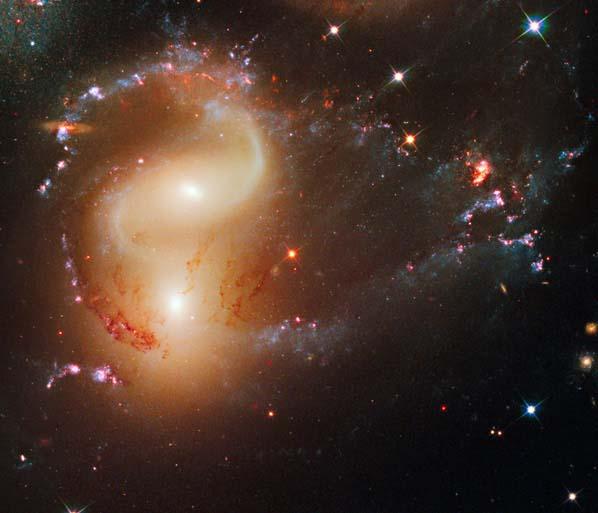
NGC 7318 A Galaxy
Constellation | Pegasus | ||||||||
|---|---|---|---|---|---|---|---|---|---|
Apparent Magnitude | Approximately 14.3 mag | ||||||||
Star Cluster | Approximately 10^10 - 10^11 | ||||||||
Distance from Earth | 300 Million Light Years | ||||||||
The NGC 7318 A Galaxy is one of the prominent members of the group known as Stephan’s Quintet. This group is one of the regions of special interest to astronomers studying dynamical interactions between galaxies and has been frequently observed in detail by NASA’s Hubble Space Telescope and James Webb Space Telescope. Due to its close proximity within the group, NGC 7318 A is engaged in strong gravitational interactions with surrounding galaxies, resulting in significant distortions and structural changes in its spiral structure.
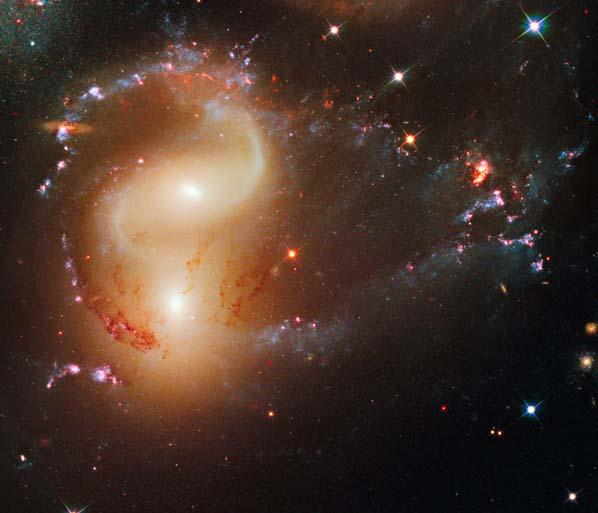
The NGC 7318 A Galaxy (NASA)
NASA observations have revealed that the interactive nature of NGC 7318 A triggers regions of star formation. This galaxy hosts numerous young, bright star clusters, particularly in areas characterized by collisions between gas and dust clouds. Detailed images from the Hubble and Webb telescopes have uncovered the complex internal structure of the galaxy, providing critical insights into its evolution and the long-term effects of intergalactic collisions. Optical observations of NGC 7318 A serve as a fundamental data source for astronomers seeking to verify theories of galaxy evolution and analyze star formation processes with greater clarity.
NGC 7318 A is located within the constellation Pegasus and is approximately 300 million light years from Earth. Its position within Stephan’s Quintet places it in strong interaction with other galaxies. This distance enables detailed study of the galaxy in infrared and radio wavelengths using advanced observatories such as NASA’s Spitzer Space Telescope, Chandra X-ray Observatory, and James Webb Space Telescope. Observations across these different regions of the electromagnetic spectrum have provided detailed information about the galaxy’s gas, dust, and star-forming regions.
In addition to professional observatories, large amateur telescopes are also used to observe NGC 7318 A; however, such amateur observations are typically limited to revealing the general structure of the group. High-resolution images and spectroscopic data from NASA’s telescopes enable astronomers to better understand galaxy interaction processes, star formation, and the evolution of galactic structures.
NGC 7318 A is structurally a typical spiral galaxy, defined by a prominent central bulge and spiral arms extending from it. Images obtained by observatories such as NASA’s Hubble Space Telescope and James Webb Space Telescope clearly reveal the dense concentration of stars in the galactic center and the complex relationship between this core and surrounding gas and dust clouds. While the central region typically contains older, reddish stellar populations, the outer regions feature young, blue star clusters that stand out prominently.
The strong interactions with neighboring galaxies have caused structural distortions and rendered the spiral arms distinctly asymmetric. Gas compression during these interactions has triggered new star-forming regions, creating bright areas within the galaxy where young stars are densely concentrated.
NGC 7318 A is one of the central members of the galaxy group known as Stephan’s Quintet and holds special significance within the group’s complex interaction dynamics. The galaxies within Stephan’s Quintet have been extensively studied by NASA’s Hubble Space Telescope and James Webb Space Telescope, making the group an ideal cosmic laboratory for understanding galaxy evolution. The close distances and gravitational influences among the group members cause significant distortions in galaxy shapes and structures, leading to collisions between gas and dust clouds and the subsequent formation of new star-forming regions.
Particularly notable is the interaction between NGC 7318 A and its closest neighbor, NGC 7318 B. Frequent close passages between these two galaxies compress dense gas clouds, triggering high rates of new star formation. This process is evident through intense energy emissions recorded by NASA’s telescopes in infrared and X-ray wavelengths. Furthermore, these interactions facilitate the flow and transfer of gas and stellar material between galaxies, resulting in asymmetric features in NGC 7318 A’s morphology and pronounced deformations in its spiral arms.
As an interacting galaxy, NGC 7318 A exhibits intense and active star formation processes. NASA observations, particularly those from the Hubble and Spitzer telescopes, have demonstrated how collisions between dense gas and dust clouds within the galaxy trigger the birth of new stars. Gas clouds compressed by these interactions rapidly condense to form bright, blue young star clusters, which emit strongly not only in visible light but also in infrared and X-ray wavelengths. These star-forming regions in NGC 7318 A constitute an important observational field for understanding the galaxy’s evolutionary process.
Additionally, the complex gravitational interactions within Stephan’s Quintet have generated large-scale shock waves in the intergalactic medium. These shock waves cause rapid heating and compression of gas and dust clouds between galaxies, creating favorable conditions for star formation. NASA’s Chandra X-ray Observatory has meticulously recorded the high-energy processes associated with these shock waves and the resulting changes in the physical conditions of the intergalactic medium.
NGC 7318 A is also a key target for multiband astronomical observations. Research conducted by NASA shows that Hubble Space Telescope observations in visible light clearly reveal the galaxy’s spiral structure and the distribution of its star-forming regions. Infrared observations from the Spitzer Space Telescope uncover young stars hidden within dusty regions and provide a more detailed view of the galaxy’s internal structure and star formation processes. Additionally, radio wavelength observations have revealed the distribution and dynamic motion of cold hydrogen gas within the galaxy, identifying the gas reservoirs that serve as fuel for star formation.
X-ray data obtained from the Chandra X-ray Observatory clearly reveal a hot gas halo surrounding the galaxy. This hot gas halo forms as a result of galaxy interactions and shock waves and provides clues about the energy balance of the intergalactic medium. Thanks to these multiband observations, NGC 7318 A has become a vital reference point for understanding galaxy evolution models and interaction processes.
NASA. "Stephan’s Quintet." *NASA Science*. Accessed May 31, 2025. https://science.nasa.gov/image-detail/stephans-quintet/.
NASA. “NGC 7318 MIRI.” *NASA 3D Resources*. Accessed May 31, 2025. https://nasa3d.arc.nasa.gov/detail/NGC-7318-MIRI.
NASA. “NGC 7318A and B HST WFC3.” *NASA 3D Resources*. Accessed May 31, 2025. https://nasa3d.arc.nasa.gov/detail/NGC-7318A-and-B-HST-WFC3.

NGC 7318 A Galaxy
Constellation | Pegasus | ||||||||
|---|---|---|---|---|---|---|---|---|---|
Apparent Magnitude | Approximately 14.3 mag | ||||||||
Star Cluster | Approximately 10^10 - 10^11 | ||||||||
Distance from Earth | 300 Million Light Years | ||||||||
Position and Observational Data
Structural Properties and Morphology
Galaxy Interactions and Role within Stephan’s Quintet
Star Formation and the Intergalactic Medium
Multiband Observations and Astronomical Research