



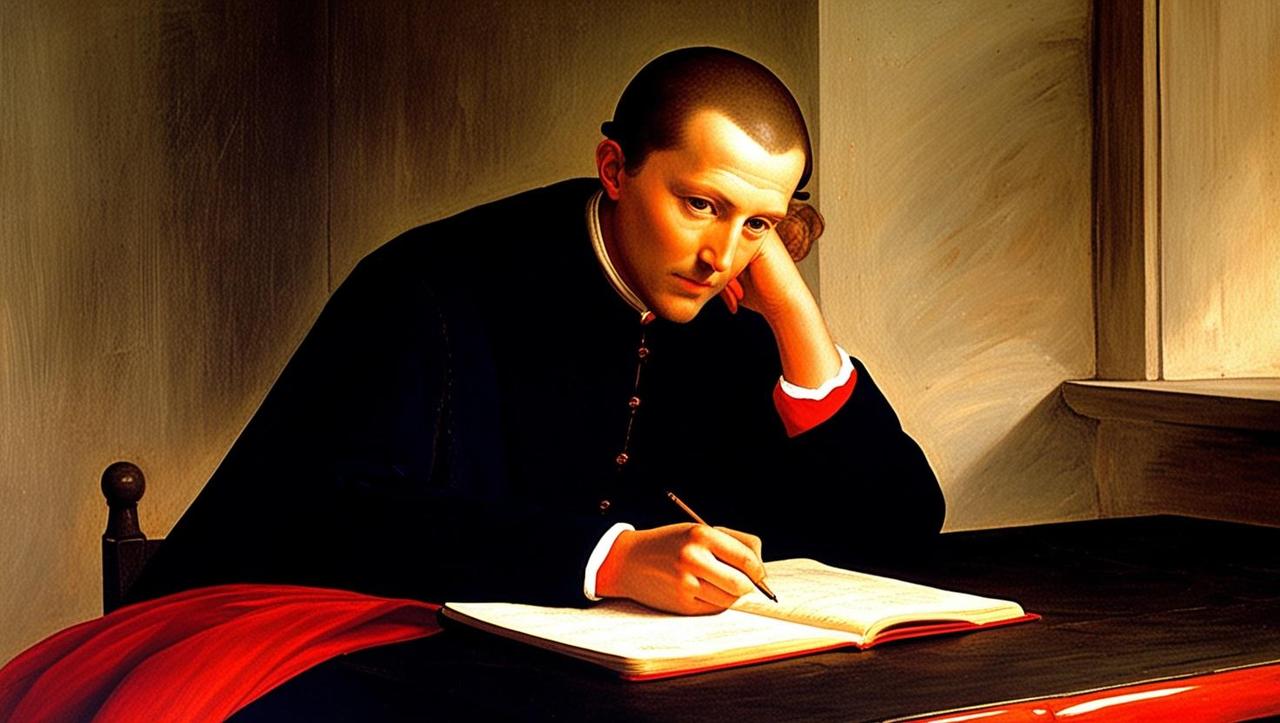
Niccolò Machiavelli
Profession(s) | Political theorist writer philosopher historian diplomat military strategist | ||||||||
|---|---|---|---|---|---|---|---|---|---|
Doğum tarihi | 1469-05-03 | ||||||||
Ölüm tarihi | 1527-06-21 | ||||||||
Era | Renaissance | ||||||||
Full Name | Niccolò Machiavelli | ||||||||
Zodiac Sign | Bull | ||||||||
Place of Death | Florence/Italy | ||||||||
Place of Birth | Florence/Italy | ||||||||
Niccolò Machiavelli, recognized as one of the founders of political science, was an Italian thinker, diplomat, and writer. He held various positions in the Republic of Florence, conducting work in diplomacy and military affairs. His most famous work, *The Prince* (*Il Principe*), attempts to present realistic and pragmatic approaches to maintaining power.
Machiavelli treated politics as a field distinct from morality, arguing that harsh and ruthless methods may sometimes be necessary to preserve power. This perspective contributed to the emergence of the concept of “Machiavellianism” and made him a figure debated for centuries. His ideas continue to influence not only his own era but also contemporary politics.
Niccolò Machiavelli was born on 3 May 1469 in Florence, Italy, as the third child of a lawyer. His family belonged to one of Florence’s old and respected lineages, though over time they had declined from nobility to the bourgeoisie. His father, Bernardo, was a lawyer prohibited from holding public office due to debt and was forced to secretly continue his profession. These financial difficulties prevented Machiavelli from receiving an education suited to his talents. Nevertheless, it is known that he studied Latin and Greek literature.
In 1494, Florence was invaded by the armies of King Charles VIII of France, leading to the exile of the Medici family and the establishment of a theocratic regime. After the fall of the priest Savonarola, who ruled with French support in 1498, a democratic government was established, and its governing body, the Ten, appointed the 29-year-old Machiavelli as secretary on 15 July 1498.
Machiavelli undertook numerous diplomatic missions during his career. He was sent to France in 1500 and 1504 and to Rome in 1506 on behalf of the Pope. During these assignments, he gained firsthand insight into the dynamics of politics. In particular, the political and military tactics of the mercenary commander Cesare Borgia left a profound impression on him.
In 1512, following the Battle of Ravenna, Florence was occupied by Spanish forces and the Medici family returned to power. Machiavelli was dismissed from office, subjected to a fine, and forbidden to leave Florence. In 1513, he was imprisoned on suspicion of involvement in a conspiracy and endured torture. After his release, he withdrew to the village of Santa Andrea near Florence. There, while struggling to support his five children in poverty, he wrote his most important works.
During this period, he began writing *The Prince*. In 1518, he wrote the comedy *La Mandragola*, and in 1521, his book *Dell’arte della guerra* (*The Art of War*) was published.
In 1520, Machiavelli came under the patronage of Pope Clement VII (born Giulio de’ Medici) and was appointed official historian of Florence, for which he wrote *Istorie Fiorentine* (*Florentine Histories*), an eight-volume work presented to the Pope in 1525.
In 1526, he was tasked with overseeing Florence’s defensive fortifications and joined the Pope’s alliance against the Roman-German Emperor Charles V. However, due to the Medici family’s inconsistent foreign policy, Charles V attacked Florence in 1527 and the city was occupied. The Medici regime collapsed, but the new government distrusted Machiavelli for his associations with the Medici and excluded him from state institutions.
Deeply disillusioned, Machiavelli fell ill and died in Florence on 21 June 1527. His body was buried in the Basilica of Santa Croce.
Machiavelli was among the first thinkers to evaluate politics independently of moral ideals. In *The Prince*, he argued that the interests of the state must take precedence over all else and that a ruler must be willing to act ruthlessly when necessary to preserve power. According to him, a ruler should prefer to be feared rather than loved, but must avoid being hated.
These approaches gave rise to the political philosophy known as “Machiavellianism,” based on the idea that “the end justifies the means.” Thinkers such as Diderot, Rousseau, Hegel, and Gramsci sought to uncover the depth of Machiavelli’s ideas. Hegel viewed Machiavelli as a patriot striving for Italian unification, while Antonio Gramsci described him as a “precocious Jacobin.”
Today, Machiavelli is recognized as one of the founders of modern political science. His effort to assess state governance not through idealistic lenses but through the balance of power and empirical realities has made him one of the most influential figures in the philosophy of politics.
Niccolò Machiavelli (1469–1527) is one of the most commented upon and debated thinkers in the history of political thought. His treatment of political power in works such as *The Prince*—as separate from morality, secular, and realistic—has generated diverse interpretations. By advancing ideas about the nature of politics that had never been articulated before, he laid the foundational stones of the modern understanding of politics.
Machiavelli sought to evaluate politics through an empirical and observational approach, free from metaphysical and teleological explanations. Breaking away from the medieval theological view of politics, he emphasized that the state and its ruler could sustain power only through popular support. In this sense, he pioneered the modern understanding of politics based on popular sovereignty. However, his framework has certain legal shortcomings; for example, while he emphasized the necessity of centralized authority, he did not elaborate in detail on its legal foundations.
In *The Prince*, Machiavelli advised rulers that they might need to deviate from moral norms, and even violate traditional ethics, if it served the state’s interests. Yet this does not imply the complete rejection of morality; according to his view, individual ethics and political realities belong to distinct domains.
Machiavelli’s ideas marked a turning point in the development of modern political thought, anticipating the new governance model emerging with the decline of feudalism. He advocated a legitimacy based on popular support by reducing the influence of feudalism and aristocracy. This approach laid the first philosophical foundations of modern state theory and the concept of the nation-state.
Machiavelli argued that power must not be divided but concentrated in a single center. This reflects the process of weakening feudal power centers such as the aristocracy and the Church. In Europe, the rise of monarchies, the development of taxation systems, and the professionalization of armies were key elements of this transformation.
Moreover, Machiavelli’s view of human nature shaped his political outlook. Believing that humans are inherently untrustworthy, self-interested, and changeable, he insisted that the state must possess a strong and authoritarian structure. Although *The Prince* advocates absolute power while *Discourses* appears to support republicanism, both works consistently affirm the necessity of a strong state and centralized authority.
Finally, we can say that Machiavelli analyzed political realities within their historical context and developed a political understanding tied to temporal and geographical conditions rather than seeking universal laws. His concept of “stato” eventually became the foundational element of the modern state.
One of the most important pairs in Machiavelli’s political thought is virtù and fortuna. Virtù refers to the skills and capabilities a ruler must possess, while fortuna represents events and chance factors beyond the ruler’s control.
Virtù: The Ruler’s Skill and Determination
For Machiavelli, virtù differs from the classical notion of “virtue.” In traditional thought, virtue encompassed wisdom, moral integrity, and self-sacrifice for the common good. Machiavelli, however, approached it pragmatically. In his view, what matters is not that a ruler be virtuous in the moral sense, but that he be capable of doing what is necessary to maintain power. For instance, a ruler who is too generous may exhaust his resources; one who is overly merciful may be deceived. Thus, politics must be thought of independently of individual morality.
Machiavelli argues that rulers should not hesitate to adopt harsh measures, including violence, to preserve power. Yet this violence must not be an end in itself but a means to secure authority. A ruler should apply pressure when necessary but must not make it a permanent mode of governance.
Fortuna: Chance and Circumstances
Fortuna refers to events and factors beyond a ruler’s control. Yet Machiavelli rejects the idea that people must submit entirely to fate. According to him, a ruler endowed with virtù must seize opportunities and possess the courage to overcome adversity. If a ruler lacks sufficient ability, the challenges he faces may become insurmountable.
Machiavelli describes fortuna as a woman: “She wishes to be dominated, submits to the bold, and refuses obedience to the timid.” Thus, chance favors determined and courageous rulers. However, political success is possible only at the intersection of virtù and fortuna. If fortune arrives and the ruler is unprepared, it can turn into a threat.
Machiavelli’s thought does not merely advocate the concentration of power in one hand but also defends a secular form of governance. He opposes the medieval notion that the state must be subordinate to religious authority. For him, political power must be explained entirely through worldly events, not divine forces. This perspective became one of the foundational elements of modern state theory.
During the Middle Ages, the Catholic Church, feudal structures, and monarchies formed powerful political actors. However, with economic and social changes, the Church began to lose its influence. As the Church’s role diminished, secularism rose and centralized authority gained strength.
Machiavelli was among the philosophical architects of this shift. He championed a secular political outlook and asserted that the Church had no significant place in this new political structure. Machiavelli proposed a state model in which political power derives not from God but from human beings. In this context, the state’s strength is shaped by aggregating individual interests through popular participation. Machiavelli’s concept of virtù, unlike traditional virtue, prioritizes the state’s interests.
In Machiavelli’s thought, religion can be used as a tool in political life. While religion serves a function in maintaining social order, it is not a decisive factor in politics. According to Machiavelli, the state’s interests must be preserved even if they conflict with traditional moral or religious norms. This approach laid the groundwork for modern political thought and established Machiavelli as a pivotal figure in the history of political secularism.
1503 - On Dealing with the Rebels of the Chiana Valley
1508 - Ritracto delle cose della Magna (Portrait of Affairs in Germany)
1510 - Ritratti delle cose di Francia (Portrait of Affairs in France)
1513 - Discourse on the First Ten Years of Titus Livius
1513 - II Principe (The Prince) – (Written in 1513, published posthumously in 1532)
1517 - Discourses on the First Decade of Titus Livius (Discorsi Sopra La Prima Deca Di Tito Livio)
1518 - La Mandragola
1518 - Adamotu
1520 - The Life of Castruccio Castracani of Lucca
1520 - Discorso sopra il riformare lo stato di Firenze (Discourse on Reforming the State of Florence)
1520 - Sommario delle cose della citta di Lucca (Summary of Affairs in the City of Lucca)
1521 - The Art of War (Dell’arte Della Guerra)
1522 - History of Conspiracies and Counter-Conspiracies
1523 - On Fortune (Della Fortuna)
1525 - Florentine Histories (Floransa Tarihi)
1525 - Clizia
1. Men are bad when they are not forced to be good.
2. Morality distinguishes man from beast; politics unites them.
3. Let a man who has fallen remain fallen. If he was pushed by another, then catch him.
4. The key consideration is this: people must either be won over or utterly destroyed; attempts to punish minor offenses invite revenge, while overwhelming force prevents resistance. When a man is oppressed, he must be treated in such a way that he has no opportunity to seek revenge.
5. Power always sides with the powerful.
6. In nature there have always been two lines: one is the summit, the other is the bottom. Those who rise to the peak cannot climb higher and therefore fall; those at the bottom cannot sink further and therefore rise. Thus in nature there is a movement from good to bad and from bad to good.
7. A ruler may appear cruel, greedy, miserly, and deceitful, yet while acting thus, he must seem merciful, generous, and truthful. Power must always shift its blame to others and claim credit for its virtues.
8. The most dangerous act in a republic is restoring a law that has been abolished.
9. I would rather go to hell than to heaven; for in hell I would be with popes, kings, and princes, while in heaven I would only find beggars, monks, and apostles.
Beriş, Hamit Emrah. "Modern Devlet Kuramının Doğuşunda Niccolò Machiavelli’nin Rolü ve Etkisi." *Amme İdaresi Dergisi* 52, no. 4 (2019): 1–23. Accessed February 13, 2025. Access Address.
Biyografiler. "Niccolò Machiavelli Kimdir?" *Biyografiler.com*, Accessed February 13, 2025. Access Address.
Karslı, Mehmet Rauf. "Niccolò Machiavelli’nin Hayatı ve Düşünceleri Üzerine Kısa Bir İnceleme." Academia.edu, Accessed February 13, 2025. Access Address.

Niccolò Machiavelli
Profession(s) | Political theorist writer philosopher historian diplomat military strategist | ||||||||
|---|---|---|---|---|---|---|---|---|---|
Doğum tarihi | 1469-05-03 | ||||||||
Ölüm tarihi | 1527-06-21 | ||||||||
Era | Renaissance | ||||||||
Full Name | Niccolò Machiavelli | ||||||||
Zodiac Sign | Bull | ||||||||
Place of Death | Florence/Italy | ||||||||
Place of Birth | Florence/Italy | ||||||||
No Discussion Added Yet
Start discussion for "Niccolò Machiavelli" article
Early Life and Education
Political Career and Diplomatic Missions
Exile and Literary Works
Return to Florence and Final Years
Thoughts and Legacy
Machiavelli and the Foundations of Modern Political Thought
The Monopoly of Power in the Modern State
Virtù and Fortuna
Machiavelli’s Secular View of Politics
The Secular State
Machiavelli’s Works
Selected Quotations from Niccolò Machiavelli’s Works