This article was automatically translated from the original Turkish version.
Year(s) | 1888 | ||||||||
|---|---|---|---|---|---|---|---|---|---|
Original Name(s) | The Night Café | ||||||||
Type(s) | Interior scene | ||||||||
Size(s) | 72.4 × 92.1 cm | ||||||||
Technique | Oil on canvas | ||||||||
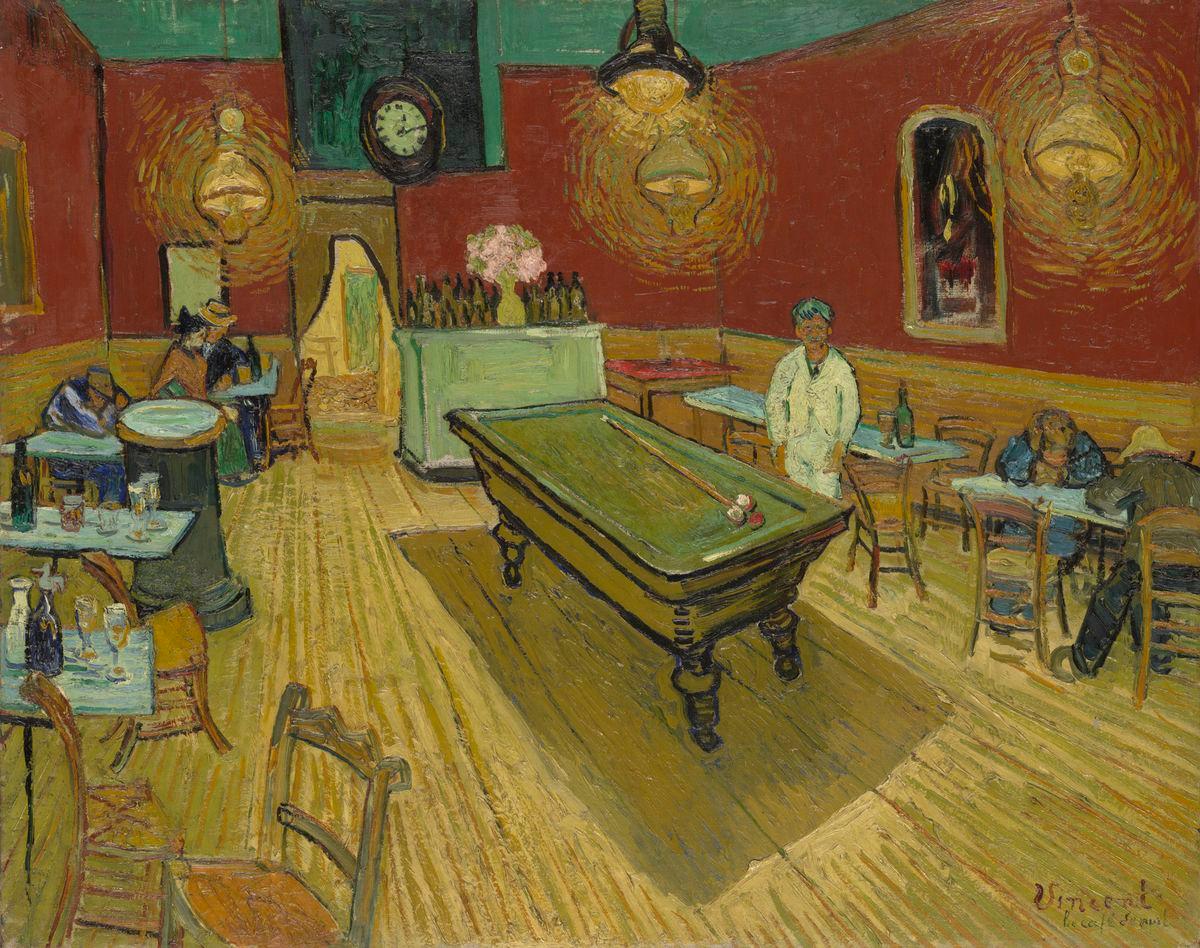
The Night Café (Le Café de nuit), by Vincent van Gogh is an oil painting created in 1888 in the French town of Arles. The work measures 72.4 × 92.1 cm and is currently part of the collection at the Yale University Art Gallery. This painting, among the public interior spaces depicted during Van Gogh’s Arles period, portrays the interior of a night café. The space is structured as an interior scene through its architectural arrangement, use of color, and placement of figures.【1】
The Night Café was produced during Van Gogh’s time in Arles, when he focused intensely on interior and nocturnal themes. During this period, the artist viewed public spaces not merely as elements of daily life but as environments that generated emotional and psychological effects. The night café depicted in the painting exemplifies this approach through its emphasis on the middle of the night and its interior layout.【2】
The composition of the painting is based on a single-point perspective system. Perspective lines are arranged to direct the viewer’s gaze directly into the space. At the center of the composition, a diagonal billiard table emerges as the primary element defining spatial depth. The use of oblique and asymmetrical lines alongside vertical and horizontal ones creates a deliberate distortion in the perception of space, evoking feelings of unease and confinement in the viewer.【3】
The Night Café is executed in oil on canvas. Van Gogh favored intense and saturated color fields, particularly emphasizing the contrast between red and green. This color scheme becomes a key element in amplifying the sense of pressure and tension generated by artificial lighting within the space. Yellow lamps arranged along the ceiling establish a rhythmic pattern of light that structures the upper portion of the composition. The colors are not used to reflect realistic illumination but rather to generate emotional impact.
The figures in the painting are depicted as patrons of the night café and its proprietor. The seated figures display weary and passive postures, while one figure is shown slumped over a table, reinforcing the heavy atmosphere of the space. The café owner stands out in the composition with a more upright and open stance. The billiard table, located at the center of the space, functions as the central structural element that guides the viewer’s gaze into the depth of the scene.
The Night Café holds significant importance in art history for demonstrating how Van Gogh employed interior space as a narrative element in his paintings. The work reveals the artist’s approach of placing architectural space at the core of his visual storytelling, questioning the relationship between environment and perception. In this regard, the painting is frequently analyzed in academic studies of Van Gogh’s artistic vision within the context of spatial construction.
Yale University Art Gallery. “Le café de nuit (The Night Café).” Accessed January 15, 2026. https://artgallery.yale.edu/collections/objects/12507
Yuliya N. Avdeeva, Kseniya A. Degtyarenko, Maria A. Kolesnik, Natalia P. Koptseva, Daria S. Pchelkina, and Anna A. Shpa. "Architectural Space in the Paintings by Vincent van Gogh." Journal of Siberian Federal University 13, no. 6 (2020): 838–859. Accessed January 15, 2026. https://www.researchgate.net/publication/343716854_Architectural_Space_in_the_Paintings_by_Vincent_van_Gogh
[1]
Yale University Art Gallery, “Le café de nuit (The Night Café),” Erişim 15 Ocak 2026, https://artgallery.yale.edu/collections/objects/12507
[2]
Yale University Art Gallery, “Le café de nuit (The Night Café),” Erişim 15 Ocak 2026, https://artgallery.yale.edu/collections/objects/12507
[3]
Yuliya N. Avdeeva, Kseniya A. Degtyarenko, Maria A. Kolesnik, Natalia P. Koptseva, Daria S. Pchelkina ve Anna A. Shpa “Architectural Space in the Paintings by Vincent van Gogh,” Journal of Siberian Federal University 13, no. 6 (2020): syf 848, https://www.researchgate.net/publication/343716854_Architectural_Space_in_the_Paintings_by_Vincent_van_Gogh


Year(s) | 1888 | ||||||||
|---|---|---|---|---|---|---|---|---|---|
Original Name(s) | The Night Café | ||||||||
Type(s) | Interior scene | ||||||||
Size(s) | 72.4 × 92.1 cm | ||||||||
Technique | Oil on canvas | ||||||||
No Discussion Added Yet
Start discussion for "Night Café (Painting)" article
Production Process and Historical Context
Composition and Perspective Construction
Technical Features
Figures and Objects
Place and Significance in Art History