


This article was automatically translated from the original Turkish version.
Imagine you want to sit on a bench. But there is an armrest in the middle of the bench. Or the surface is so slanted that you slide off when you try to sit. Perhaps you wanted to lean against a window sill in front of a shop, but small metal protrusions blocked you. You probably just muttered, “What kind of design is this?” and moved on. It is precisely this “moving on” state that constitutes the real success of these designs. These designs are called hostile architecture.
The purpose of hostile architecture is simple: to physically make certain behaviors in public spaces—mostly lying down, sleeping, or loitering—impossible.
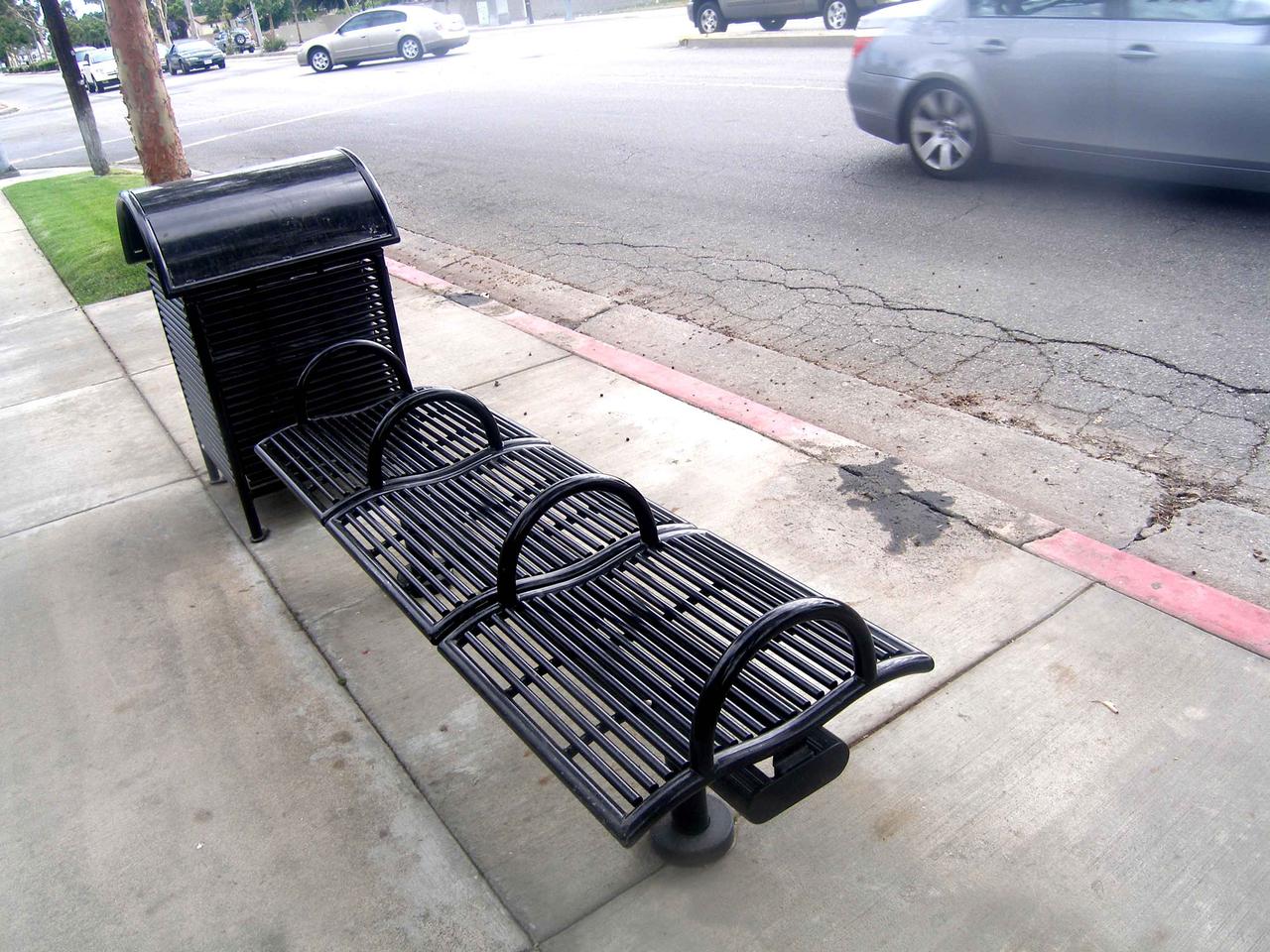
Bir Bank Örneği (flickr)
Parks, squares, sidewalks... These are theoretically public spaces. Their designation as public should grant people the right to be there, to rest, and even to be homeless. Urban planners and engineers are precisely responsible for maintaining this equality; professional ethical codes commit them to consider the diverse needs of society and advocate for an inclusive public good.
But how does making a sidewalk or a bench unusable for sleeping align with this principle?
It does not.
It is not possible in most places to pass a law that punishes someone simply for sleeping in a park. But making that park impossible to sleep in is extremely easy. So design quietly accomplishes what the law cannot.
The most famous example is the Camden Bench, commissioned in 2012 by the London borough council. Calling it a bench is even generous; it is a concrete block with sharp edges and slopes, with no flat surface at all. Designed to deter both sleeping and skateboarding, its sole purpose is to replace standard benches and prevent “undesirable” behavior. A space that is “public” on paper is quietly privatized through design.
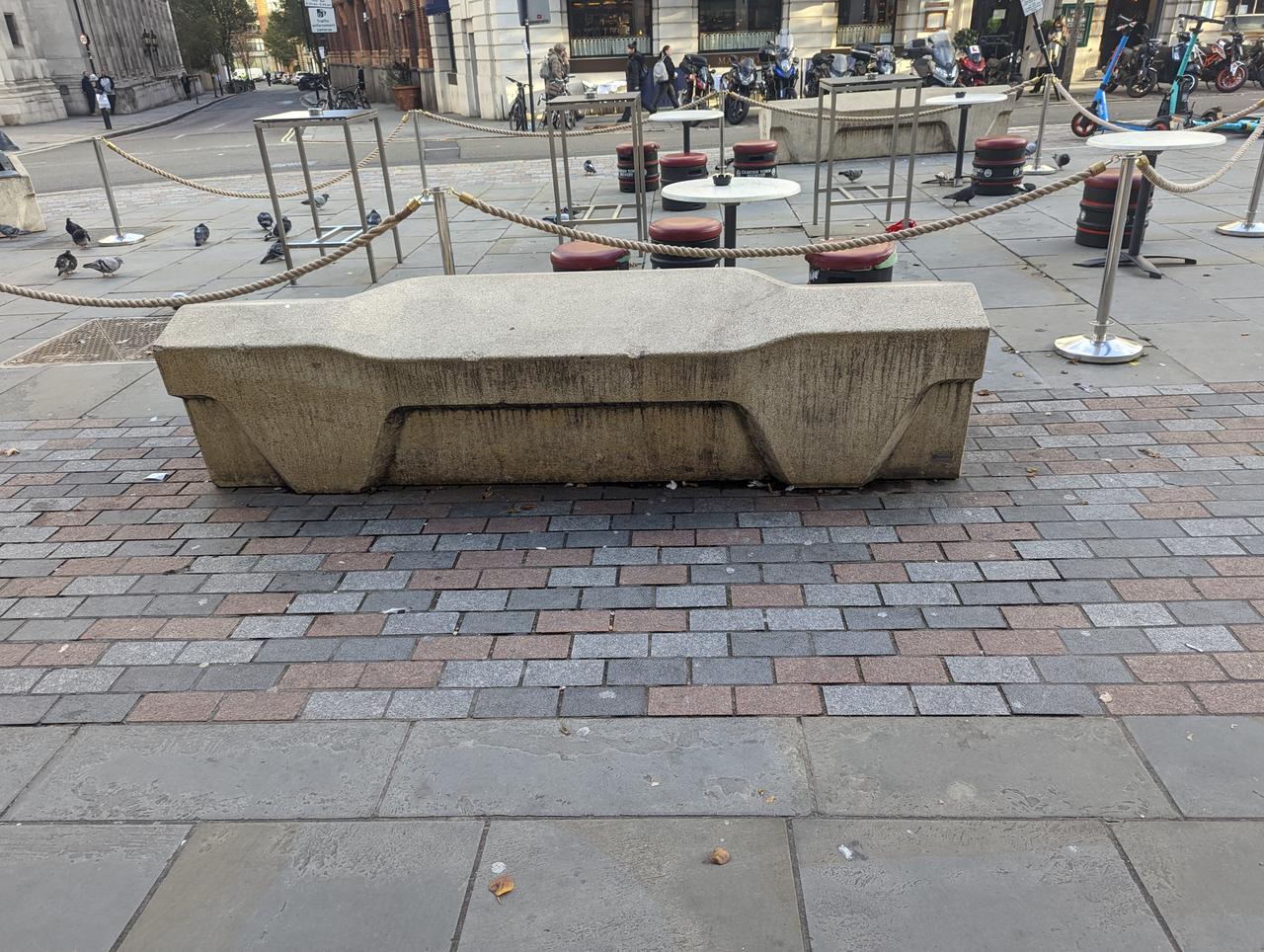
Camden Bank (flickr)
And this does not only target homeless people or skateboarders. The slanted surface of the Camden Bench also makes sitting difficult for elderly people or those with mobility impairments. When residents in San Francisco raised thousands of dollars to place large rock boulders on sidewalks to deter the homeless, those same sidewalks became impassable for wheelchair users. By making a space unusable for everyone, you exclude not only your intended target but far more people.
The most insidious aspect of hostile architecture is its usual invisibility. Because most of these designs are concealed within what is considered a “socially acceptable” function. A bench that cannot be lain on still provides seating. Nighttime automatic fountains are said to water the park. No one stops to think, because the real intent is not visible.
Armrests placed in the middle of benches are not there for sitting but to prevent lying down. Slanted seating at bus stops is designed to make loitering difficult. Flooring has been engineered to deter lying down and even living inside a vehicle.
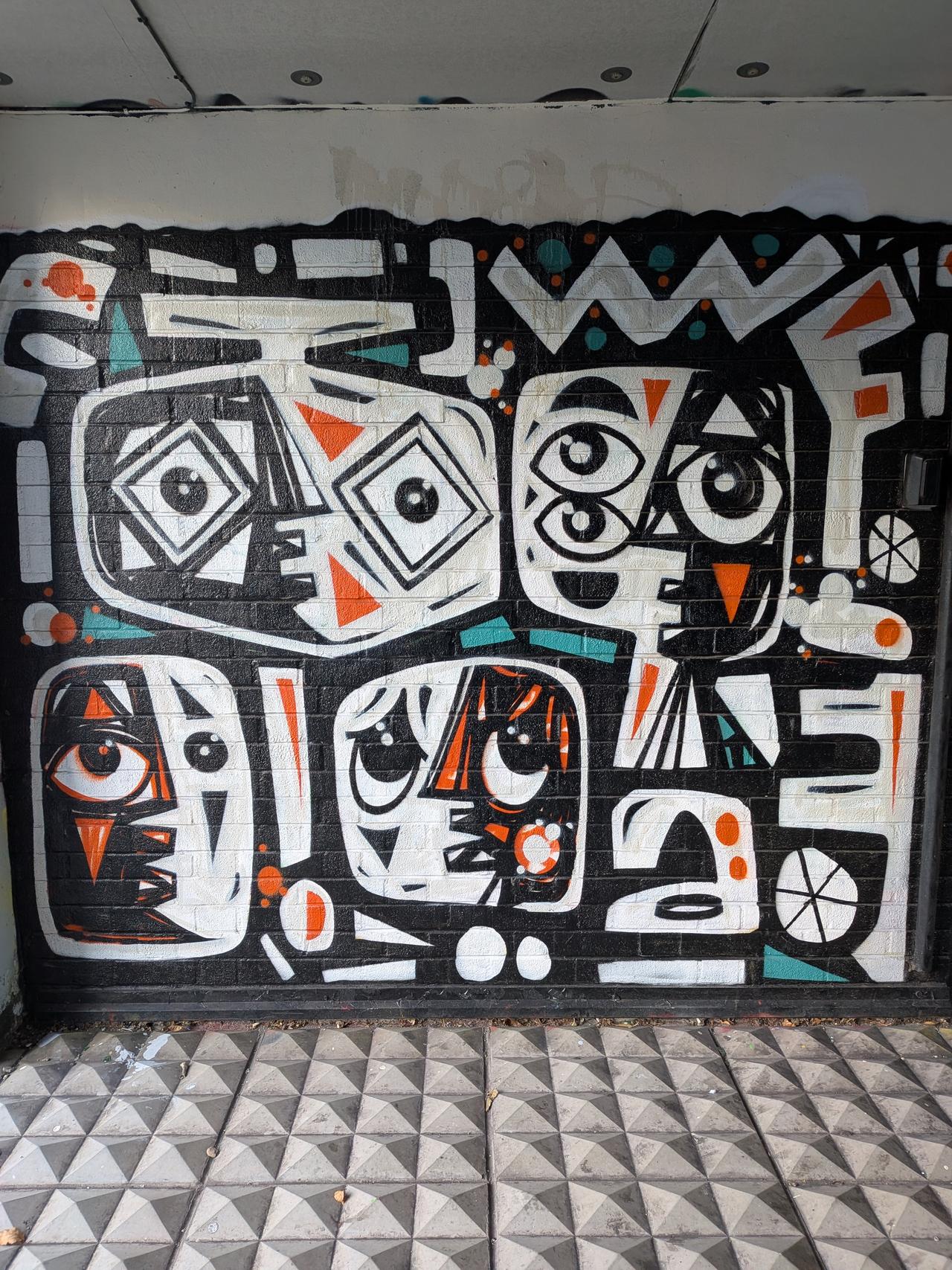
Zemin Döşemesi Örneği (flickr)
Designers are also aware of the issue. Lorraine Gamman, a design professor at Central Saint Martins, says that spikes (metal studs designed to deter the homeless) are “now an outdated and socially unacceptable part of a fortress aesthetic.”【1】
Artists and activists, under the banner of “design activism,” are questioning this architecture. Sarah Ross’s “Archisuits” project enables homeless people to adapt to public furniture. Stuart Semple’s platform hostiledesigns.org and Michael Beitz’s works on “hostile and friendly benches” all ask the same question: Whom are we really defining public good for?
The strangest point about hostile architecture is that it not only fails to solve homelessness but often ends up being more expensive. Seattle spent $1.1 million on a viaduct to deter homeless people. In New York, “leaning bars” installed in subway stations cost $74 million.【2】 Even a small town like Iowa City, with a population of 75,000, allocated a budget of $150,000 to make its benches “homeless-proof.”【3】
That money could have gone elsewhere. Instead of condemning a person to a bench they cannot sleep on, investing in a solution that provides them shelter is both more lasting and ultimately cheaper. Because pushing homeless people out of public spaces does not eliminate them; they do not vanish, since they have nowhere else to go. The only way to solve the problem at its root is to redirect the money spent on making people invisible toward housing them.
We must ask a honest question here: Why do we not object to most of these designs? Because they do not directly affect us and, by design, are minimal and unobtrusive. What if the message were not so easily ignored?
What if, instead of adorning parks and streets with protrusions and armrests, we installed “No Entry” signs and alarms? The outcome would be the same. But then society would have to consciously acknowledge or confront its own discomfort. Most of us would find this openness disturbing. That is why we must directly confront the moral dimension of the issue.
In fact, a bench is not just a bench. The moment we decide who can use it, we are also deciding who has the right to exist in the city. No one wants to walk through a landscape saturated with homelessness; the discomfort and sense of insecurity are real and cannot be dismissed. But hostile architecture does not solve this problem. A bench you cannot sleep on, a spiked ledge, does not remove a person. It merely pushes them to the next street, out of our line of sight. The problem appears solved, but it has only been relocated—and often expanded.
This is the true paradox of hostile architecture. Moving a person out of the place where we see them does not prevent their existence; it merely shifts the discomfort to someone else’s doorstep. In short, it saves no one but succeeds in keeping everyone on their feet.
Avocado, Laurie. "Anti-Homeless Bench and Trash Receptacle." Flickr. Accessed July 20, 2026.https://flic.kr/p/4RtgzY
Doctorow, Cory. "Camden bench 1, Soho, London, UK." Flickr. Accessed July 20, 2026.https://flic.kr/p/2nYobDg
Doctorow, Cory. "Graffiti and hostile architecture, Shoreditch, London, UK." Flickr. Accessed July 20, 2026.https://flic.kr/p/2rGuE6N
Hustings, Megan, and Bob Erlenbusch. *Design Against Humanity*. Edited and compiled by Ramina Davidson. National Coalition for the Homeless, August 2023. Accessed July 20, 2026.https://nationalhomeless.org/wp-content/uploads/Design-Against-Humanity_Hostile-Architecture-paper-2023.pdf
Nussbaum, Zoe. "Hostile Architecture: The Ethical Problem of Design as a Means of Exclusion." *Viterbi Conversations in Ethics.* Accessed July 20, 2026.https://vce.usc.edu/volume-7-issue-1/hostile-architecture-the-ethical-problem-of-design-as-a-means-of-exclusion/
The Guardian. "Anti-homeless spikes are part of a wider phenomenon of 'hostile architecture'." Accessed July 20, 2026.https://www.theguardian.com/artanddesign/2014/jun/13/anti-homeless-spikes-hostile-architecture
[1]
The Guardian, "Anti-homeless spikes are part of a wider phenomenon of 'hostile architecture'," Accessed July 20, 2026.
[2]
Megan Hustings ve Bob Erlenbusch, Design Against Humanity, haz. ve der. Ramina Davidson (National Coalition for the Homeless, Ağustos 2023), 12. Son Erişim 20 Temmuz 2026, https://nationalhomeless.org/wp-content/uploads/Design-Against-Humanity_Hostile-Architecture-paper-2023.pdf
[3]
Hustings ve Erlenbusch, Design Against Humanity,13.
The Sneaky Nature Hidden in Design
Actually More Expensive
Silently Endorsed Exclusion
