


This article was automatically translated from the original Turkish version.
Non-destructive testing (NDT) is the general term for inspection methods used to detect internal or surface flaws in materials or components without compromising the serviceability or structural integrity of the examined structure. These methods enable the identification of defects or discontinuities without causing permanent changes to the tested object. NDT is applied in various sectors including energy, defense, aerospace, automotive, and construction for quality assurance, maintenance, and repair processes.
Non-destructive testing techniques became more systematic and necessitated standardization following the increased industrial production after World War II. Among the earliest methods used were visual inspection and liquid penetrant testing. With advancing technology, ultrasonic, radiographic, electromagnetic, and other methods were also introduced.
Non-destructive testing methods aim to identify discontinuities, cracks, voids, delaminations, or other flaws within the internal structure or on the surface of materials. The objectives of inspections using these methods are not limited to defect detection alone; they also include the early identification of manufacturing errors, monitoring of damage occurring during service life, and planning of maintenance schedules.
Visual Testing (VT): The most fundamental inspection method. Macroscopic defects such as large surface cracks, surface irregularities, and dimensional deviations are detected directly by the eye or using optical aids. However, it can only reveal obvious surface flaws and provides no information about depth or internal structure.

Representative Image of Visual Testing Method
Liquid Penetrant Testing (LPT): Used to detect surface-breaking discontinuities. This method utilizes capillary action by applying a low-surface-tension liquid to the surface of the test part. After removing excess liquid, a developer is applied to make the defects visible. It can only identify open surface flaws and is limited in porous materials.

Representative Image of Liquid Penetrant Method
Magnetic Particle Testing (MT): Applicable to ferromagnetic materials. The component is magnetized, and any discontinuities cause leakage fields at their edges. Magnetic particles are then dispersed over the surface; their accumulation patterns allow visual detection of discontinuities. This method is effective for identifying surface and near-surface flaws.

Representative Image of Magnetic Particle Method
Ultrasonic Testing (UT): Based on the principle of sending high-frequency sound waves into the material and analyzing the reflected waves. It is particularly common for detecting internal flaws. It can provide precise results but requires skilled application. The material must have good acoustic transmission properties.
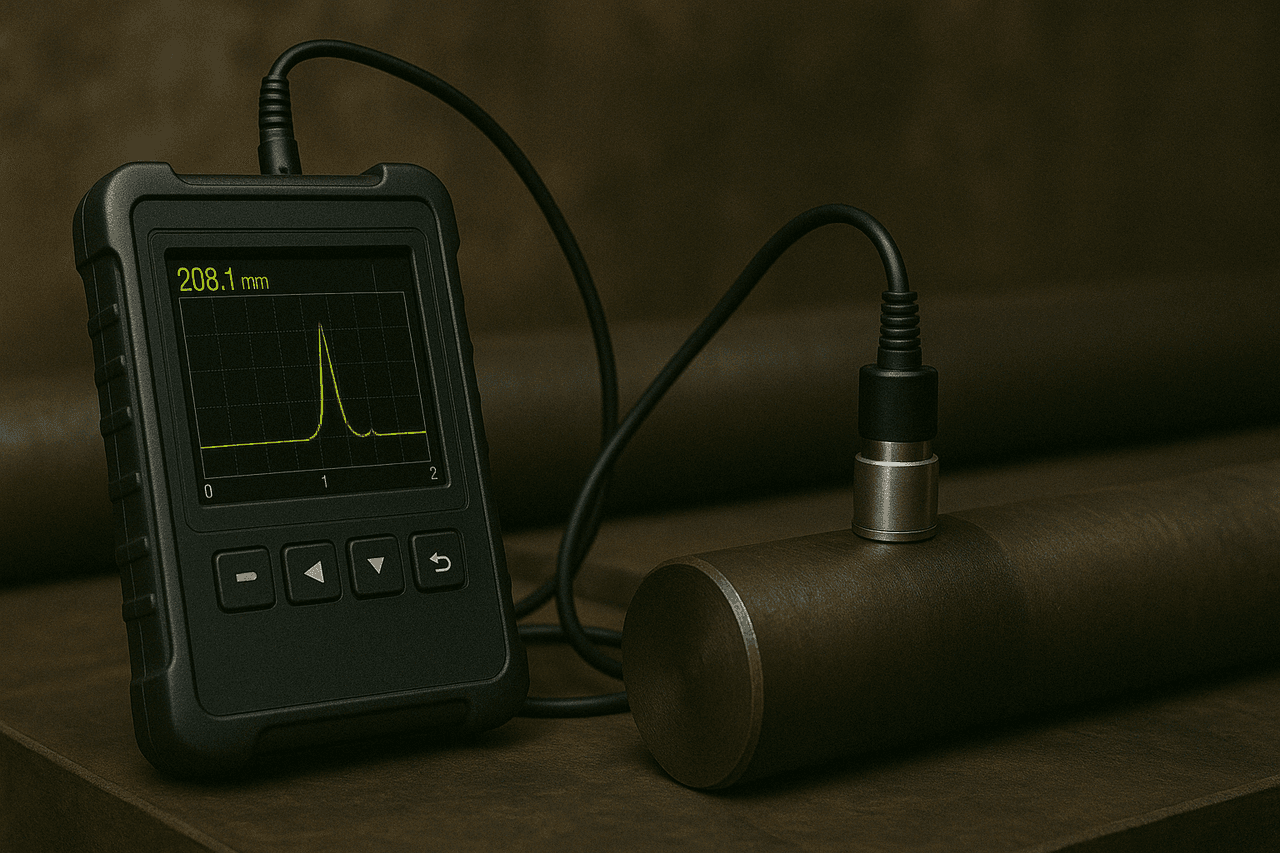
Representative Image of Ultrasonic Testing Method
Radiographic Testing (RT): Internal flaws are detected using X-rays or gamma rays. Voids, porosities, or foreign inclusions within the material are identified by radiographic film or digital detectors. It is a highly sensitive method but has limitations due to radiation safety concerns.
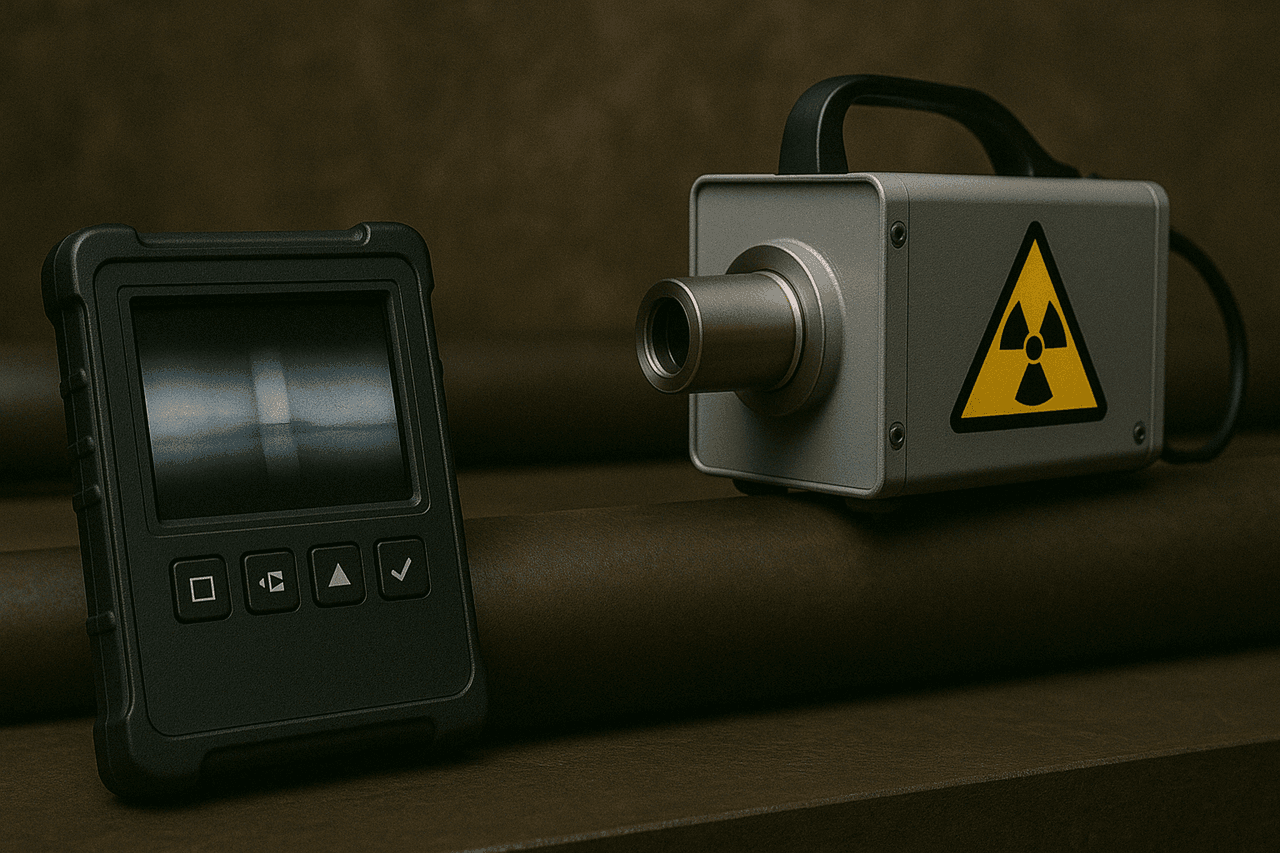
Representative Image of Radiographic Testing Method
Eddy Current Testing: Used to detect surface and near-surface discontinuities in conductive materials. An alternating current passed through a coil generates an electromagnetic field that is disturbed by discontinuities in the material; these disturbances are analyzed to identify defects.
Acoustic Emission Testing (AE): Detects elastic waves generated by sudden energy releases within the material. It is typically suitable for structures under high pressure, stress, or temperature. It is especially used in continuous monitoring (structural health monitoring) systems.
Thermography (Infrared Thermography): Defects beneath the surface are detected by measuring the heat distribution emitted from the material surface. It has two types: passive and active. Active thermography relies on differences in heat dissipation after external thermal excitation. It is particularly used for detecting delaminations in composite materials.
Optical Methods (Shearography, Speckle, Digital Image Correlation): These optical-based methods can precisely detect surface deformations. They are especially preferred in aerospace and composite structure inspections. Shearography analyzes surface displacement gradients after loading, while digital image correlation provides full-field measurement of surface deformations.
Non-destructive testing methods are used across a wide range of applications including power plants, petrochemical facilities, pipelines, aerospace structures, automotive components, welded joints, pressure vessels, and composite materials. Particularly, the aerospace and defense industries are the areas where NDT applications are most intensively utilized due to their high safety requirements.
A single non-destructive testing method may not be sufficient for all cases. When both surface and internal flaws need to be evaluated simultaneously, multiple methods must be combined. For example, liquid penetrant testing is suitable for surface defects, while ultrasonic testing is preferred for detecting deep internal cracks. The optimal NDT method varies depending on the material type and application.
Non-destructive testing practices are regulated by national and international standards. In Türkiye, the Turkish Standards Institution (TSE) and various certification bodies provide training and inspection services in this field. Standards such as EN ISO 9712 and ASNT SNT-TC-1A define the competency requirements for personnel working in this area.
Chris, Roshan C., Raghul C., Hari Vasanth Ram, Suraj K. P., and John Solomon. "Non-Destructive Testing by Liquid Penetrant Testing and Ultrasonic Testing – A Review." International Journal of Advance Research, Ideas and Innovations in Technology 5, no. 2 (2019): 694–696.
Dwivedi, Sandeep Kumar, Manish Vishwakarma, and Akhilesh Soni. "Advances and Researches on Non Destructive Testing: A Review." Materials Today: Proceedings 5 (2018): 3690–3698.
SZUTEST. "Tahribatsız Muayeneler." Accessed April 20, 2025. https://www.szutest.com.tr/tahribatsiz-muayeneler/.
TSE (Türk Standardları Enstitüsü). "Tahribatsız Muayene." Accessed April 20, 2025. https://www.tse.org.tr/tahribatsiz-muayene/.
Zhu, Yong-Kai, Gui-Yun Tian, Rong-Sheng Lu, and Hong Zhang. “A Review of Optical NDT Technologies.” *Sensors* 11, no. 8 (2011): 7773–7798. https://doi.org/10.3390/s110807773.
Çidem, Aytaç, Tuğçe Yağcı, and Hülya Durmuş. "Geçmişten Günümüze Tahribatsız Muayene Yöntemleri." Soma MYO Teknik Bilimler Dergisi, n.d.

No Discussion Added Yet
Start discussion for "Non-Destructive Testing" article
Historical Development
Basic Principles and Application Objectives
Main Non-Destructive Testing Methods
Application Areas
Method Selection and Combination of Methods
Standards and Certification