

This article was automatically translated from the original Turkish version.
History | 12 November 1999, Friday | ||||||||
|---|---|---|---|---|---|---|---|---|---|
Time | 18:57 (local time) | ||||||||
Epicenter | Kaynaşlı, Düzce, Türkiye | ||||||||
Magnitude | Mw 7.1 (moment magnitude scale) | ||||||||
Duration | Approximately 30 seconds | ||||||||
Intensity | VIII (according to the MSK scale) | ||||||||
Fault Type | On the North Anatolian Fault Zone (NAFZ); right-lateral strike-slip fault, Fault length: Approximately 40 km, Surface displacement: Up to 5 meters | ||||||||
Depth(s) | Approximately 10 km (shallow earthquake) | ||||||||
The 12 November 1999 Düzce earthquake occurred due to the rupture of the Düzce fault within the North Anatolian Fault Zone (NAFZ). The earthquake had a magnitude of Mw = 7.1 on the moment magnitude scale. The Düzce fault is a segment that had accumulated stress following the 1999 İzmit earthquake (Mw = 7.4) and had been inactive for approximately 200 years. The İzmit earthquake acted as a trigger for this fault segment.
The surface rupture was approximately 40 kilometers long and exhibited strike-slip faulting. Maximum lateral displacements of up to 5 meters and vertical displacements of up to 3 meters were observed along the fault.

The NAFZ splits into two branches near Bolu: a northern and a southern branch. The Düzce earthquake occurred along the northern branch, specifically along the Karadere–Bakacak–Elmalık fault segments. Earthquakes in 1944 Bolu-Gerede (Mw=7.4), 1957 Abant (Ms=7.1), and 1967 Mudurnu Valley (Mw=7.1) occurred on the southern branch. Consequently, the prolonged seismic quiescence of the northern branch led to significant energy accumulation.
In Düzce and its surroundings, particularly in districts such as Kaynaşlı, Gölyaka, and Cumayeri, the building stock was inadequately designed for seismic resistance. The fault’s passage through these areas combined with the absence of engineering services in construction contributed to increased damage and loss of life.
Paleoseismological excavations have identified at least three additional large earthquakes on the Düzce fault between the years 890–1020, 1495–1700, and 1685–1900. This indicates that the fault generates major earthquakes at average intervals of 350–400 years.
The Düzce earthquake on 12 November 1999 was a natural event that began abruptly and developed through a complex, multi-layered rupture process lasting approximately 30 seconds. Its magnitude was determined as Mw = 7.1 on the moment magnitude scale and resulted from the rupture of the Düzce fault within the North Anatolian Fault Zone.
The earthquake initiated on the Düzce fault, a strike-slip fault, within a segment that had accumulated significant stress over time. The elastic energy stored during the fault’s prolonged inactivity was released suddenly through a rapid rupture. This rupture involved displacement along a segment approximately 40 kilometers long at the surface.
Maximum lateral displacements of 5 meters and vertical displacements of 3 meters were observed along the fault trace. These deformations caused cracking in the ground, fractures in road and infrastructure systems, and visible surface fault scarps. The earthquake exhibited a rupture mechanism combining right-lateral strike-slip motion with localized vertical components.
Immediately after the earthquake’s onset, primary (P) and secondary (S) seismic waves propagated rapidly through the surrounding region. The shaking, centered in Düzce, was strongly felt in the Western Black Sea and Marmara regions. As these waves reached the surface, ground motion intensity increased sharply. The earthquake generated severe ground acceleration, which amplified structural damage, particularly in areas with weak soil due to resonance effects.
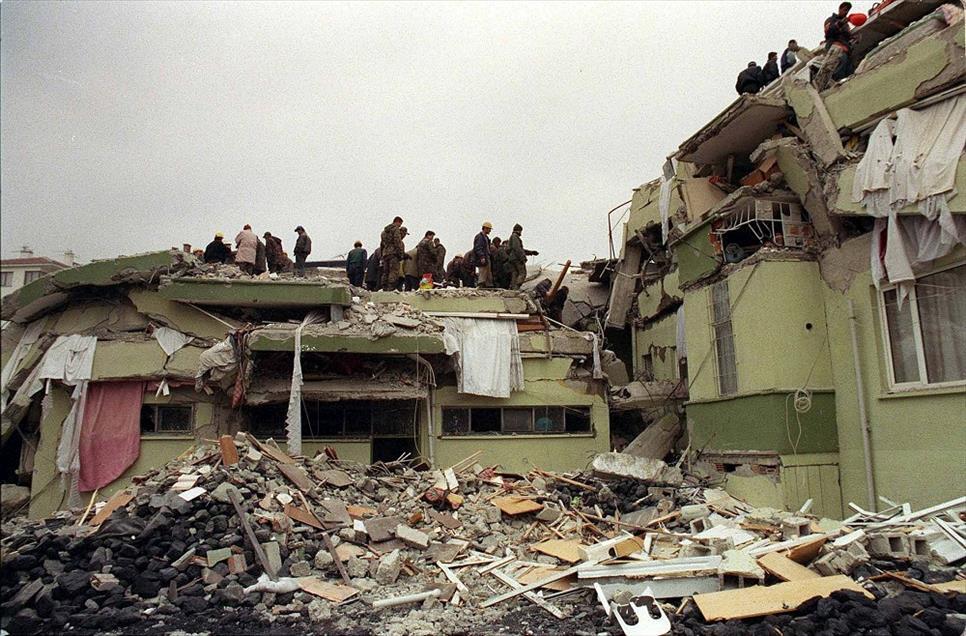
The earthquake began on 12 November 1999 at 18:57 and lasted approximately 30 seconds. It was measured at a magnitude of 7.2. The epicenter was located in Düzce and was felt in many provinces. 845 people lost their lives, and approximately 13,000 homes and 2,450 commercial buildings suffered severe damage.

A photograph showing the effect of the earthquake (AA)
The Düzce earthquake on 12 November 1999 did not result solely in short-term physical destruction; it left lasting impacts on Türkiye’s disaster management, building safety, urban planning, and societal awareness. These impacts triggered fundamental changes in both structural regulations and social approaches.
Following the Düzce earthquake, Türkiye established a new building inspection system. The 2001 Building Inspection Law (No. 4708) imposed stricter controls on the design, construction, and inspection processes of buildings. The earthquake revealed the extreme risks posed by structures built without engineering oversight, prompting critical reassessment of practices such as building amnesty programs.
Microzonation studies accelerated for settlements located along fault zones such as Düzce, and mandatory soil investigations became widespread. These developments laid the groundwork for later policies, including the 2012 law on urban transformation and the redevelopment of areas exposed to disaster risk.
The Düzce earthquake occurred shortly after the 17 August İzmit earthquake, further exposing weaknesses in Türkiye’s disaster response system. This process directly influenced the establishment of the Directorate of Emergency Management (AFAD) in 2009, leading to the adoption of a centralized and coordinated approach to disaster management.
Public awareness of disaster risks increased significantly after the earthquake. Civil society organizations and volunteer networks, such as AKUT and GEA, became more institutionalized. Earthquake culture began to emerge through educational programs, drills, and media support.
The Düzce earthquake was extensively studied by numerous domestic and international scientific institutions, significantly expanding Türkiye’s data capacity in paleoseismology, seismic hazard analysis, and fault modeling. Such collaborations enhanced the country’s preparedness for future disasters.

The destruction caused by the earthquake (AA)
The Düzce earthquake has shaped not only Türkiye’s past but also its future resilience to disasters. It has generated long-term and systemic impacts across multiple domains—from legal reforms and institutional restructuring to public awareness and scientific research. These impacts form the foundation of many current disaster policies and urban planning decisions in Türkiye.
Anadolu Ajansı. “Düzce Depreminde Yaşamını Yitirenlerin Acısı 22 Yıldır Unutulmuyor.” aa.com.tr. Accessed November 8, 2025. https://www.aa.com.tr/tr/gundem/duzce-depreminde-yasamini-yitirenlerin-acisi-22-yildir-unutulmuyor-/2417839Anadolu Ajansı. “Düzce Depreminin Üstünden 15 Yıl Geçti.” aa.com.tr. Accessed November 8, 2025. https://www.aa.com.tr/tr/pg/foto-galeri/duzce-depreminin-ustunden-15-yil-gecti/0/45399Anadolu Ajansı. “Düzce’de 20 Yıl Önceki Depremin İzleri Silindi.” aa.com.tr. Accessed November 8, 2025. https://www.aa.com.tr/tr/turkiye/duzcede-20-yil-onceki-depremin-izleri-silindi-/1641406CNN Türk. “12 Kasım Düzce Depremi Saat Kaçta, Kaç Şiddetinde Oldu? 1999 Düzce Depremi Kaç Saniye Sürdü, Kaç Kişi Öldü?” cnnturk.com. Accessed November 8, 2025. https://www.cnnturk.com/yasam/12-kasim-duzce-depremi-saat-kacta-kac-siddetinde-oldu-1999-duzce-depremi-kac-saniye-surdu-kac-kisi-oldu-1861865Düzce Üniversitesi. “12 Kasım 1999 Düzce Depremi.” deprem.duzce.edu.tr. Accessed November 8, 2025. https://deprem.duzce.edu.tr/sayfa/e7ff/12-kasim-1999-duzce-depremiDüzce Valiliği. “12 Kasım Düzce Depremi.” duzce.gov.tr. Accessed November 8, 2025. http://www.duzce.gov.tr/12-kasim-duzce-depremiSakarya Üniversitesi Afet Yönetim Uygulama ve Araştırma Merkezi. 2022 Düzce Depremi Raporu. Sakarya: Sakarya Üniversitesi, 2022. Accessed November 8, 2025. https://aym.sakarya.edu.tr/sites/aym.sakarya.edu.tr/file/Rapor_2022-Duzce.pdf

History | 12 November 1999, Friday | ||||||||
|---|---|---|---|---|---|---|---|---|---|
Time | 18:57 (local time) | ||||||||
Epicenter | Kaynaşlı, Düzce, Türkiye | ||||||||
Magnitude | Mw 7.1 (moment magnitude scale) | ||||||||
Duration | Approximately 30 seconds | ||||||||
Intensity | VIII (according to the MSK scale) | ||||||||
Fault Type | On the North Anatolian Fault Zone (NAFZ); right-lateral strike-slip fault, Fault length: Approximately 40 km, Surface displacement: Up to 5 meters | ||||||||
Depth(s) | Approximately 10 km (shallow earthquake) | ||||||||
No Discussion Added Yet
Start discussion for "November 12, 1999 Düzce Earthquake" article
Earthquake Substructure
Fault Structure and Tectonic Setting
Pre-Earthquake Infrastructure and Risks
Historical and Paleoseismological Data
Sequence and Phases of the Düzce Earthquake
Initiation of Rupture
Surface Rupture Formation and Lateral Displacements
Propagation of Seismic Waves
Intensity and Duration of the Earthquake
Long-Term Impacts of the Düzce Earthquake
Changes in Building Inspection and Urban Planning Policies
Urban Transformation and Risk-Zone Planning
Disaster Management and Institutional Reforms
Increase in Public Awareness and Civil Society Participation
International Cooperation and Scientific Research