


This article was automatically translated from the original Turkish version.
+2 More
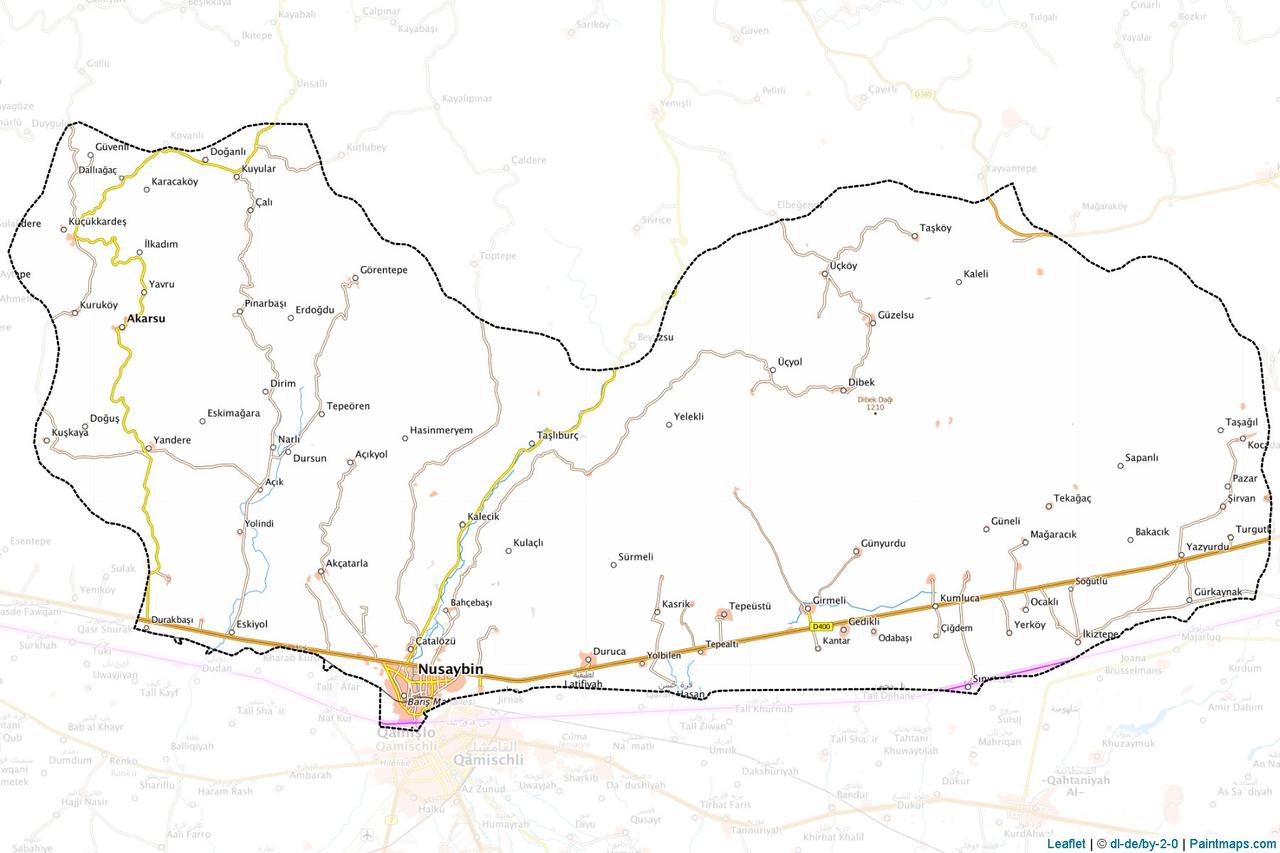
Nusaybin (District)
Nusaybin is one of the most ancient settlement areas in Upper Mesopotamia, belonging to Mardin Province in Türkiye. Located at the zero point on the E-90 Silk Road along the Syrian border, the district lies in the northern part of the Mesopotamian basin between the Tigris and Euphrates rivers. With a history spanning six thousand five hundred years, Nusaybin has served as a crossroads of commercial and cultural networks and was regarded as the most important social, political, economic and cultural center of the region until the 11th century. Situated in the region known as the “Fertile Crescent,” Nusaybin is a significant archaeological area where Chalcolithic, Early Bronze Age and Medieval cultures developed. According to 2013 data, the population of the district is 115,380, of which 49.75 percent are male (57,403) and 50.25 percent are female (57,977). Nusaybin has four administrative units including one town and the villages of Akarsu, Duruca and Girmeli.
Nusaybin, known by its earliest recorded name Nisibis, is an ancient settlement with a deep historical legacy. In the 30th century BCE it was part of the Hurrian homeland, and by the 14th century BCE it came under the dominion of the Mitanni Kingdom. Excavations at the southern slopes of Gırnavaz Höyüğü, located 4 km north of Nusaybin, confirm that this site was the center of the Mitanni Kingdom. Surface surveys conducted in 1980 indicate that Gırnavaz was continuously inhabited from the late 4th millennium BCE (Late Uruk Period) to the 7th century BCE (Neo-Assyrian Period). The stratified layers identified at the mound belong successively to the Late Uruk, Early Dynastic, Old Assyrian, Middle Assyrian and Neo-Assyrian periods. Particularly, a vase attributed to Hurrian artisans confirms the site’s importance as a major Hurri-Mitanni center.
Throughout history, the region was ruled by Arameans, Assyrians (13th century BCE), Medes, Babylonians, Persians and, in 331 BCE, by the Macedonians. After Alexander’s death, Nusaybin came under Seleucid rule and later under Tigranes. During the Roman period it frequently changed hands between the Romans and the Sassanids. In the 5th century CE the district became a religious center for the Nestorians and suffered raids, becoming entangled in Byzantine-Arab conflicts. Following the rule of the Hamdanids, Marwanids, Seljuks, Artuqids and Ayyubids, in the 13th century the region came under the dominance of the Mongols, the Ilkhanids, the Jalayirids and the Safavids. Finally, in 1517, during the Ottoman campaign in Egypt, Nusaybin was incorporated into Ottoman territory.
In antiquity, Nusaybin was known as Nırbo by the Sumerians, Aramis by the Babylonians, Nabila or Nas-ü-building by the Hurri-Mitannians, Nabula or Naşibina by the Assyrians and Mygdonia by Strabo. Its earliest name remains unknown. During the Roman and Early Byzantine periods, the district occupied a strategic position at the intersection of trade trade routes.
Nusaybin is situated in Upper Mesopotamia, south of the Abdin Mountains and overlooking the Cezire plain. Tur Abdin is a 200 km long mountain range that emerged during the Tertiary period with the formation of the Taurus folds. The mountains generally have a layered structure composed of ash colorful or yellow marly limestones and red and pink limestones from the Paleocene epoch. While the average elevation of Çağ Çağ Valley is 500 meters, the peaks of Tur Abdin reach 1000 to 1100 meters. The Çağ Creek, which irrigates the district, contributes significantly to the fertility of the plain. Gırnavaz Höyüğü and Çağ Çağ Valley are key elements that complete Nusaybin’s geographical and archaeological richness.
Nusaybin’s climate reflects the general characteristics of Mesopotamia and is favorable for agriculture. The Çağ Çağ Valley is notable for its fertile orchards. In the valley, varieties such as Şarpıze, Verdani, Çurık, Dêvani, Caniyê and Devrovi like grape; and fig varieties including Kulhırmi, Zerê Bırahimki, Sor-i Sosini, Şinek, Payızi and Rızki are cultivated, along with pomegranate, peach, apple, hairless peach, apricot, almond and plum. Additionally, cotton and cereal cultivation enrich the region’s vegetation cover. Historically known for its vineyards, Nusaybin continues to preserve this characteristic today.
Nusaybin has been a meeting point of diverse civilizations throughout history and thus possesses a rich cultural and religious heritage. The Purple Mor Yakup Monastery (5th century CE) and the Zeynel Abidin Camii Külliyesi (12th century) are important examples of the district’s religious and social fabric. The Mor Yakup Monastery served as a center for Nestorian Christians, becoming a metropolitan seat in the 8th century and later a patriarchate for the Turabdin region between 1364 and 1839. The Zeynel Abidin Camii Külliyesi houses the tombs of Zeynel Abidin and Sitti Zeynep, descendants of the Prophet Muhammad in the 13th generation, and is regarded as a site of great significance in the Islamic world. Today, the külliye’s madrasa rooms are used as a Girls’ Quran School. The district has been home to Syriac, Arab and Kurdish communities, reflecting its multicultural social character.
Nusaybin’s economy is based on agriculture, trade and subterranean resources. Cotton and cereal farming are significant in the plain irrigated by the Çağ Creek. In the Çağ Çağ Valley, viticulture, fruit production and lumbering are important income sources. Its location on the Syrian border provides the district with substantial potential for cross-border trade. Furthermore, the development of oil-producing regions highlights the economic contribution of Nusaybin’s subterranean wealth. In antiquity, the strategic importance of the Kaşiyari Road transformed the region into a vital trade hub connecting Anatolia and Mesopotamia.
Nusaybin possesses significant tourism potential due to its historical and natural richness. Structures such as Gırnavaz Höyüğü, the Mor Yakup Monastery, the Zeynel Abidin Camii Külliyesi, the Çağ Çağ Valley (declared an archaeological site in 2007), Marin Castle, Dimitros Castle, Mor Evgin Monastery and Mor Yuhanna Church serve as key attractions for tourists. In the Çağ Çağ Valley, remains from the Roman and Early Byzantine periods, including rock tombs, castles and churches, are found. The district’s recreational areas and parks — such as 15 July Park, Mitanni Park and Democracy Park — attract attention with their natural beauty. As a cultural and religious tourism initiative, a project to create a cultural faith park by integrating the Mor Yakup Church and the Zeynel Abidin Camii aims to revitalize tourism.
According to 2013 data, Nusaybin’s population is 115,380, with nearly equal gender distribution (49.75 percent male, 50.25 percent female). Outside the central town, the district includes the towns of Akarsu, Duruca and Girmeli. Throughout history, Nusaybin has been inhabited by diverse ethnic and religious groups, exhibiting a multicultural demographic building. Syriac Christians, Muslim Arabs and Kurds are the main communities shaping the district’s population. This diversity enriches Nusaybin’s social and cultural fabric.
Nusaybin is regarded as the birthplace of Mesopotamia and, through its historical, natural and cultural richness, serves as a vital link between past and present while offering significant potential for the future.

Nusaybin (District)
No Discussion Added Yet
Start discussion for "Nusaybin (District)" article
History
Geographical Structure
Climate and Vegetation
Social Structure
Economic Structure
Tourism Potential
Demographic Structure